
To summarize a PDF effectively, start with the document type and the result you need. A short text-based PDF may only need a quick AI overview, while a long report, scanned file, research paper, or group of related PDFs benefits from OCR, follow-up questions, source verification, or multi-document analysis.
This guide is a hub for the main PDF summarization workflows. It explains how to summarize ordinary, long, scanned, research, and multi-file PDFs, compares nine AI PDF summarizers for different needs, and points to dedicated guides when you need a deeper ChatGPT, citation, research, or multi-document workflow.
Quick Answer:
For a normal PDF, use an AI PDF summarizer to extract the main ideas, then ask follow-up questions and verify important details in the source. If the file is scanned, run OCR first. For research papers, citations, or several related PDFs, use a source-grounded workflow that keeps important answers connected to the original documents.


 G2 Rating: 4.5/5 |
 100% Secure
In this article
Part 1. What Is the Best Way to Summarize a PDF?
The best way to summarize a PDF depends on the file itself and what you need to do after the summary. A one-click overview is enough for some documents, but complex PDFs require a more deliberate workflow so important context, evidence, and source details are not lost.
Your PDF task |
Recommended workflow |
Why it works |
| Quick overview of one normal PDF | AI PDF summarizer | Fast way to extract the main ideas, conclusions, and action items. |
| Long PDF or report | Whole-document overview + section summaries | Preserves the document structure instead of flattening a long file into one generic paragraph. |
| Scanned or image-based PDF | OCR + AI summarization | The AI needs reliable machine-readable text before it can summarize the file well. |
| Research paper | Structured summary + source verification | Research summaries should preserve the question, methodology, evidence, limitations, and conclusions. |
| Several related PDFs | Multi-document AI workspace | Lets you compare themes, findings, differences, and source support across files. |
| Homework, essay, or evidence-based notes | Summary + source references | Helps you trace important claims back to the original PDF before reusing them. |
What Should a Good PDF Summary Include?
A useful PDF summary should preserve the document's purpose, main points, supporting evidence, important conclusions, and any limitations or action items that change how the content should be interpreted.
- Purpose: What is the document trying to explain, report, prove, request, or decide?
- Main points: What are the most important arguments, findings, instructions, or decisions?
- Evidence: Which facts, examples, numbers, or sections support those points?
- Limitations or exceptions: What important qualifications should not disappear in a shorter version?
- Next step: Does the reader need to study, compare, decide, respond, or take action?
Part 2. How to Summarize a PDF Step by Step
A reliable PDF summarization workflow has four stages: prepare the file, request the right summary, ask targeted follow-up questions, and verify important information against the source.
Step 1. Check Whether the PDF Is Text-Based or Scanned
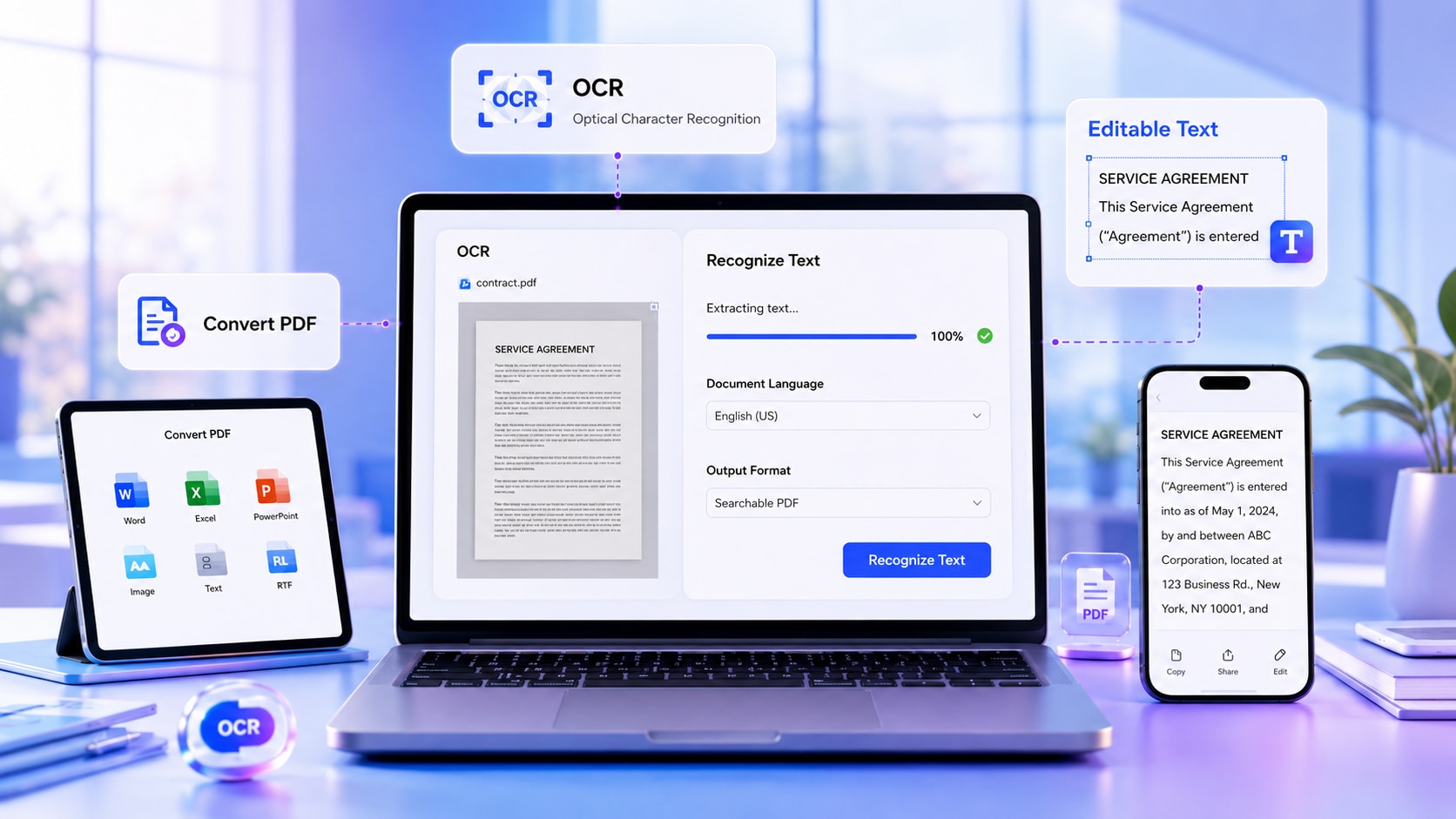
Try selecting or searching a sentence in the PDF. If the text cannot be selected, the file may be scanned or image-based. Run OCR first so the summarizer receives readable text. Recognition errors in names, figures, formulas, or tables can otherwise become summary errors.
Step 2. Ask for the Right Type of Summary
Avoid relying only on a vague prompt such as "summarize this PDF." Tell the AI what to preserve and how the output should be structured.
Example prompt: Summarize this PDF in 8-10 bullet points. Include the document's purpose, main arguments or findings, strongest supporting evidence, important limitations, and any action items or conclusions. Do not add information that is not supported by the PDF.
Step 3. Ask Follow-Up Questions
Treat the first summary as a map of the document rather than the final answer. Follow-up questions help recover details that compression may omit.
- Which section supports this conclusion?
- What evidence or numbers are most important?
- What limitations or exceptions did the summary leave out?
- What changed between the first and final sections?
- Which claims should I verify before reusing this summary?
Step 4. Verify Important Claims in the Original PDF
A summary can omit context or make qualified language sound more certain than the source. Check important numbers, quotations, dates, definitions, risks, and conclusions in the original PDF before using them in academic, legal, financial, technical, or business work.
Part 3. How to Summarize Different Types of PDFs
Different PDFs need different summarization strategies. Use the short workflow below, then open the dedicated guide when your task needs more detail.
How to Summarize a PDF with ChatGPT
Upload the PDF, specify the type and length of summary you want, then refine the result with follow-up questions. This works well when flexible prompting matters more than editing the PDF itself. For prompts, limits, long-file strategies, and scanned-file considerations, see how to summarize a PDF with ChatGPT.
How to Summarize a Research Paper
A research paper summary should not simply rewrite the abstract. Capture the research question, methodology, sample or dataset, findings, supporting evidence, limitations, and implications, then verify critical details in the source. See how to summarize a research paper with AI.
How to Summarize a PDF with Citations
When you need source-backed notes, connect important claims to source locations and open those passages before reuse. A source reference helps verification; it is not automatically the same as a formal APA, MLA, Chicago, or journal citation. See how to summarize a PDF with citations.
How to Summarize Multiple PDFs
For several related documents, summarize each source consistently before asking for a cross-document synthesis. Require the AI to identify which file supports each conclusion so information from separate documents is not blended together. See how to summarize multiple PDFs with AI.
How to Summarize a Scanned PDF
Run OCR first, review the recognized text, then summarize the OCR-processed PDF. Check names, numbers, tables, formulas, and page order before relying on the result. For poor-quality scans, improving the OCR input is often more important than changing the AI prompt.
How to Summarize a Long PDF
Start with a whole-document overview, then summarize important sections or chapters individually. Finish with a synthesis explaining how the sections connect. This preserves structure better than splitting a long PDF into arbitrary page ranges and summarizing each chunk without context.
Part 4. 9 Best AI PDF Summarizers for Different Needs
The best AI PDF summarizer depends on what you need after the first summary. Some tools are strongest for quick condensation, some for conversational Q&A or academic reading, and others for working with several documents or continuing into a full PDF workflow.
Tool |
Best for |
Q&A |
Multi-PDF |
Edit / OCR |
| PDFelement V13 | Complete PDF summarization workflow | Yes | Yes | Yes |
| QuillBot | Quick text-focused summaries | Limited | No | No |
| Claude | Detailed long-document analysis | Yes | Yes | No |
| ChatPDF | Conversational PDF Q&A | Yes | Limited | No |
| NotebookLM | Source-grounded multi-document research | Yes | Yes | No |
| Get Digest | Simple free summaries | No | No | No |
| Scholarcy | Academic papers and structured reading | Limited | Yes | No OCR |
| PDF2GPT | Focused PDF-to-summary workflow | Varies | Limited | No |
| Taskade | Team and workspace-based summarization | Yes | Yes | No |
1. Wondershare PDFelement V13 - Best for a Complete PDF Summarization Workflow
Wondershare PDFelement - PDF Editor Wondershare PDFelement Wondershare PDFelement combines AI summarization with the document tools needed before and after the summary. You can summarize a full PDF or selected text, use OCR on scanned files, ask follow-up questions, and continue editing, annotating, translating, converting, or organizing the same PDF.
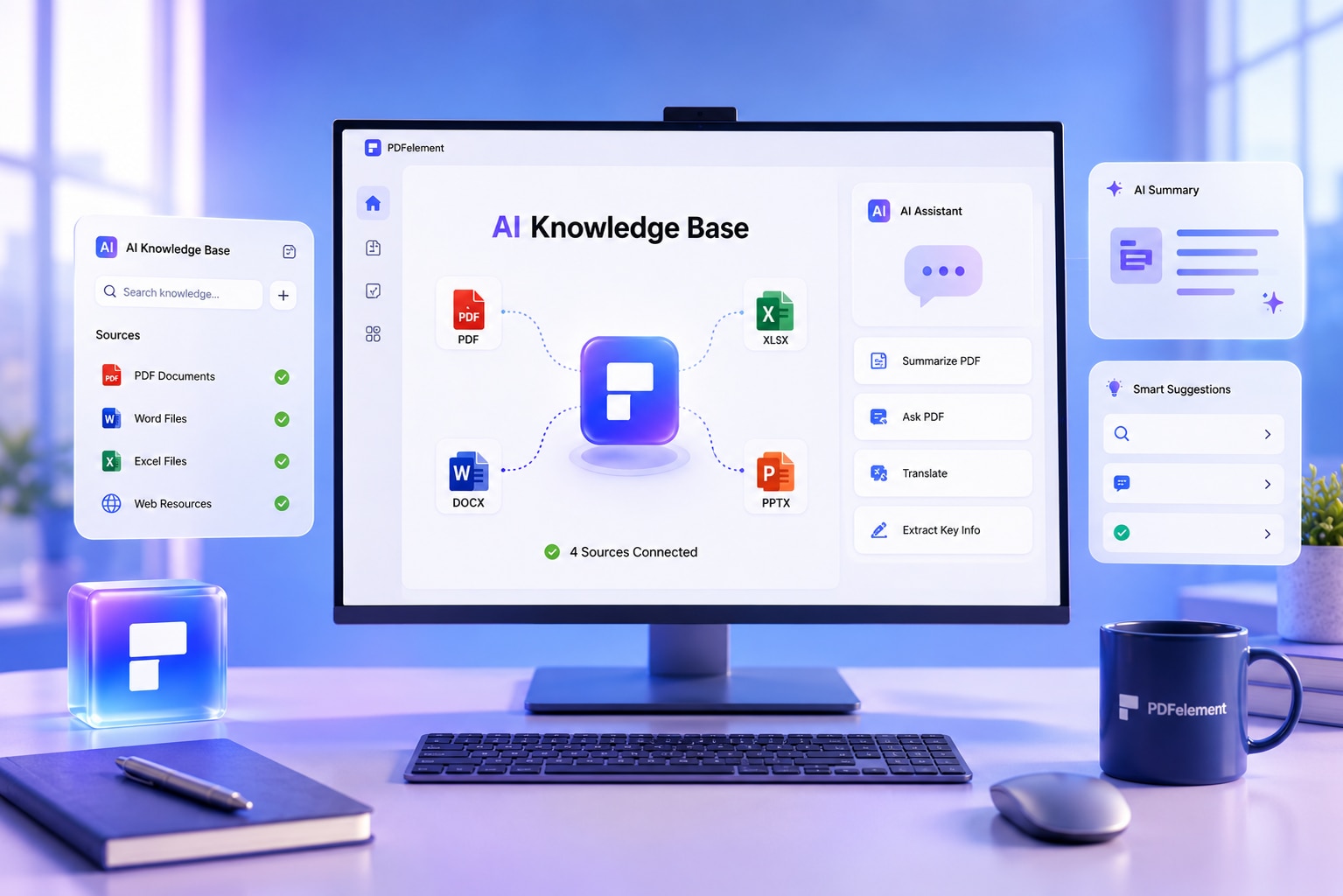
V13 is particularly useful when the task expands beyond one file. Related PDFs can move into a shared AI knowledge workflow for cross-document questions, comparison, source-backed analysis, and reusable outputs such as Knowledge Cards, flashcards, quizzes, mind maps, reports, and podcast-style study material.
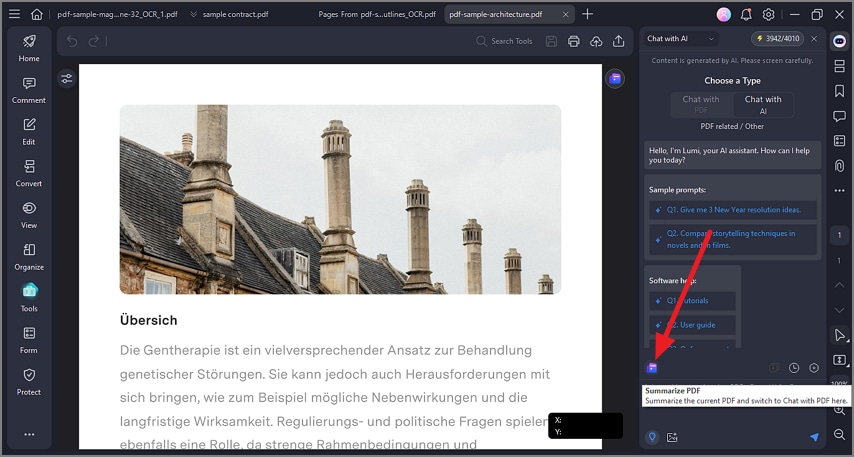
Best for: users who need PDF summarization together with OCR, follow-up questions, editing, annotation, and multi-document work.
- Summarize a full PDF or selected text.
- Run OCR before summarizing scanned or image-based PDFs.
- Ask follow-up questions about evidence, definitions, conclusions, or action items.
- Continue into editing, annotation, translation, conversion, or multi-file research.
Watch for: the full desktop workflow requires installing PDFelement, and AI availability or usage may vary by plan.
G2 Rating: 4.5/5 |100% Secure
2. QuillBot - Best for Quick Text-Focused PDF Summaries
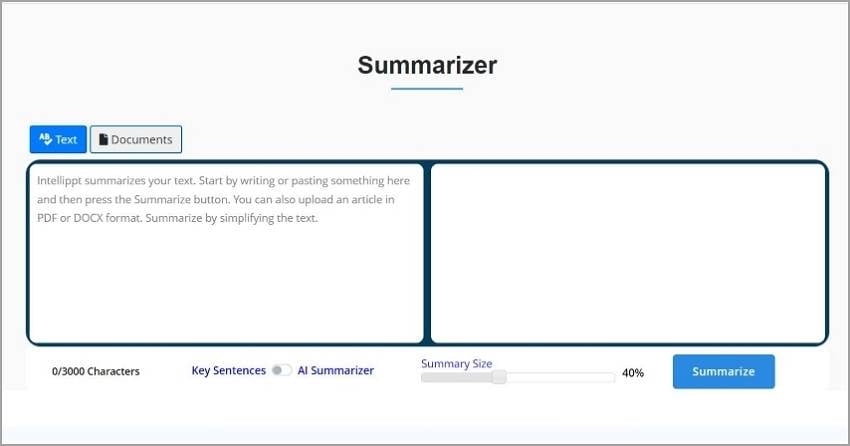
QuillBot is a practical choice when you mainly want to condense a text-heavy PDF and then refine the wording. Its PDF summarizer accepts direct PDF uploads and is designed for quick extraction of key points from essays, reports, research papers, and other text-based documents.
Best for: fast summaries followed by rewriting or polishing.
- Direct PDF upload for text-based documents.
- Quick key-point extraction and concise summaries.
- Fits naturally with QuillBot's paraphrasing and writing tools.
Watch for: it is less document-centric than a full PDF editor when you also need OCR, source-side review, annotation, or multi-file analysis.
3. Claude - Best for Detailed Long-Document Analysis
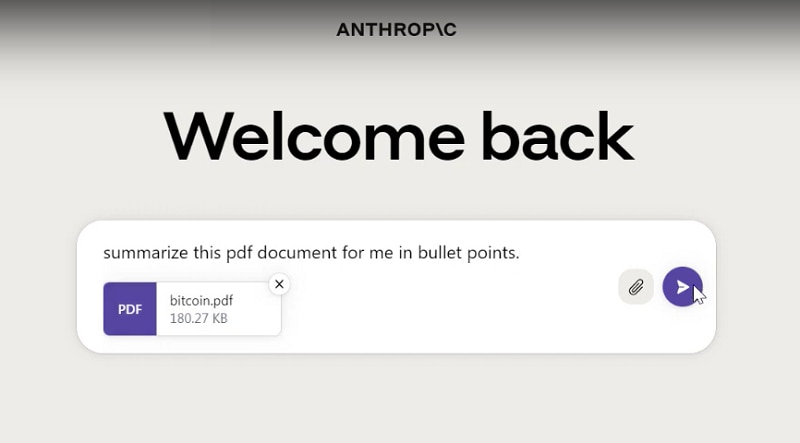
Claude is well suited to users who want a detailed explanation of a long, text-heavy document and expect to continue asking questions after the first summary. It is useful for reports, technical material, policy documents, and other files where context matters more than producing the shortest possible answer.
Best for: deeper analysis, explanation, and iterative follow-up questions.
- Flexible prompts for executive summaries, outlines, explanations, or section analysis.
- Conversational follow-up after the initial summary.
- Useful when preserving nuance and context matters.
Watch for: it is a general AI assistant rather than a PDF editing environment, and current file or usage limits depend on the account and model.
4. ChatPDF - Best for Conversational PDF Q&A
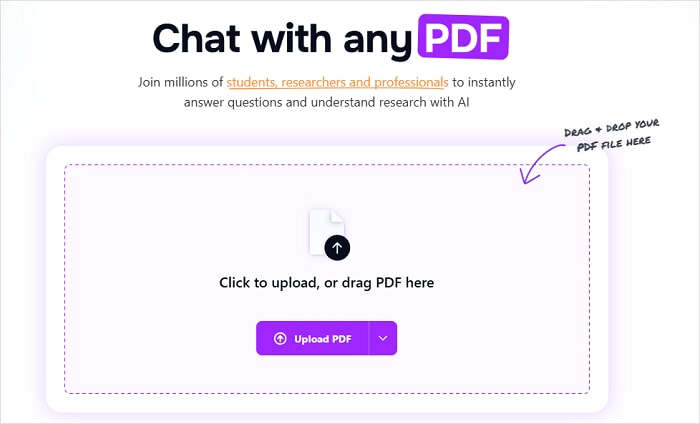
ChatPDF focuses on the read-and-ask workflow: upload a PDF, get an overview, then ask questions such as "What are the key arguments?" or "Which section supports this conclusion?" This makes it useful when interactive exploration matters more than editing the document.
Best for: users who prefer a chat-first interface for understanding one PDF.
- Upload-and-chat workflow designed around PDF documents.
- Follow-up questions after the first summary.
- Useful for quickly locating and explaining information in a source.
Watch for: it does not replace a full PDF editor, OCR workflow, or broader document-management environment.
5. NotebookLM - Best for Source-Grounded Multi-Document Research
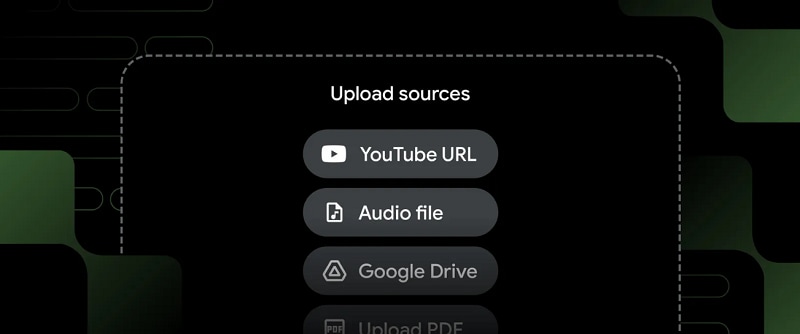
NotebookLM makes the most sense when your question depends on several sources rather than one PDF. It is designed around source-based notebooks, so summaries and follow-up questions can be grounded in the documents you add to the workspace.
Best for: comparing and synthesizing several sources in one research workspace.
- Multi-source research and synthesis.
- Question-based interaction with selected sources.
- Useful for study guides, research notes, and topic exploration.
Watch for: it is designed for research and knowledge work rather than PDF editing, cleanup, or OCR-heavy document preparation.
6. Get Digest - Best for Simple Free Summaries
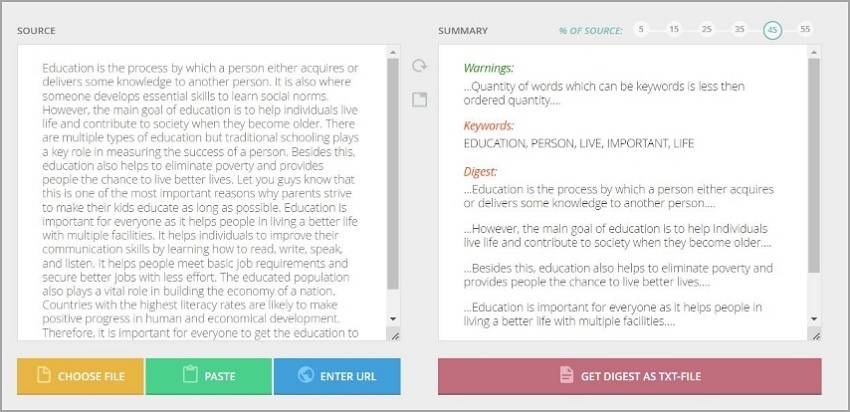
Get Digest is useful when you want a lightweight summarization workflow without a larger AI workspace. It focuses on extracting key sentences and reducing a document to a shorter representation.
Best for: simple, low-friction summaries of text-focused content.
- Simple interface with minimal setup.
- Adjustable summary length in its summarization workflow.
- Useful when you only need a basic overview rather than document Q&A.
Watch for: it offers a narrower workflow than chat-based or PDF-native tools. Check current file and text limits before relying on it for long PDFs.
7. Scholarcy - Best for Academic Papers and Structured Reading
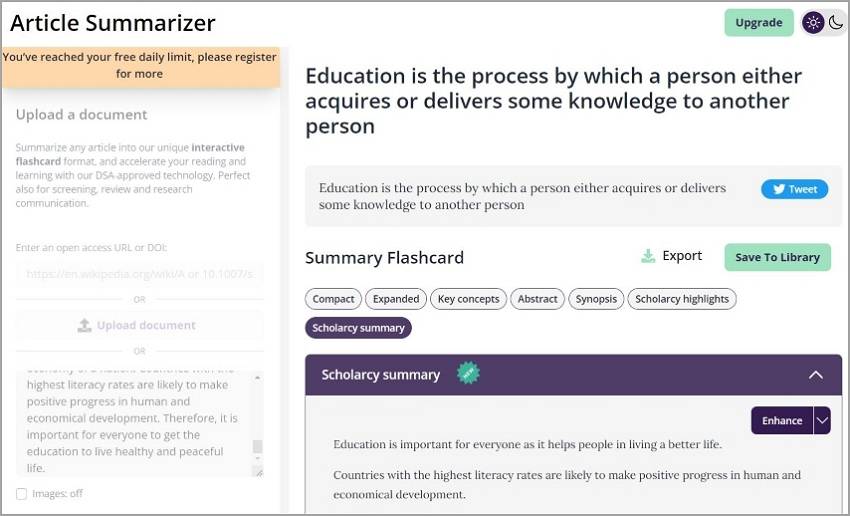
Scholarcy is built around academic reading. It turns papers and other scholarly material into structured Summary Flashcards and can surface elements such as key findings, objectives, methods, results, conclusions, references, and other research-specific details.
Best for: students and researchers screening papers or building structured literature notes.
- Research-oriented structured summaries and flashcards.
- Highlights findings, methods, references, and other academic elements.
- Supports organization and comparison of research material.
Watch for: Scholarcy states that scanned PDFs without extractable text need OCR before import, so image-only research papers require a preprocessing step.
8. PDF2GPT - Best for a Focused PDF-to-Summary Workflow
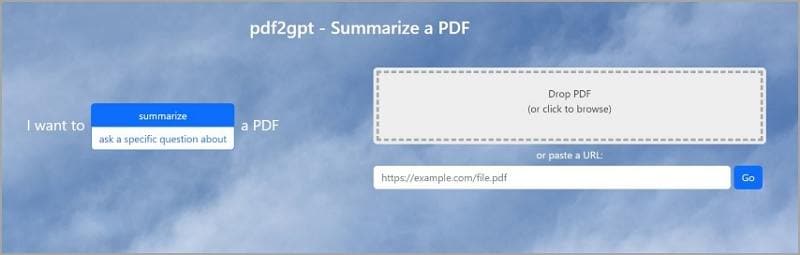
PDF2GPT is most useful when you want a focused PDF-to-summary workflow without a broader editing or research suite. Its appeal is simplicity: provide the document, generate an AI summary, and use the result as a quick reading shortcut.
Best for: users who want a straightforward summarization utility rather than a complete PDF workspace.
- Focused PDF summarization workflow.
- Simple setup for one-off reading tasks.
- Useful when additional document editing features are unnecessary.
Watch for: current upload, page, and usage limits can change, so check the service before using it for very large documents.
9. Taskade - Best for Team and Workspace-Based Summarization
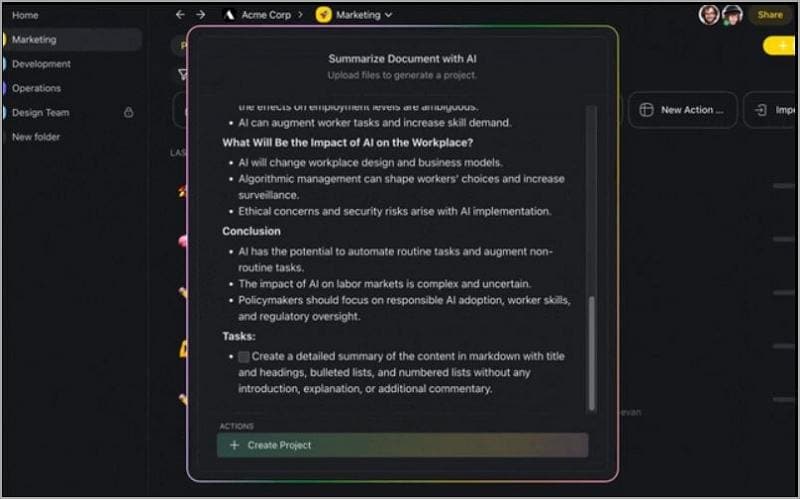
Taskade is useful when a PDF summary is the beginning of a team workflow rather than the final output. Its current import workflow can turn PDFs and other document formats into structured summaries or projects, and the source can also become AI agent knowledge for follow-up work.
Best for: teams that want to turn document summaries into shared projects, tasks, agent knowledge, or collaborative workflows.
- Summarizes PDFs and other common document formats.
- Turns imported content into structured, editable projects.
- Fits broader team, AI-agent, and workflow automation use cases.
Watch for: Taskade is primarily a workspace and productivity platform, so it is less suitable when your main need is PDF-native editing, OCR, or detailed source-side markup.
Part 5. How PDFelement V13 Extends PDF Summarization
PDFelement V13 is most useful when summarization is only the first step. The workflow keeps AI reading, OCR, editing, annotation, translation, and multi-document work close to the source PDF, so you can move from understanding a document to working with it without rebuilding the process in separate tools.
1. Summarize a Single PDF or Selected Text
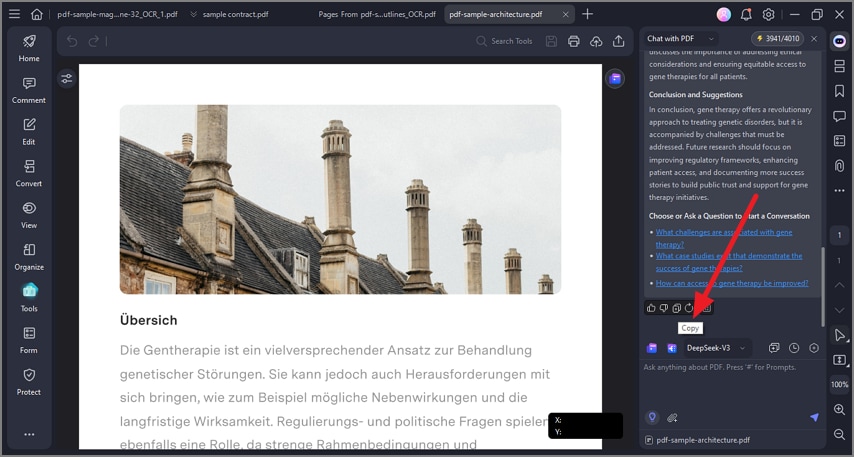
Open the PDF and use the AI summarization workflow to generate an overview of the current document. If you only need one passage, select the text and summarize that section instead of processing the whole file.
2. Run OCR Before Summarizing a Scanned PDF
For scanned or image-only PDFs, use OCR first so the document has a searchable text layer. Review recognition errors before summarization because incorrect OCR can distort names, values, terminology, formulas, or conclusions.
3. Ask Questions and Verify the Source
After the first summary, ask follow-up questions about evidence, exceptions, definitions, and conclusions. Keep the original PDF available while reviewing the answer so important claims can be checked before reuse.
4. Move from One PDF to a Multi-Document Knowledge Workflow
V13 extends PDF summarization beyond a single document. Related files can be brought into a shared AI knowledge workflow for cross-document questions, comparison, recurring themes, and source-based analysis. This is useful for research sets, project files, reports, contracts, and study materials that only make sense when read together.
5. Turn Verified Content into Reusable Outputs
Once important information has been checked, the workflow can continue into Knowledge Cards, flashcards, quizzes, mind maps, reports, podcast-style outputs, translation, and other document tasks. These outputs are most useful after verification rather than as substitutes for the original source.
G2 Rating: 4.5/5 |100% Secure
Part 6. Explore More PDF Summarization Workflows
Use this page as the starting point, then move to the dedicated guide that matches your task. This keeps broad PDF summarization guidance here while more specific search intents live on their own pages.
What you want to do |
Dedicated guide |
When to use it |
| Summarize a PDF with ChatGPT | How to Summarize a PDF with ChatGPT | For direct upload, prompt design, ChatGPT limits, and conversational summarization. |
| Summarize a research paper | How to Summarize a Research Paper with AI | For methods, findings, evidence, limitations, and academic verification. |
| Summarize several PDFs together | How to Summarize Multiple PDFs | For cross-file comparison, synthesis, and source separation. |
| Summarize with source references | How to Summarize a PDF with Citations | For source verification and evidence-based notes. |
| Use a dedicated AI summarizer | AI PDF Summarizer | For product-led summarization workflows. |
| Summarize a PDF in the browser | Online AI PDF Summarizer | For quick browser-based summarization without installing software. |
Conclusion
The best PDF summarizer is the one that matches the document and what you need to do next. A lightweight tool may be enough for a quick text summary, while research papers, scanned documents, long reports, and multi-file projects benefit from OCR, follow-up questions, source verification, or a shared document workspace.
Use this page as the main entry point for PDF summarization, then move to the dedicated ChatGPT, research, citations, multiple-PDF, online, or product workflow when the task becomes more specific. PDFelement V13 fits users who want summarization to stay connected to the PDF itself and continue into OCR, verification, editing, annotation, translation, or multi-document knowledge work.
People Also Ask
-
Can AI summarize a PDF?
Yes. AI can analyze a text-based PDF and condense its main ideas, findings, supporting points, and conclusions into a shorter summary. For scanned PDFs, run OCR first so the AI can access the page text reliably. -
What is the best AI PDF summarizer?
The best tool depends on the task. PDFelement is suited to a complete PDF workflow with OCR and editing, ChatPDF to conversational PDF Q&A, NotebookLM to multi-source research, Scholarcy to academic papers, and QuillBot to quick text-focused summaries. -
What is the best way to summarize a long PDF?
Start with a whole-document overview, then summarize the most important sections separately and finish with a synthesis. This preserves the structure of a long report better than relying on a single short summary. -
Can AI summarize a scanned PDF?
Yes, but image-based PDFs usually need OCR first. Review names, numbers, formulas, and tables after OCR because recognition errors can affect the AI summary. -
Can AI summarize multiple PDFs at once?
Yes. Multi-document AI workflows can compare several PDFs, identify recurring themes or differences, and synthesize findings. Ask the AI to identify which file supports each conclusion so sources do not get mixed together. -
Can a PDF summarizer create summaries with citations?
Some tools can provide source references or locations that help you verify where an answer came from. For formal academic work, verify the source and cite the original publication rather than treating the AI summary itself as the authority. -
How do I get ChatGPT to summarize a PDF?
Upload the PDF to ChatGPT, specify the summary format, length, audience, and focus, then ask follow-up questions to refine the result. For a dedicated workflow, see our guide to summarizing a PDF with ChatGPT.