
In this article
- What Are the Exact Legal Size Paper Dimensions?
- Legal Size vs. Standard Letter vs. A4: Understanding the Differences
- Clarifying the Confusion: Legal Paper Size A3 and Folio Paper Size
- Why Do We Use Legal Size Paper? (Common Use Cases)
- How to Format and Print a Legal Page Size Document
- How to Resize a PDF to Legal Paper Size
- Filing and Storing Legal Size Documents
- Frequently Asked Questions (FAQ)
What are the exact dimensions of legal paper, and why does it seem to be the exception to everyday printing rules? Whether you are preparing a contract, formatting a lengthy spreadsheet, or trying to figure out why a printer is cutting off part of a document, understanding legal paper size helps you choose the right page settings.
In this guide, you will find the exact legal size paper dimensions in inches, millimeters, and centimeters, see how Legal compares with Letter and A4, and learn how to format, print, resize, and store Legal-size documents correctly.


 G2 Rating: 4.5/5 |
 100% Secure
What Are the Exact Legal Size Paper Dimensions?
If you are simply wondering, how big is a legal size paper?, the answer is straightforward. In the North American paper size system, standard Legal paper is longer than everyday Letter paper.
Here are the precise legal size paper dimensions:
- Inches: 8.5 x 14 inches
- Millimeters: 216 x 356 mm
- Centimeters: 21.6 x 35.6 cm
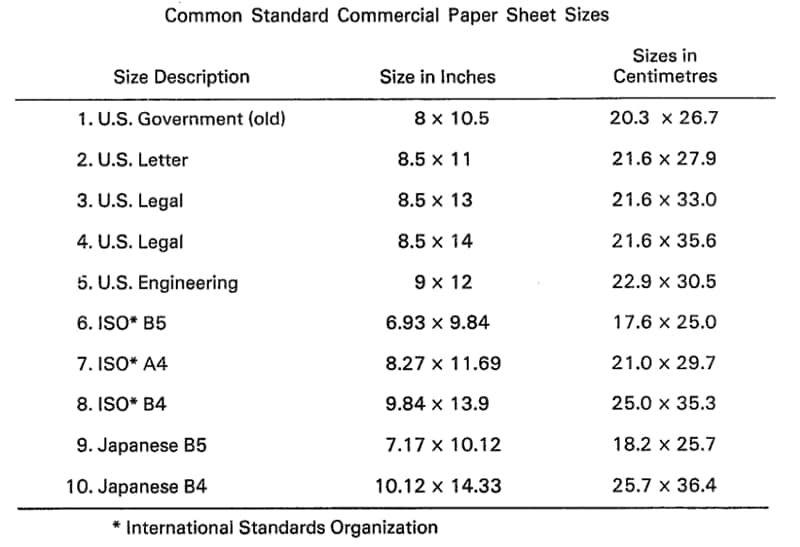
This 8.5 x 14 paper size is the standard US Legal format. It has the same 8.5-inch width as standard US Letter paper but is 3 inches longer, giving documents more vertical space on each page.
Legal Size vs. Standard Letter vs. A4: Understanding the Differences
Legal, Letter, and A4 are three different paper formats. Letter and Legal are commonly used in North America, while A4 belongs to the ISO 216 paper-size system used in most other parts of the world.
A4 measures 210 x 297 mm (8.27 x 11.69 inches). It is slightly narrower than US Letter paper but longer. US Legal paper, at 8.5 x 14 inches, is considerably longer than both Letter and A4.
If you are exchanging documents internationally, pay close attention to the page size requested by the recipient. Printing a Legal-size document on A4 or Letter paper without adjusting the print settings can cause the content to be scaled, repositioned, or clipped.

Paper Size Comparison Table
Here is a quick comparison of legal paper size and other common page formats:
| Paper Format | Dimensions (Inches) | Dimensions (Millimeters) | Common Use |
|---|---|---|---|
| US Legal | 8.5" x 14" | 216 x 356 mm | North American business, forms, and selected legal or government documents |
| US Letter | 8.5" x 11" | 216 x 279 mm | General office, school, business, and many official documents |
| A4 | 8.27" x 11.69" | 210 x 297 mm | International business and general document printing |
| A3 | 11.69" x 16.54" | 297 x 420 mm | Charts, diagrams, posters, drawings, and larger-format documents |
| Ledger / Tabloid | 11" x 17" | 279 x 432 mm | Spreadsheets, diagrams, publications, and larger layouts |
G2 Rating: 4.5/5 |100% Secure
Clarifying the Confusion: Legal Paper Size A3 and Folio Paper Size
When dealing with paper sizes, terminology often gets mixed up. Two common points of confusion involve A3 paper and Folio or Foolscap paper.
Is Legal Paper the Same as A3?
A common search query is legal paper size a3, but Legal and A3 are entirely different formats.
- US Legal: 8.5 x 14 inches (216 x 356 mm)
- A3: 11.69 x 16.54 inches (297 x 420 mm)
A3 is both wider and longer than Legal paper. A3 is commonly used when more visual space is needed for diagrams, drawings, charts, or posters, while Legal is a narrower format designed around document-style layouts.
What Is Folio Paper Size?
Folio and Foolscap are historical paper-size terms that can vary by country, manufacturer, and document standard. They should not automatically be treated as another name for US Legal paper.
- US Legal: 8.5 x 14 inches
- Government Legal: Often 8.5 x 13 inches
- Folio / Foolscap: Dimensions can vary, with formats around 8.5 x 13 inches or similar sizes appearing in different regions
If a form or organization asks for Folio, Government Legal, or Legal paper, check the exact dimensions instead of relying only on the name.
Why Do We Use Legal Size Paper? (Common Use Cases)
The main advantage of Legal paper is simple: it provides three additional inches of vertical space compared with US Letter while keeping the same 8.5-inch width. That extra space can be useful for forms, tables, agreements, and layouts that do not fit comfortably on Letter paper.
Is Legal Size Paper Still Required for Legal Documents?
Despite its name, Legal-size paper is not automatically required for legal documents. Courts, government agencies, law firms, and other organizations may specify their own filing and formatting requirements, and many documents today use standard 8.5 x 11-inch Letter paper.
Legal paper is still used for some contracts, real estate documents, government forms, business records, and legacy workflows where the additional page length is useful. If you are preparing an official filing, always follow the paper-size requirements provided by the court, agency, client, or organization receiving the document.
Accounting and Spreadsheets
The additional page length can also be useful for financial reports, worksheets, schedules, and spreadsheets that contain more information than fits comfortably on Letter paper. Depending on the layout, Legal size may reduce the need to split content across additional pages.
Menus, Forms, and Brochures
The longer format can also work well for menus, forms, handouts, and selected brochure layouts. Designers may use Legal paper when they want more vertical space without moving to a much wider format such as Ledger or A3.
How to Format and Print a Legal Page Size Document
If you are preparing a document that requires the legal size paper dimensions, both the document settings and the printer settings need to match 8.5 x 14 inches.
Setting Up Legal Size in Microsoft Word
1. Open your document in Microsoft Word.
2. Navigate to the Layout tab on the ribbon.
3. Click Size.
4. Select Legal (8.5" x 14") from the available paper sizes.
5. Review margins, tables, images, headers, and page breaks after changing the page size.
Setting Up Legal Size in Google Docs
1. Open your Google Doc.
2. Click File and select Page setup.
3. Under Paper size, select Legal (8.5" x 14").
4. Review the margins and page layout.
5. Click OK.
Printing Tips for 8.5 x 14 Legal Paper
Many office printers support Legal paper, but not every home or compact printer can handle a 14-inch sheet. Before printing, check your printer specifications and make sure the paper tray can accommodate 8.5 x 14-inch paper.
In Word, a PDF reader, or the system print dialog, select Legal as the paper size and confirm that the printer driver uses the same setting. A mismatch between the document size and printer setting can cause the page to be scaled, clipped, or printed incorrectly on Letter paper.
If your printer does not show Legal as an available size, check the selected printer, printer driver, tray configuration, and supported paper formats before changing the document itself.
For PDF-specific options such as printer selection, orientation, page range, scaling, and paper settings, see the PDFelement PDF printing guide.
How to Resize a PDF to Legal Paper Size
If a PDF was created in Letter, A4, or another page format but needs to use legal paper size, you can resize the PDF pages to 8.5 x 14 inches before printing or sharing the file.
PDFelement provides page-size controls that let you select a standard format such as Legal or apply custom dimensions. Keep in mind that changing the PDF page size changes the page canvas; you should still review margins, images, tables, and text after resizing.
G2 Rating: 4.5/5 |100% Secure
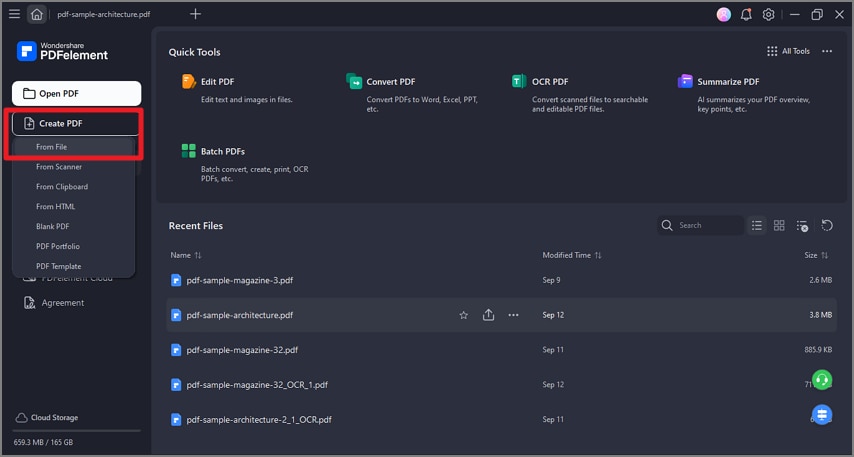
Step 1Open the PDF
Launch PDFelement and click Open PDF to select the document you want to resize. The PDF will open so you can review its current page dimensions before making changes.
Step 2Open the Page Size Options
Go to Organize > Size. The page-size settings allow you to choose a fixed standard size or enter custom dimensions.
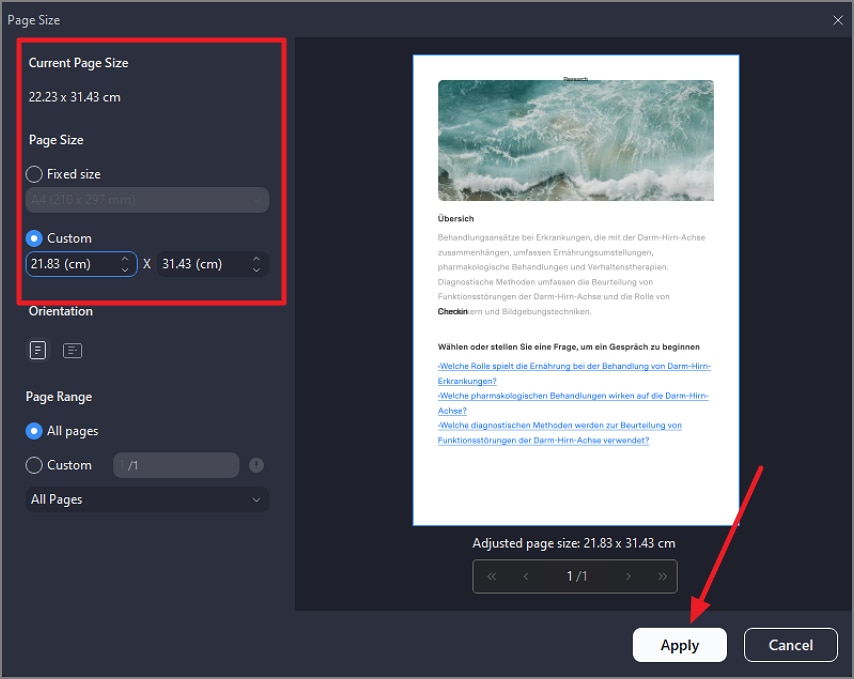
Select Legal if it appears in the preset list. If you need to enter the dimensions manually, use 8.5 x 14 inches or the corresponding metric dimensions.
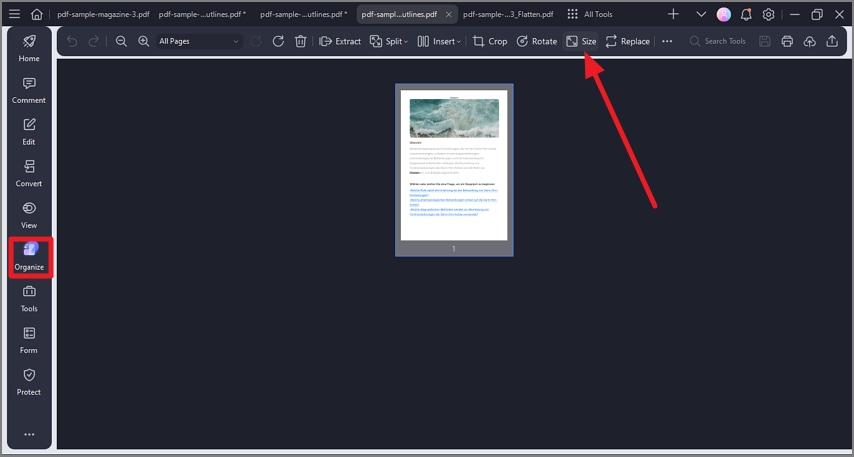
Step 3Apply the Legal Page Size
Select the pages you want to resize and apply the Legal page-size setting. If needed, use the custom size controls to enter the exact dimensions. Click Apply when the settings are correct.
After resizing, review the page layout before saving or printing the PDF. Check that text, images, margins, headers, footers, and tables still fit correctly within the new page dimensions.
If you regularly work with different page formats, see how to change PDF page size for Legal, Letter, A4, A3, and custom dimensions.
Filing and Storing Legal Size Documents
Legal paper has the same 8.5-inch width as Letter paper but is 3 inches longer. If you regularly store physical Legal-size documents, use folders and filing systems that can accommodate the full 14-inch page length.
- Legal-size folders: These provide enough depth for a 14-inch sheet, reducing the risk of bending or folding the bottom of the document.
- Filing cabinets: Some filing cabinets support both Letter and Legal hanging folders, while others are designed around one format. Check the drawer depth and rail configuration before purchasing folders or organizing large collections.
People Also Ask
-
How big is a legal size paper?
A standard US Legal size paper measures 8.5 x 14 inches. In metric units, it is approximately 216 x 356 millimeters or 21.6 x 35.6 centimeters. -
Can I print legal size on a standard printer?
It depends on the printer. Many office printers support 8.5 x 14-inch Legal paper, but some home and compact printers do not. Check the printer specifications, adjust the paper tray if necessary, and make sure both the document and printer settings are set to Legal before printing. -
Why is it called legal size?
The name is associated with the historical use of longer paper formats for contracts, government records, agreements, and other formal documents. However, the name does not mean that every legal document must be printed on Legal-size paper. -
Do legal documents have to be printed on legal size paper?
No. Legal paper measures 8.5 x 14 inches, but many courts, agencies, law firms, and organizations use or require standard Letter-size paper instead. Always follow the formatting and paper-size requirements provided by the organization receiving the document. -
Is legal size the same as foolscap?
No. US Legal paper has a standard size of 8.5 x 14 inches. Folio and Foolscap are historical terms whose dimensions can vary by region, so the exact measurements should be checked rather than assuming they are identical to Legal paper. -
What is the difference between Legal and Letter size?
US Legal and US Letter paper have the same width of 8.5 inches. Letter paper is 11 inches long, while Legal paper is 14 inches long, making Legal exactly 3 inches longer.