

In this article
- What is Scan Text Recognition (OCR)?
- Method 1: Scan Words from Image with Wondershare PDFelement (Best for Accuracy)
- Method 2: How to Scan Image Convert to Text Using Google Drive (Free Online Method)
- Method 3: Scan Text from Photo Using Native OS Tools (Windows & Apple)
- Method 4: Extract Text Using Microsoft OneNote
- Expert Tips for Better Image-to-Text Results
- Why Choose a Professional Tool Over Free Alternatives?
Working with electronic documents, screenshots, physical reports, or photos of textbooks often leaves us with a common, frustrating problem: the text is locked inside an image. In the past, if you needed to reference a paragraph from a scanned tax form or quote a page from a physical book, your only option was to manually type it out word for word.
Fortunately, modern technology has eliminated the need for manual data entry. Whether you need to digitize a physical document or grab data from a quick screenshot, learning how to scan words from image files can save you countless hours. Using Optical Character Recognition (OCR), you can quickly turn static pixels into fully editable documents.
In this comprehensive guide, we will explore four easy and highly effective methods to extract text from images, ranging from professional desktop software to free built-in OS tools.


 G2 Rating: 4.5/5 |
 100% Secure
What is Scan Text Recognition (OCR)?
Before diving into the methods, it is helpful to understand how computers actually "read" images. When you take a picture of a document, your computer or smartphone just sees a collection of colored pixels. It does not recognize the shapes as letters or words.
To bridge this gap, software utilizes scan text recognition, more commonly known as OCR (Optical Character Recognition). OCR algorithms scan the image, identify the distinct shapes of letters, compare them against known fonts and languages, and translate those shapes into digital, selectable text characters.
Today's advanced OCR technology is highly accurate. Whether you want to scan text from photo sources, pull data from a complex chart, or extract paragraphs from an old book, OCR allows you to seamlessly scan and copy text without losing your mind to tedious typing.
Method 1: Scan Words from Image with Wondershare PDFelement (Best for Accuracy)
If you regularly deal with scanned documents, multi-page PDFs, or high-resolution images that need to be converted into editable formats, a professional tool is your best bet. Wondershare PDFelement is widely recognized as one of the most powerful and intuitive document management programs available.
Unlike basic free tools that often jumble the layout or misread characters, PDFelement's industry-leading OCR technology ensures exceptional accuracy. It allows you to scan picture to text while perfectly preserving the original formatting, fonts, and layout. Plus, it supports dozens of languages and can easily convert files from scan to Word, Excel, PowerPoint, or plain text.
Here is how you can scan image convert to text in three quick steps using PDFelement:
Step 1Connect a Scanner or Open Your Image
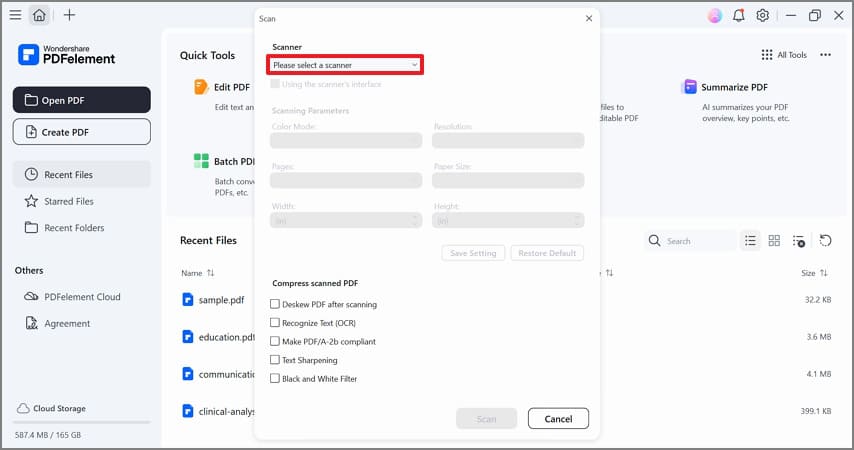
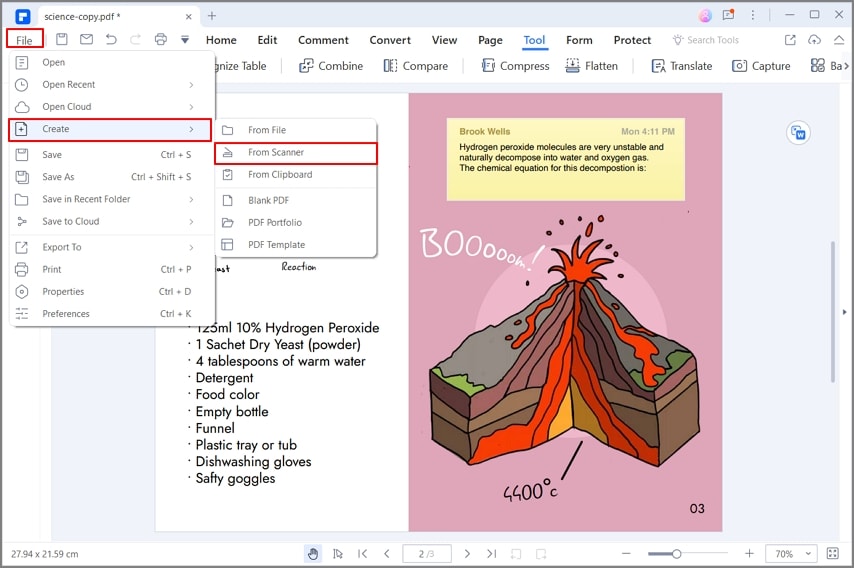
If you have a physical document, you can connect your scanner directly to your computer. Launch PDFelement, click the "Arrow" button on the top-left corner to enter the main window, and navigate to "Home" > "From Scanner" to bridge your device. Alternatively, if you already have the image saved on your PC or transferred from your mobile phone, you can simply click "Create PDF" and select your image file to open it in the software.
Step 2Perform Scan Text Recognition (OCR)
Once your image or scanned file is open in the workspace, PDFelement will automatically detect that it is an image-based file and prompt you to perform OCR. A pop-up window will appear offering scanning settings. Select the "Recognize Text (OCR)" option. You can choose to make the text "Searchable Text Image" or "Editable Text." To edit or copy the words, choose the editable option and select the correct language of the text.
G2 Rating: 4.5/5 |100% Secure
Step 3Convert to Text or Word
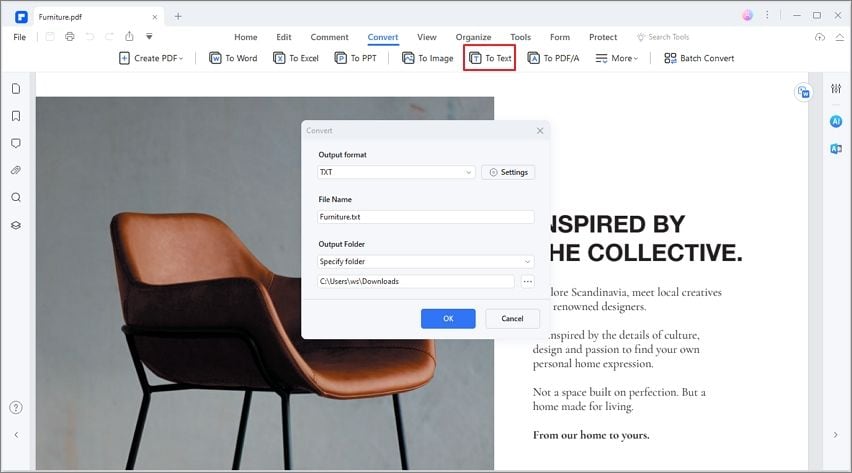
After the OCR process is complete, the text within your image will become fully selectable and editable. You can directly edit the text within PDFelement, or if you prefer to export it, navigate to the "Convert" tab. Click the "To Text" or "To Word" button to start the conversion. Within seconds, you will have a perfectly formatted, editable document.
Method 2: How to Scan Image Convert to Text Using Google Drive (Free Online Method)
If you are looking for a completely free, cloud-based solution and don't mind sacrificing a bit of formatting, Google Drive includes a surprisingly powerful built-in OCR tool. Because it is entirely web-based, you can use it on any operating system without installing third-party software.
Here is how to scan picture to text using Google Drive:
Step 1Upload Your Image to Google Drive
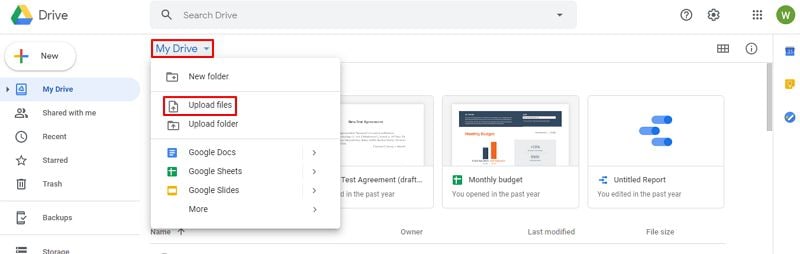
First, log into your Google Drive account. Click the "New" button or the "My Drive" dropdown menu, and choose "File Upload." Select the image (JPG, PNG, or GIF) containing the text you want to extract and wait for it to upload to your drive.
Step 2Open Scanned Image in Google Docs
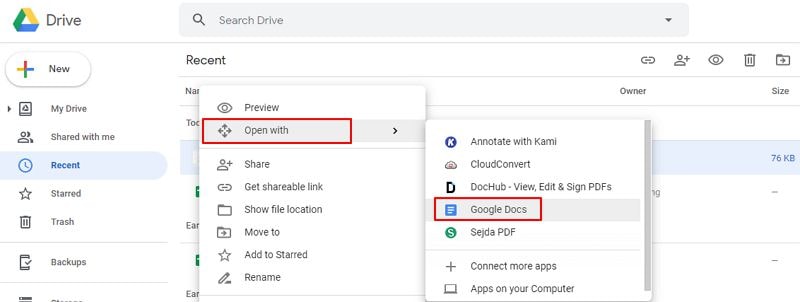
Once the image is uploaded and visible in your Google Drive account, simply right-click the file. From the context menu, select "Open with" > "Google Docs". A sheet icon will appear, indicating that Google Docs is processing the file and running its background OCR engine to extract the text.
Step 3Edit and Save Your Text
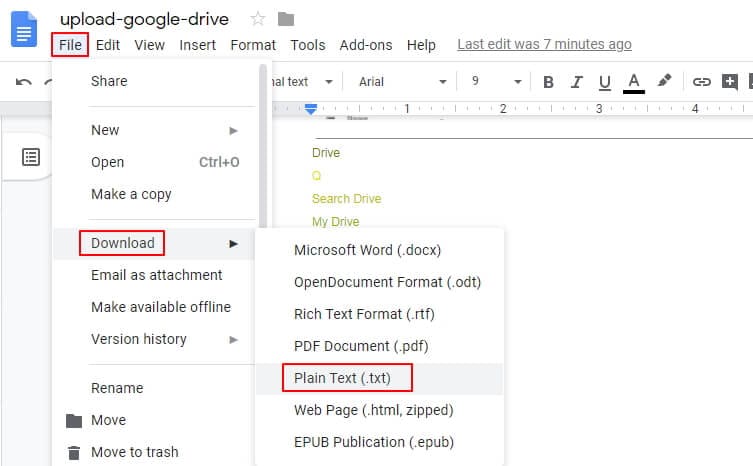
When the file opens in Google Docs, you will see your original image at the top of the page, and the extracted, editable text directly below it. Note that while Google Drive is great for plain text, there may be minor formatting issues (like lost columns or altered fonts). You can edit the text directly in the browser, or click "File" > "Download" to save it as a .txt or Microsoft Word (.docx) file.
Method 3: Scan Text from Photo Using Native OS Tools (Windows & Apple)
If you just need to quickly grab a phone number, an address, or a short paragraph from a photo, you might not even need to upload the file to a cloud service or open a heavy application. Both modern Windows and Apple operating systems now feature built-in OCR tools.
Extract Text with Windows Snipping Tool
If you are using Windows 11, the built-in Snipping Tool recently received a massive AI-powered upgrade.
Step 1
Open the image containing your text on your screen.
Step 2
Press Windows Key + Shift + S to open the Snipping Tool and drag a box around the text.
Step 3
Once the screenshot opens in the Snipping Tool window, click the "Text Actions" icon located in the top toolbar.
Step 4
The tool will automatically highlight all readable words. You can then click "Copy all text" and paste it into any document.
Use Apple Live Text on Mac and iOS
Apple users have access to an incredibly smooth feature called Live Text, available on iOS 15+ and macOS Monterey or later.
- On iPhone/iPad: Simply open the Photos app and view your image. If the phone detects words, a small "Live Text" icon will appear in the bottom right corner. Tap it to highlight all the text, which you can then copy, translate, or share.
- On Mac: Open any picture in the native Preview app or Apple Photos. Hover your cursor over the text in the image; the cursor will change to a text-selection tool. Simply click, drag, and copy the text as if you were reading a regular text document.
Method 4: Extract Text Using Microsoft OneNote
For business professionals and students already heavily invested in the Microsoft Office ecosystem, Microsoft OneNote provides a brilliant, under-the-radar way to get from scan to word.
Step 1
Open a new or existing notebook in Microsoft OneNote (available for free on Windows and Mac).
Step 2
Drag and drop your image into the note, or go to "Insert" > "Pictures" to upload it.
Step 3
Right-click the inserted image and select "Copy Text from Picture".
Step 4
The text is now copied to your computer's clipboard. You can paste it directly below the image in OneNote, or paste it into a blank Microsoft Word document to easily scan photo to word.
Expert Tips for Better Image-to-Text Results
While OCR technology is incredibly smart, it still relies on the quality of the source image. If you are struggling to get accurate results when you scan text from photo sources, keep these best practices in mind:
- Improve Lighting: Shadows and glare can confuse OCR software. Ensure the document is evenly lit when snapping a photo.
- Keep it Flat and Straight: A warped page or a photo taken from a harsh angle will distort the shapes of the letters. Try to take the photo directly from above, keeping the camera parallel to the page.
- High Resolution Matters: If the image is blurry, pixelated, or compressed, the software will struggle to differentiate an "e" from a "c". Always capture at the highest resolution possible.
- Crop Out the Noise: If a photo has a messy background (like a desk or a patterned tablecloth), crop the image so only the document is visible before running it through your OCR tool.
G2 Rating: 4.5/5 |100% Secure
Why Choose a Professional Tool Over Free Alternatives?
As we have demonstrated, there are multiple ways to scan words from image files. However, free tools like Google Drive or native OS text extractors come with notable limitations. They are excellent for copying a quick sentence or two, but they usually destroy the layout of the document. If you scan a complex invoice with tables, Google Docs will likely spit out a messy, unformatted block of text.
If your goal is to digitize important documents, create searchable archives, or convert multi-page scan photo to word files while keeping the original fonts, margins, and tables intact, a comprehensive PDF management suite like PDFelement is unparalleled. It offers bulk OCR processing, offline security (meaning your sensitive data isn't uploaded to a cloud server), and dedicated editing tools that free alternatives simply cannot match.
People Also Ask
-
Can OCR tools scan words from image files that contain handwriting?
Yes, but the accuracy heavily depends on the legibility of the handwriting and the sophistication of the tool. Advanced AI-powered OCR tools and features like Apple's Live Text or Microsoft OneNote are increasingly good at reading neat, cursive, and print handwriting. However, messy or stylized handwriting may still result in errors.
-
Is it safe to upload my images to online text extractors?
If your image contains sensitive or confidential information (like financial data, social security numbers, or private medical records), it is generally safer to use offline, desktop-based software like PDFelement rather than a free, browser-based online converter, as you cannot always guarantee how online tools handle or store your data.
-
How do I scan an image directly to a Word document?
The fastest way to convert from an image straight to a Word document is to use OCR software that supports direct export formatting. With PDFelement, you simply open the image, run OCR, and click the "To Word" conversion button. Alternatively, you can use Adobe Acrobat or upload the image to Google Drive, open it in Google Docs, and download the resulting file as a .docx.
-
Why is the extracted text from my image full of errors?
OCR errors usually stem from poor image quality. If the original photo is blurry, has low contrast (e.g., light gray text on a white background), or the text is heavily stylized or handwritten, the software may struggle. Enhancing the image contrast and ensuring high resolution before scanning will drastically improve accuracy.