
Table of Contents
- Why Your Word Document Is Protected
- How to Edit a Protected Word Document in Microsoft Word
- How to Edit a Word Document That Is Protected When You Do Not Have the Password
- How to Protect a Word Document From Being Edited
- Use PDFelement When Your Protected Word Workflow Becomes a PDF Workflow
- Troubleshooting Protected Word Documents
A protected Word document is not always “locked” in the same way. Sometimes it is only marked as final. Sometimes editing is restricted to comments or form fields. Sometimes the file is read-only because of where it is stored. And in stricter cases, the document is encrypted or protected by a password that only the owner can remove.
That difference matters. The right way to edit a protected Word document depends on the kind of protection applied. If you use the wrong method, you may waste time, lose formatting, or create a copy that is harder to clean up than the original.
This guide walks through the practical, legitimate ways to edit protected Word files, including what to do when you have the password, what to check when Word only says “Read-Only,” how to work with a PDF copy when appropriate, and how to protect your own Word document from being edited.


 G2 Rating: 4.5/5 |
 100% Secure
Why Your Word Document Is Protected
Word protection is usually added for one of three reasons: to prevent accidental edits, to control collaboration, or to protect sensitive content. A company may send a policy document as read-only so employees do not alter the original. A legal team may restrict editing to comments. A teacher may distribute a worksheet where students can only type in selected fields.
Before trying to edit anything, identify what kind of restriction you are dealing with. Microsoft Word uses several protection features, and they behave differently.
A document may be:
Marked as Final, which is more of a warning than a security lock.
Opened as Read-Only, often because of file properties, email attachments, cloud permissions, or Protected View.
Restricted for editing, meaning only certain actions are allowed, such as comments, tracked changes, or filling forms.
Protected with a restriction password, where Word asks for a password before removing editing limits.
Encrypted with an open password, where you cannot even open the file without the password.
The last type is the most restrictive. If a Word document is encrypted and you do not know the open password, Word cannot simply “turn off” that protection. Microsoft’s own support documentation treats password loss seriously because Office file encryption is designed to prevent unauthorized access. You can read more about Word protection options on Microsoft Support.
There is also an ethical point worth making: only edit protected documents you own or have permission to modify. If the document belongs to a client, employer, school, or another author, ask for an editable version or the correct password. That is usually faster than trying risky workarounds, and it avoids version-control problems later.
How to Edit a Protected Word Document in Microsoft Word
Start with Word’s built-in options. They preserve the original formatting better than opening the file in another editor or converting it through another format.
Edit a password protected Word document with the correct password
If you have the restriction password, this is the cleanest way to edit password protected Word document content. It removes the editing restriction inside Word without changing the file format.
Open the document in Microsoft Word. Go to the Review tab, then look for the Protect group. Depending on your Word version and screen size, you may see Restrict Editing directly or under a Protect drop-down.
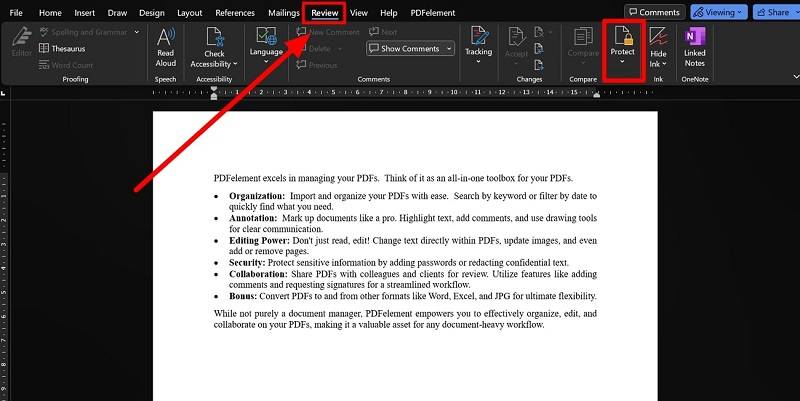
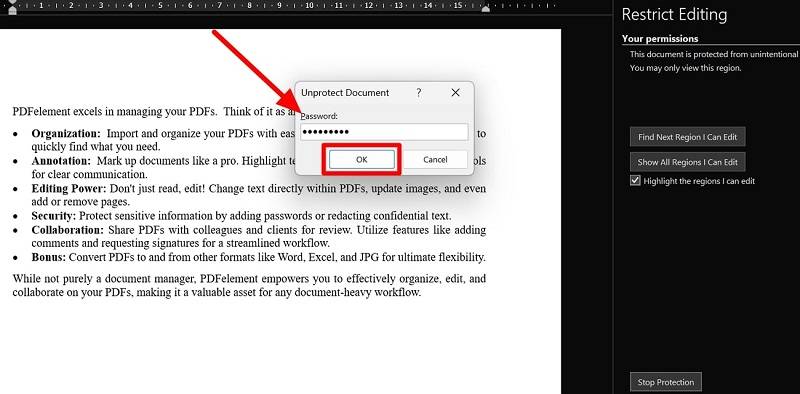
Click Restrict Editing. A panel appears on the right side of the document. If protection is active, Word shows the editing restrictions currently applied to the file. At the bottom of that panel, click Stop Protection.
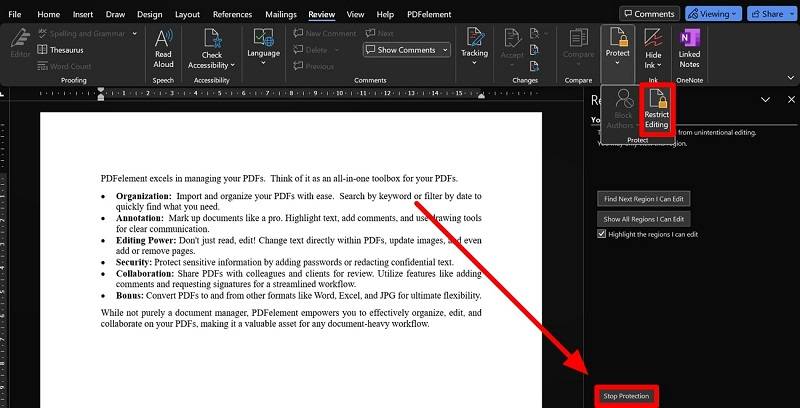
Word will ask for the password. Type it carefully, then click OK. Once accepted, you can edit the document normally.
After editing, decide whether the document should remain unrestricted. If you are returning the file to a team, client, or reviewer, you may need to reapply the same protection before sending it back.
Edit a document that is only marked as final
“Marked as Final” is easy to confuse with true protection. It tells readers the document is finished and discourages changes, but it does not provide strong security.
If the yellow or gray bar at the top says the document has been marked as final, click Edit Anyway. Word will switch the document back into editable mode.
This is common with reports, proposals, and policy drafts where the author wants to prevent accidental typing. It is not meant for confidential or tamper-proof files.
Save a copy under a new file name
Sometimes a Word document opens in read-only mode because the file is stored in a restricted folder, downloaded from email, opened from a temporary location, or synced from a cloud drive where you have view-only access.
In that case, try saving a separate copy:
- Open the document in Word.
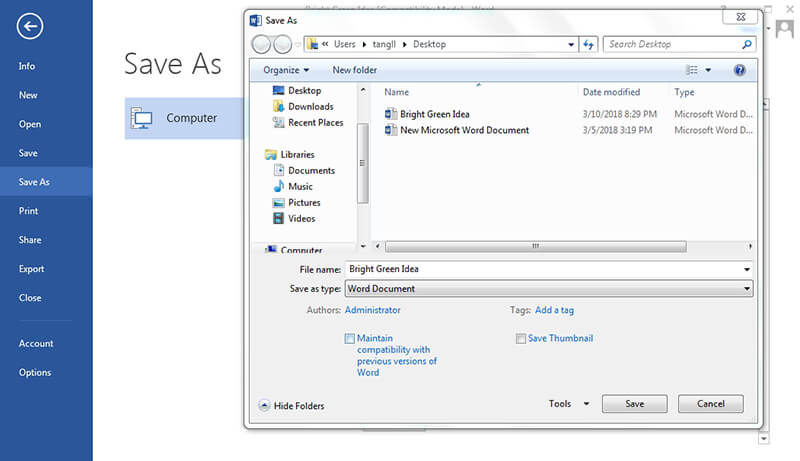
- Go to File > Save As.
- Choose a local folder such as Documents or Desktop.
- Rename the file.
- Click Save and try editing the new copy.
This does not remove a real editing password. It only helps when the issue is file access, read-only status, or a temporary copy. If the document is still restricted after saving a copy, use the Review > Restrict Editing panel to check whether Word protection is active.
Check file properties if Word says Read-Only
On Windows, a file can be marked as read-only at the system level. Right-click the document in File Explorer, choose Properties, and look at the General tab. If Read-only is checked, clear it and click Apply.
If the file is stored in OneDrive, SharePoint, Google Drive, Dropbox, or a network folder, permissions may be controlled by the owner. Saving a local copy may let you edit your own version, but it will not give you permission to modify the shared original.
Insert the protected document into a new Word file
If the document opens but the file container is causing issues, you can sometimes pull the content into a new file. This is useful for damaged files, awkward templates, or documents with restrictions that do not transfer cleanly.
Create a blank Word document. Go to Insert, then in the Text group choose Object > Text from File. Select the protected document and insert its contents.
This method can preserve much of the text and some formatting, but it is not perfect. Headers, footers, tracked changes, comments, form controls, and section-level formatting may not behave exactly the same in the new document. Use it for content recovery or cleanup, not as your first choice for formal documents.
How to Edit a Word Document That Is Protected When You Do Not Have the Password
If you are asking how to edit a Word document that is protected but you do not have the password, the safest answer depends on what you are allowed to do with the file.
There is a big difference between recovering your own content and bypassing someone else’s restrictions. For work documents, contracts, academic files, HR forms, and client deliverables, ask the owner for either the password or an editable copy. It keeps the document history clean and prevents disputes about unauthorized changes.
Ask for an editable copy or permission change
This is not glamorous advice, but it is often the most reliable fix. If the file came from a colleague, ask them to remove restriction settings or send a version intended for editing. If the file is in SharePoint or OneDrive, request edit permission rather than downloading random copies.
A good request is specific: “Could you send an editable version or remove Restrict Editing? I need to update sections 2 and 4 and return the revised file today.” That tells the owner why you need access and reduces back-and-forth.
Print or export to PDF, then convert back to Word
If you are allowed to use the content but cannot edit the Word file directly, you may be able to print or export it to PDF, then convert the PDF back to Word. This is common when a protected file is being used as a source document and you need a working copy for notes, extraction, formatting, or repurposing.
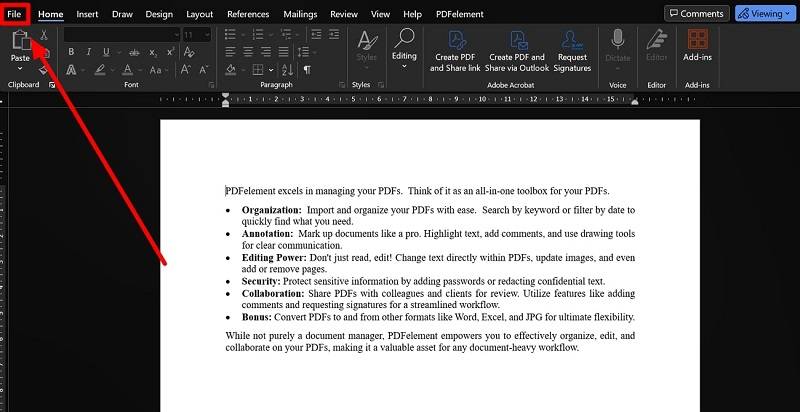
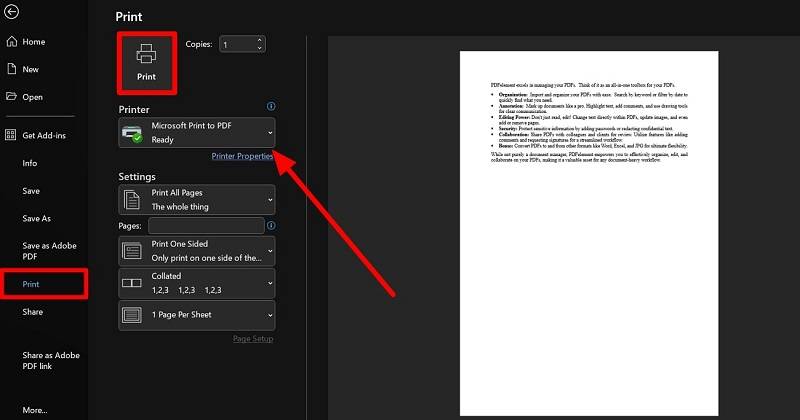
In Word, open the document and go to File > Print. Choose Microsoft Print to PDF as the printer, then click Print and save the PDF.
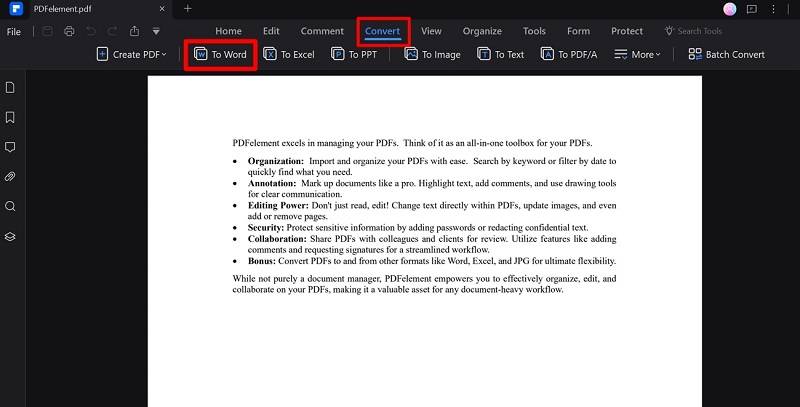
Once you have a PDF, open it in a PDF editor or converter. For example, in Wondershare PDFelement, open the PDF and use Convert > To Word to create an editable DOCX copy.
G2 Rating: 4.5/5 |100% Secure
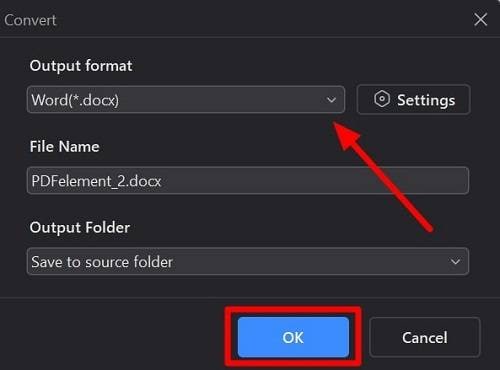
Choose the output format and save location, then export the file.
This workflow has limits. A printed PDF is a flattened representation of the document. It may not preserve every style, comment, form field, tracked change, hyperlink, or layout detail. If the PDF is scanned or image-based, you will need OCR before the text becomes editable.
Use this approach when you need a practical editable copy and have permission to work with the content. Do not use it to sidestep restrictions on documents you are not authorized to modify.
Open the file with another word processor
Some protected Word files can be opened in Google Docs, LibreOffice Writer, WordPad, or another word processor. This may let you copy text or create a new editable version, especially if the original restriction is not enforced outside Microsoft Word.
This approach is best for simple documents. Complex layouts can shift. Tables may resize. Fonts may change. Comments, tracked changes, macros, content controls, and form fields may be lost or converted.
If you try this, keep the original untouched. Save the edited version under a new name and compare it carefully before sharing it.
Be careful with “password removal” tricks
Older tutorials often recommend editing document code, renaming files, changing internal XML, or replacing password-related strings. These methods are unreliable across modern Word versions and can corrupt the document. They also raise permission issues if the file is not yours.
For a document you own, the better path is to recover from a backup, look for an earlier unrestricted copy, check email attachments, or use the correct restriction password. For an encrypted file that cannot be opened, there is no dependable built-in Word method to reveal the password.
How to Protect a Word Document From Being Edited
The reverse question matters too: if you are preparing a file for others, how do you protect a Word document from being edited while still making it usable?
Word gives you several levels of control. Choose the lightest option that matches the situation. Over-protecting a file can annoy collaborators; under-protecting it can lead to accidental changes.
Restrict editing in Word
Use Restrict Editing when you want readers to see the document but limit how they can change it.
Open the document and go to Review > Restrict Editing. In the panel, you can set formatting restrictions and editing restrictions. Common choices include:
No changes (Read only) for a document people should not edit.
Tracked changes when reviewers can revise but edits must be visible.
Comments when reviewers can comment but not alter the main text.
Filling in forms when users should only complete fields.
After choosing the restriction type, click Yes, Start Enforcing Protection and enter a password if needed. Keep that password somewhere safe. If you forget it, you may lock yourself out of your own editing workflow.
Add a password to open the document
If the document contains confidential content, editing restrictions are not enough. Someone may not be able to edit the file, but they can still read it. For sensitive documents, use an open password.
In Word, go to File > Info > Protect Document > Encrypt with Password. Enter a strong password and save the file. Anyone who opens the document will need that password.
Be cautious: if you lose the password, Microsoft cannot simply recover it for you. Use a password manager or your organization’s approved credential storage process.
Mark as final for soft protection
Use Mark as Final when you only want to signal that the document should not be edited casually. It is suitable for final drafts, approved reports, or read-only reference files shared inside a team.
Go to File > Info > Protect Document > Mark as Final. Word will show a message telling readers the document is final. They can still click Edit Anyway, so do not use this for sensitive or legally controlled files.
Share as PDF when editing is not required
If the recipient only needs to read, print, sign, or comment, PDF is often a better delivery format than Word. PDF keeps layout more stable across devices and reduces casual editing. It is especially useful for invoices, manuals, signed agreements, training materials, and approved forms.
You can save a Word document as PDF from File > Save As or File > Export. If you need stronger PDF controls, use a PDF editor to add permissions, redact sensitive content, flatten form fields, or request signatures.
Use PDFelement When Your Protected Word Workflow Becomes a PDF Workflow
Microsoft Word is the right place to remove Word editing restrictions when you have the password. PDFelement does not magically remove Word passwords, and it should not be positioned as a tool for bypassing Word document security.
Where PDFelement becomes useful is the surrounding document workflow. Many protected Word files end up as PDFs because teams need to preserve layout, share read-only copies, collect comments, or create an editable version from an authorized PDF export.
For example, if you can legally print or export a protected Word file to PDF, PDFelement can convert that PDF back to Word for editing. If the PDF is scanned, its OCR feature can recognize text so you can copy, search, or export it. If you do not need to return to Word, you can edit text directly in the PDF, add comments, sign the file, compress it for email, organize pages, or combine it with other documents.
This is especially helpful in common office situations: a vendor sends a locked Word-based form as a PDF, a scanned contract needs comments before signing, or an old printed policy needs to be turned into editable text. Instead of rebuilding the document manually, you can use PDF conversion and OCR to reduce retyping.
The key is to match the tool to the task. Use Word for Word restriction settings. Use PDFelement when the file is already a PDF or when an authorized PDF copy is the most practical route for editing, reviewing, or converting the content.
G2 Rating: 4.5/5 |100% Secure
Troubleshooting Protected Word Documents
Protected Word files can fail in small, confusing ways. If the obvious method does not work, check the symptom before trying another fix.
The document opens in Protected View
If Word shows a yellow bar saying the file opened in Protected View, it usually came from the internet, email, or another location Word considers unsafe. Click Enable Editing only if you trust the source.
Protected View is a security feature, not a document authoring restriction. If you click Enable Editing and the document is still locked, then a separate editing restriction may also be active.
The file is read-only after downloading from email
Email attachments often open as temporary files. Save the attachment to your computer first, then open the saved copy. If it still opens read-only, check file properties or ask the sender whether they restricted editing.
Word allows comments but not text edits
The document is probably restricted to comments. Go to Review > Restrict Editing and check the panel. If you have the password, click Stop Protection. If you do not, ask the owner to change the restriction or send a version that allows edits.
Only form fields are editable
This is intentional in many forms. Word can restrict editing so users only fill in selected fields. If you are supposed to complete the form, type in the available fields. If you need to change the labels, instructions, or layout, you need the restriction password or an editable source copy.
Track Changes cannot be turned off
Some documents enforce tracked changes so every edit is visible. This is common in legal, editorial, and policy review workflows. If the restriction is enforced, you will need the password to stop protection. If not, go to Review > Track Changes and turn it off manually.
The password does not work
Check for simple issues first: Caps Lock, keyboard language, extra spaces, or confusion between the open password and the restriction password. Word can have both. One password may open the file, while another controls editing permissions.
If you received the password from someone else, ask them to test it on their copy. The document may have been updated, reprotected, or replaced after they sent the password.
People Also Ask
-
How do I edit a protected Word document if I know the password?
Open the file in Word, go to Review > Restrict Editing, click Stop Protection, enter the password, and click OK. You should then be able to edit the document normally. Save a new copy if you want to preserve the protected original. -
Can I edit a password protected Word document without the password?
If the document is only marked as final, read-only, or restricted by file permissions, you may be able to save a copy or click Edit Anyway. If Word requires a restriction password to stop protection, you need the correct password or permission from the owner. If the file is encrypted and cannot be opened, there is no safe built-in Word method to reveal the password. -
Why does my Word document say “Read-Only”?
It may be stored in a location where you do not have edit permission, opened from an email attachment, marked read-only in file properties, opened in Protected View, or restricted by the document owner. Save a local copy first, then check Review > Restrict Editing if editing is still blocked. -
How can I tell whether a Word file has editing restrictions?
Open the document and go to Review > Restrict Editing. If protection is active, the side panel will show what editing is allowed and whether you can stop protection. You can also look for messages near the top of Word, such as Marked as Final, Protected View, Read-Only, or Enable Editing. -
Will saving a protected Word document with a new name remove the password?
Usually no. Saving a copy can help with read-only file access problems, but it does not remove a real Word restriction password or encryption. If the file is protected through Restrict Editing, you normally need the password to remove that protection cleanly. -
Can Google Docs edit a protected Word document?
Sometimes Google Docs can open the content and create an editable copy, especially with simple files. However, formatting, comments, fields, and tracked changes may not transfer correctly. It should be treated as a conversion workaround, not a reliable way to preserve a professional Word document. -
How do I protect a Word document from being edited?
Use Review > Restrict Editing to limit changes, comments, or form filling. For stronger control, add a password when you start enforcing protection. If the content is confidential, use File > Info > Protect Document > Encrypt with Password so users need a password to open the file. -
Is PDF better than Word for sharing a document people should not edit?
Often, yes. PDF is better when the recipient only needs to read, print, comment, or sign. It preserves layout more consistently and discourages casual editing. If you need to convert, OCR, annotate, sign, or manage that PDF later, a tool like PDFelement can fit naturally into the workflow.