

In this article
Do you have a handwritten document, a scanned invoice, or an old book written in Thai script that you desperately need to convert into digital, editable text? Taking a picture or scanning the document is the easy part. The real challenge begins when you try to edit that scanned document.
Standard PDF readers and image viewers cannot manipulate the text locked inside a flat image. To extract and edit that data, you need specialized Thai OCR (Optical Character Recognition) technology.
Finding software that accurately recognizes the OCR Thai language is notoriously difficult due to the unique complexities of the Thai alphabet. In this comprehensive guide, we will explore the best desktop software, enterprise solutions, and Thai OCR online tools available in 2026. Whether you are dealing with a single image or need a bulk PDF OCR Thai solution, this article will help you find the perfect match.


 G2 Rating: 4.5/5 |
 100% Secure
Why is OCR for the Thai Language So Challenging?
If you have ever tried to use a generic OCR tool on a Thai document, you may have noticed that the results are often jumbled, missing characters, or completely illegible. But why does this happen? The OCR Thai language processing faces several unique linguistic and typographical hurdles:
- No Spaces Between Words: Unlike English, where words are clearly separated by spaces, Thai sentences are written as a continuous string of characters. Spaces are typically only used to separate clauses or sentences. An OCR engine must use advanced natural language processing (NLP) to determine where one word ends and another begins.
- Complex Character Stacking: Thai script includes consonants, vowels, and tone marks. Vowels and tone marks can be placed above, below, before, or after the consonant they modify. Sometimes, multiple marks stack on top of a single consonant. Standard OCR tools often struggle to read these vertical stacks accurately.
- Similar Looking Characters: The Thai alphabet consists of 44 consonants, 15 vowel symbols (which form at least 28 vowel forms), and 4 tone marks. Several characters look remarkably similar, differing only by a tiny loop or the length of a tail (e.g., ข and ช, or ด and ต).
- Varied Fonts and Handwriting: The difference between traditional Thai fonts (which feature loops) and modern, loopless Thai fonts is vast. An OCR engine must be extensively trained to recognize both, alongside handwritten script.
Because of these complexities, you cannot rely on just any basic text extractor. You need software specifically optimized for Thai OCR.
Top Desktop Software for PDF OCR Thai
When dealing with multi-page documents, sensitive business contracts, or large files, desktop software is usually the best route. Here are the top desktop tools for performing OCR Thai PDF conversions.
1. Wondershare PDFelement
Many professionals consider Wondershare PDFelement to be the cream of the crop when it comes to document management. It is incredibly intuitive, fast, and provides an all-in-one suite of tools for editing, converting, annotating, and protecting PDFs.
When it comes to PDF OCR Thai, PDFelement stands out for its high accuracy. Powered by top-tier OCR technology, it can accurately read stacked Thai characters and perfectly recreate the layout of your original scanned document. Furthermore, PDFelement includes a built-in AI translation feature—a massive time-saver if Thai is not your native language and you need an immediate translation of the extracted text.
Supported Platforms: Windows, macOS, Android, iOS
Pricing: Free trial available; Premium plans start around $79.99 (one-time or subscription options).
G2 Rating: 4.5/5 |100% Secure
How to Perform Thai OCR on PDFelement
A. If you already have a scanned Thai PDF:
Step 1Open PDFelement and click on OCR from the main home screen, or navigate to Tools > OCR.
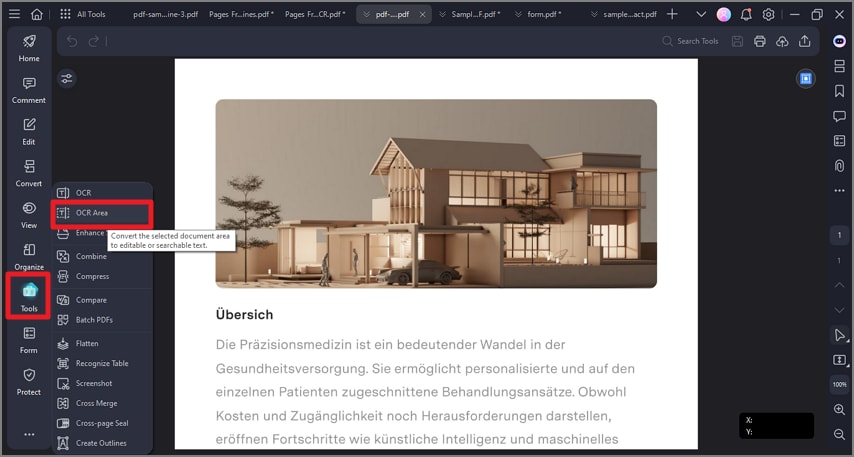
Step 2Select the PDF containing the Thai text.
Step 3Choose your scan option: "Scan to editable text" or "Scan to searchable text in image".
Step 4Select the page range you wish to process.
Step 5Click on More Options and set the recognition language to Thai.
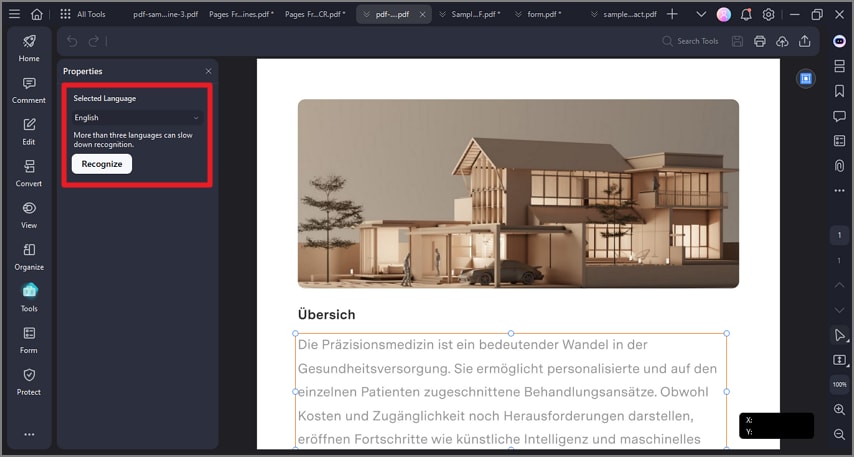
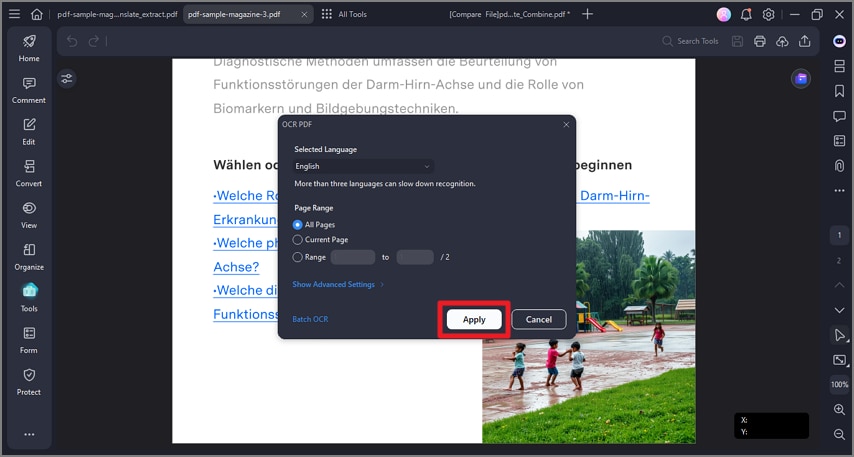
Step 6Click Apply to begin the conversion.
B. If you have an image (JPG/PNG) instead of a PDF:
Step 1Open PDFelement, and click Create PDF > From File to open your image.
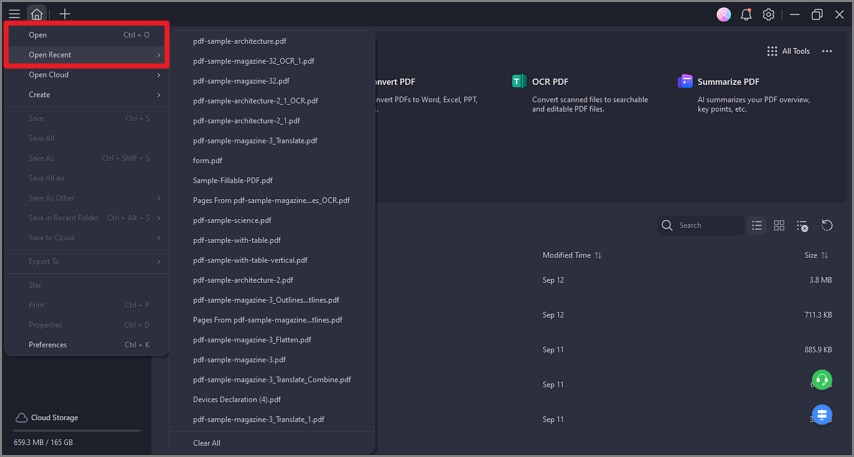
Step 2Click OCR or Perform OCR under the Tools menu.
Step 3Choose your scan options and ensure the language is set to Thai.
Step 4Click Apply to extract the text.
2. Adobe Acrobat Pro
As the inventor of the PDF format, Adobe Acrobat Pro remains a heavyweight in the industry. Its OCR engine is highly sophisticated and handles the OCR Thai language requirement with precision. If you are already integrated into the Adobe Creative Cloud ecosystem, this is a natural choice.
Supported Platforms: Windows, macOS, Web
Pricing: Starts at $19.99/month (Subscription only).
Best Thai OCR Online Tools (Free & Paid)
If you are on a public computer, using a Chromebook, or simply don't want to install heavy desktop software, a Thai OCR online tool is the perfect alternative.
3. HiPDF
HiPDF is an advanced online PDF solution. It offers dozens of PDF manipulation tools, including a highly accurate online OCR feature. HiPDF’s cloud-based engine supports dozens of languages, making it a reliable Thai OCR online solution for quick extractions.
Supported Platforms: Web (Accessible from any OS)
Pricing: Free basic access; HiPDF Pro Plus costs $5.99/month or $39.99/year.
How To Convert Thai Images to Text Using HiPDF
Step 1Navigate to HiPDF's online OCR tool and click Choose File.
Step 2Select the scanned PDF or image containing the Thai text.
Step 3Once uploaded, click OCR Settings and set the language specifically to Thai.
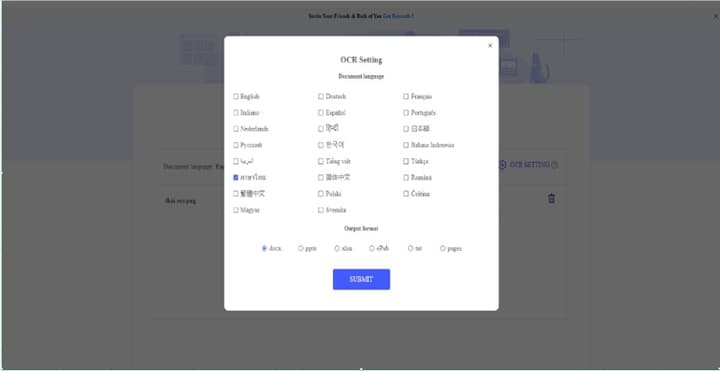
Step 4Select your preferred output format and click Submit.
Step 5Click Convert.
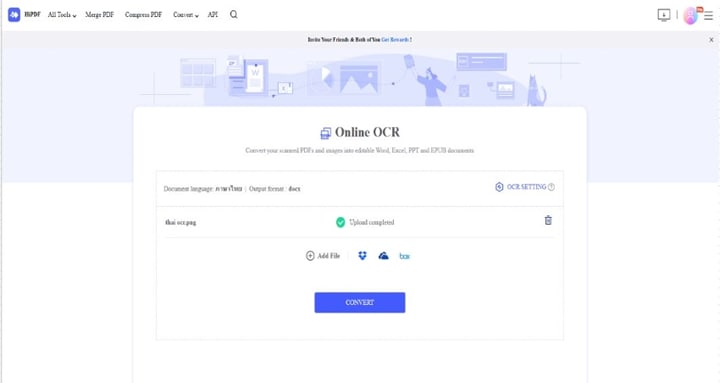
Step 6Wait a few moments for the cloud engine to process.
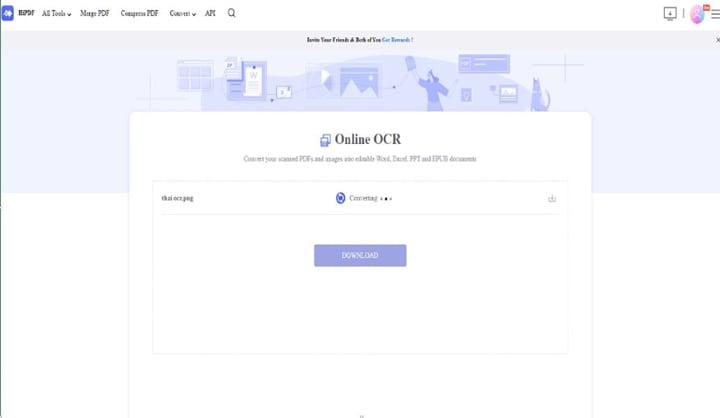
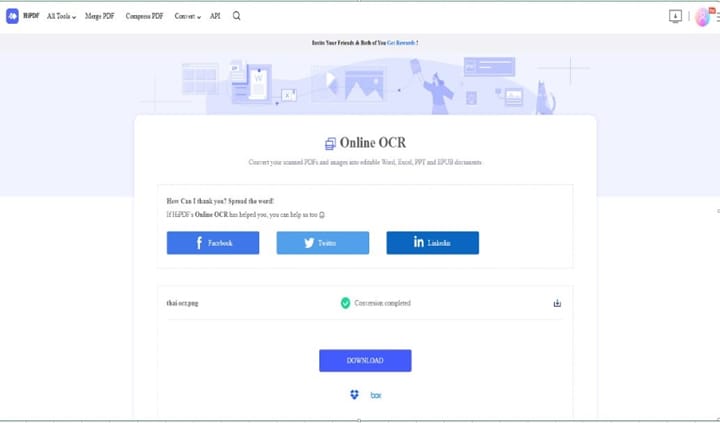
Step 7Once finished, click Download to save your document.
4. i2ocr
If you are looking for a completely free Thai OCR online tool, i2ocr is an excellent choice. It is a registration-free online OCR service that supports over 100 languages, including Thai.
Supported Platforms: Web
Pricing: 100% Free
How to Convert Thai Images to Text Using i2ocr
Step 1Go to the i2ocr website and select Image OCR or PDF OCR.
Step 2Set the OCR language to Thai.
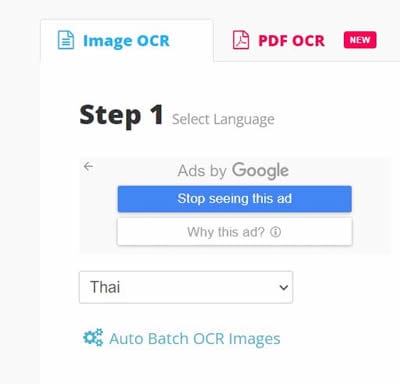
Step 3Select Image or Select PDF and upload your file.
Step 4Complete the Captcha verification.
Step 5Click Extract Text.
Step 6Scroll down to view, copy, or download your extracted Thai text.
5. Google Drive / Google Docs (The Free Hack)
Google Drive has a powerful, built-in OCR engine that is completely free to use. Leveraging Google's AI infrastructure, this is an excellent workaround for extracting Thai text.
Supported Platforms: Web
Pricing: Free (Requires a Google Account)
Step 1Upload your Thai image or scanned PDF to Google Drive.
Step 2Right-click the file and select Open with > Google Docs.
Step 3Wait for the automatic OCR to complete; the text will appear below the image.
Best Advanced Thai OCR for Enterprise & Business
For large-scale corporations or businesses operating heavily in Southeast Asia, standard desktop software might not be enough. Automated data extraction is crucial for OCR Thailand business logistics.
6. Nanonets
Nanonets OCR uses deep learning to extract relevant data from complex images. Unlike standard tools, Nanonets allows you to train custom AI models to recognize specific fields like "Total Amount" from a Thai receipt.
Supported Platforms: Web, API integration
Pricing: Starts at $499/model monthly for professional tiers.
How To Use Nanonet’s Pre-Trained Models
Step 1Log into the Nanonets dashboard.
Step 2Select the appropriate OCR model for your document type.
Step 3Click Add Files to upload your Thai documents.
Step 4Review the extracted data fields.
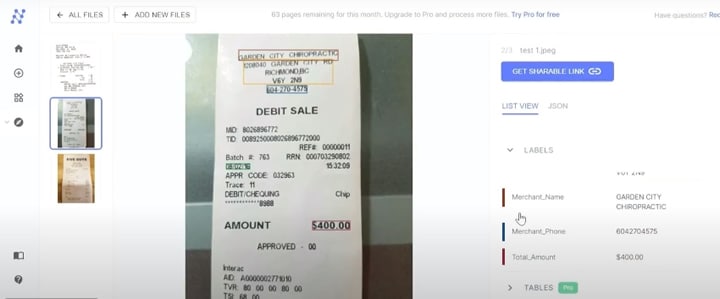
Step 5Click Export To.
Step 6Select your output format (CSV, Excel, JSON).
How to Choose the Right Thai OCR Software
Consider the following factors when picking your tool:
- Your Budget: Use free tools like i2ocr or Google Drive for one-off tasks. Invest in PDFelement for regular professional use.
- Document Complexity: Use a dedicated desktop editor like PDFelement to retain layout in complex documents.
- Privacy & Security: Desktop software processes files locally, offering better security for sensitive data compared to random online sites.
G2 Rating: 4.5/5 |100% Secure
Tips to Improve Thai OCR Accuracy
To ensure perfect text extraction, follow these tips:
- High Resolution: Scan your documents at a minimum of 300 DPI.
- Good Contrast: Ensure strong contrast between text and background.
- Straighten Images: Deskew skewed images before uploading.
Frequently Asked Questions (FAQs)
-
Can I perform Thai OCR on my mobile phone?
Yes. Apps like Wondershare PDFelement have mobile versions for iOS and Android that include OCR capabilities. You can simply take a photo of a Thai document with your phone's camera and use the app to extract the text instantly. -
Why does my OCR software output random symbols instead of Thai text?
This happens when the software's OCR language setting defaults to English. Because the engine is looking for Latin characters, it misinterprets the complex curves and tone marks of the Thai alphabet as random punctuation. Always double-check that you have manually selected "Thai" in the OCR settings before scanning. -
Is there a free way to convert Thai PDFs to Word?
Yes, you can use Thai OCR online tools like i2ocr or HiPDF's free tier. For scanned, image-based PDFs, using the Google Drive to Google Docs method is the most effective free workaround to get your Thai text into an editable word processor.
Conclusion
Digitizing documents shouldn't be a headache, even when dealing with beautifully complex scripts. If you are on a tight budget, i2ocr or Google Docs are fantastic free solutions. However, for reliability and perfect layout retention, Wondershare PDFelement stands out as the ultimate PDF OCR Thai solution. For cloud processing, HiPDF offers convenience, while enterprise users will benefit from the automation of Nanonets.