

Table of Contents
Turning a spreadsheet into a PDF is easy. Turning it into a PDF people can actually type into is the part that causes confusion. If you use Excel’s normal Save as PDF or Export to PDF option, the result usually looks right, but the blank cells are just static page content. Recipients cannot click into those cells as real form fields unless you add interactive PDF fields afterward.
That is the key difference behind the phrase convert excel to fillable pdf. You are not only converting the file format. You are also creating text boxes, check boxes, dropdowns, date fields, or signature areas on top of the PDF layout. A PDF form editor such as Wondershare PDFelement can help by detecting form areas automatically and letting you adjust the fields before sharing the final form.
Below is a practical workflow for building the form in Excel, converting it to PDF, making it fillable, and checking that it works before you send it to clients, employees, students, vendors, or anyone else who needs to complete it.


 G2 Rating: 4.5/5 |
 100% Secure
Why Excel PDFs Are Not Fillable by Default
Excel is a spreadsheet application, not a PDF form builder. It is excellent for arranging rows, columns, tables, totals, and structured labels. That makes it a convenient place to design forms such as expense reports, registration sheets, purchase requests, inspection checklists, and intake forms.
But when Excel exports a worksheet as a PDF, it preserves the visual appearance of the sheet. It does not automatically turn empty cells into PDF input boxes. A blank bordered cell in Excel becomes a blank bordered area on the PDF page. It may look like a field, but it behaves like an image or printed page element.
A true fillable PDF contains interactive form fields. These fields have properties: field names, font size, border style, value format, tab order, export value, and sometimes validation rules. PDF readers can recognize these fields, let users type into them, and save the completed form.
This matters because the wrong workflow can create extra work. If you send a flattened PDF, recipients may print it, write by hand, scan it, and email it back. If you send a fillable PDF, they can complete the form digitally and return a cleaner file.
Excel is still a good starting point when the form depends on a grid. It gives you precise control over column widths and row heights. For paragraph-heavy forms, Word may be easier. For the final interactive version, however, a PDF editor is usually the most reliable place to create and check fillable fields.
Prepare the Excel Form Before Conversion
Before opening a PDF editor, spend a few minutes cleaning up the Excel file. A well-prepared worksheet is easier to convert and much easier for automatic form recognition to interpret.
Build the Form Layout in Excel
Start with the form’s structure. Put labels where users need guidance, and leave clearly defined spaces for their answers. For example, instead of placing “Name” and “Email” in the same narrow cell, give each label enough room and place a blank bordered cell beside it.
If the form will be printed or signed, design it for a standard page size such as Letter or A4. Excel forms often sprawl horizontally because spreadsheets make it easy to add columns. A PDF form should be more controlled. If users need to zoom and scroll sideways, the form will feel awkward on smaller screens.
Use Excel’s page layout tools to check the final page boundaries. Set the print area, margins, orientation, and scaling before conversion. Microsoft’s guide to printing worksheets and workbooks is useful if your worksheet keeps breaking across pages unexpectedly.
Format Cells So Form Tools Can Recognize Them
If you are researching how to create a fillable pdf form in excel, the most important layout habit is this: make answer areas obvious. Automatic form recognition works best when the form has visible boxes, lines, or consistent blank spaces.
Use cell borders around areas where people should type. For short answers such as name, phone number, department, or invoice number, one bordered cell or a merged group of cells is fine. For longer answers, use a larger bordered rectangle with enough vertical space.
For checklists, make small square cells or symbols next to each option. Keep the labels aligned and evenly spaced. If you plan to add radio buttons later, group related options clearly, such as “Payment Method” or “Preferred Contact Method.”
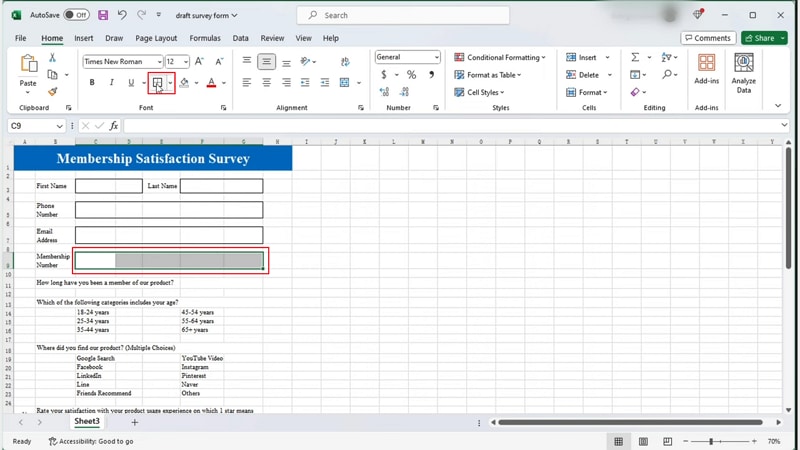
Do not over-design the file. Heavy background colors, decorative borders, and merged-cell complexity can make field detection less predictable. A clean form usually converts better than a visually crowded one.
Check Page Size, Print Area, and Labels
Before saving the Excel file, preview the page. Confirm that labels are not cut off, rows are not split in strange places, and the form has enough white space for readable answers.
Also check the wording of your labels. Once the form becomes a PDF and is shared externally, vague labels can create bad data. “Date” could mean today’s date, date of birth, requested date, or invoice date. Use specific labels where needed, such as “Date of Request” or “Service Start Date.”
G2 Rating: 4.5/5 |100% Secure
If the form collects sensitive information, add short instructions near the top. Tell users how to return the form and what information is required. Do not rely only on red asterisks unless the meaning is explained somewhere.
How To Convert Excel to Fillable PDF With PDFelement
Wondershare PDFelement is useful for this workflow because it handles both parts of the job: converting the Excel file into a PDF and adding interactive form fields. The form recognition feature can save time on structured Excel forms, and the manual form tools let you fix anything that needs more control.
Step 1: Create and Save the Excel Form
Finish the form layout in Excel first. Add labels, borders, and empty answer areas. Set the print area and page orientation so the PDF page looks intentional rather than like a spreadsheet dump.
Save the file in a standard Excel format such as .xlsx. Keeping the original Excel file is a good habit because you may need to revise the form later. Treat the Excel file as your editable design source and the PDF as the distribution version.
Step 2: Convert the Excel File to PDF
Open PDFelement and create a PDF from the Excel file. You can do this from the home screen by choosing the create-from-file option and selecting the workbook. PDFelement converts the worksheet into a PDF while preserving the page layout.
If your workbook has multiple sheets, check whether all required sheets were included. In many form workflows, it is better to convert only the final form sheet instead of the entire workbook. Hidden notes, calculation sheets, or draft tabs should not end up in the PDF by accident.
Step 3: Recognize Form Fields Automatically
After the PDF opens in PDFelement, go to the form tools and use the form recognition option. The software scans the page for blank lines, boxes, and areas that look like form inputs. It then places fillable fields on those areas.
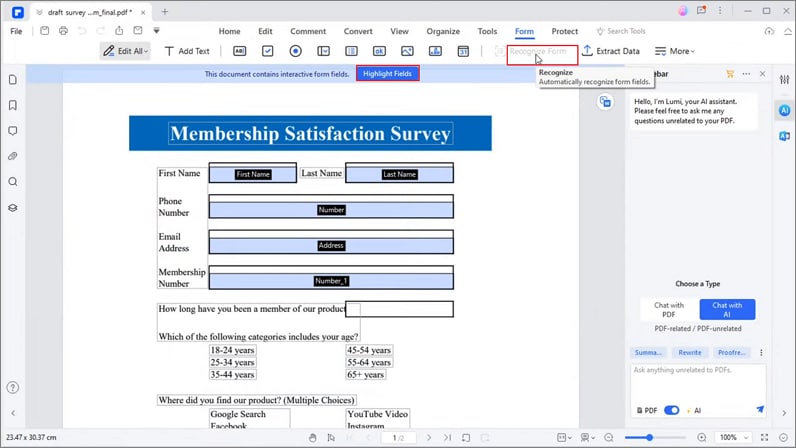
This is where the earlier Excel preparation pays off. Bordered cells and consistent spacing give the recognition tool clearer targets. You may still need to review the results, especially if the form has complex tables or unusual spacing, but automatic detection is faster than placing every field manually.
Step 4: Edit Field Properties and Add Missing Fields
Automatic recognition is a starting point, not the final check. Click through the fields and make sure each one matches the answer you expect. A long comment area should not be a tiny one-line field. A check box should not be recognized as a text field. A group of mutually exclusive options may work better as radio buttons.
PDFelement lets you adjust field properties such as field name, appearance, border, font, default value, and other settings. Field names matter if you plan to export form data later because they become the labels for collected responses.
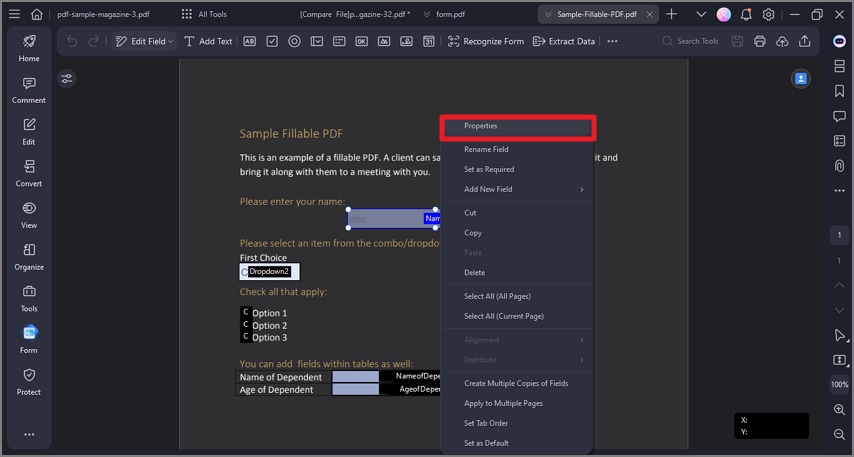
Use clear internal names such as employee_name, invoice_number, or approval_date rather than leaving vague names if you will process responses. The person filling out the form may not see these names, but they help when exporting or organizing form data.
If PDFelement misses a field, add it manually. You can insert text fields, check boxes, radio buttons, dropdowns, list boxes, buttons, and signature-related fields depending on the form’s purpose.
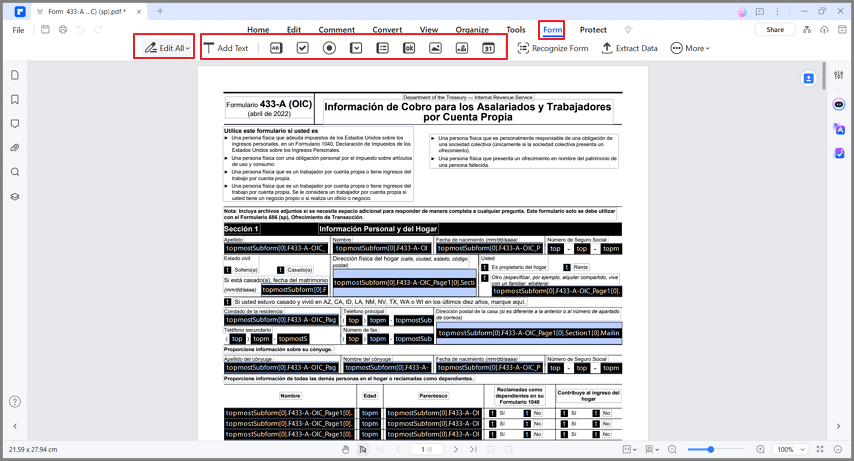
Manual editing is also the best time to fix alignment. A field that is slightly too high or too wide may still work, but it can make the completed form look unprofessional. Adjust field boundaries so typed text sits naturally inside the visual boxes.
Step 5: Preview, Test, and Save the Fillable PDF
Switch to preview or reading mode and fill out the form as if you were the recipient. Type sample answers into every field. Check boxes. Select dropdown values. Try a long answer in any comment field to see whether the text scrolls or becomes too small.
Save the completed test copy, close it, and reopen it in a common PDF reader. This extra step catches a common mistake: a form may look fine in the editor but behave differently for recipients. Adobe’s general explanation of PDF forms is helpful if you want to understand how form fields behave across PDF tools.
Once the test works, save a clean blank version for distribution. Consider using a filename that distinguishes it from the Excel source, such as Vendor-Registration-Fillable.pdf.
How To Create a Fillable PDF Form From Word
Excel is not always the best source file. If your form is mostly text, instructions, clauses, or paragraphs with occasional answer fields, Word may be easier to design. That is why many users also search for create fillable pdf from word or create pdf fillable form from word when they are comparing workflows.
The Word process is similar: design the document, convert it to PDF, then add or recognize fillable PDF fields.
Create a Clean Word Form Layout
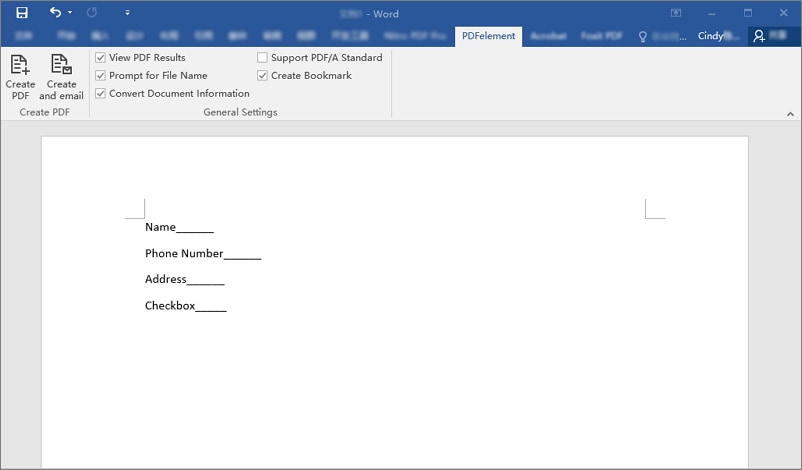
Open Word and draft the form with clear labels and answer areas. You can use tables to align fields neatly, or you can use underlines for short responses. Tables are often easier to control because they prevent labels and answer spaces from shifting unexpectedly.
For example, a client intake form may include a two-column table with labels on the left and blank spaces on the right. A contract addendum may use short underlined areas inside paragraphs. Both can work, but consistency matters. If every answer space looks different, automatic recognition may require more cleanup.
Convert Word to PDF
After the Word form is ready, convert it to PDF. If PDFelement is installed, you can create a PDF directly from the Word file. You can also use Word’s built-in PDF export, but remember that the exported PDF may not contain interactive fields unless you add them afterward in a PDF editor.
The goal at this stage is to create a stable PDF layout. Once the content is in PDF format, the text and spacing are less likely to move around when someone opens the file on a different device.
Run Form Recognition and Adjust Fields
Open the PDF in PDFelement and use the form recognition tool. The software will detect likely input areas and add interactive fields. Review the results carefully, especially around underlined spaces, tables, and multi-line response areas.
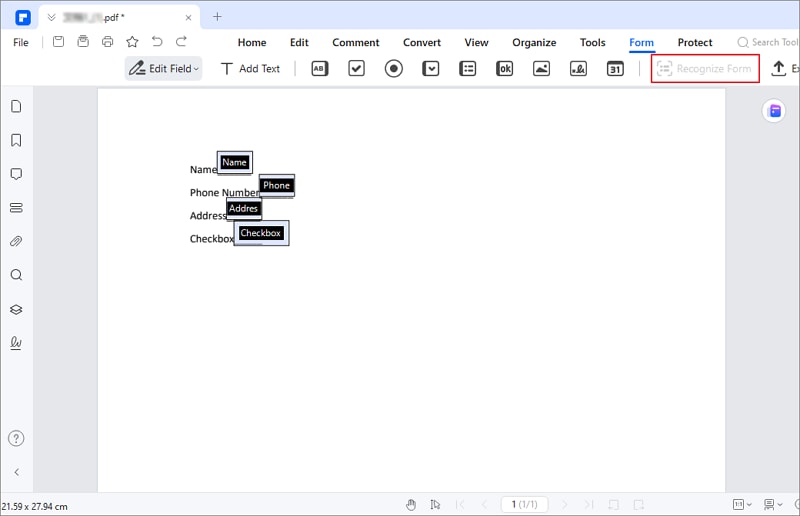
This workflow is particularly useful for HR documents, application forms, waivers, onboarding packets, school forms, and internal approval templates. Word gives you a natural writing environment, while PDFelement gives you control over the final fillable PDF.
G2 Rating: 4.5/5 |100% Secure
A Note About Word’s Built-In Fillable Controls
Word has its own fillable controls under the Developer tab. You can add text controls, check boxes, date pickers, and dropdown lists inside a Word document. To show the Developer tab, go to Word options and enable it under the ribbon customization settings.
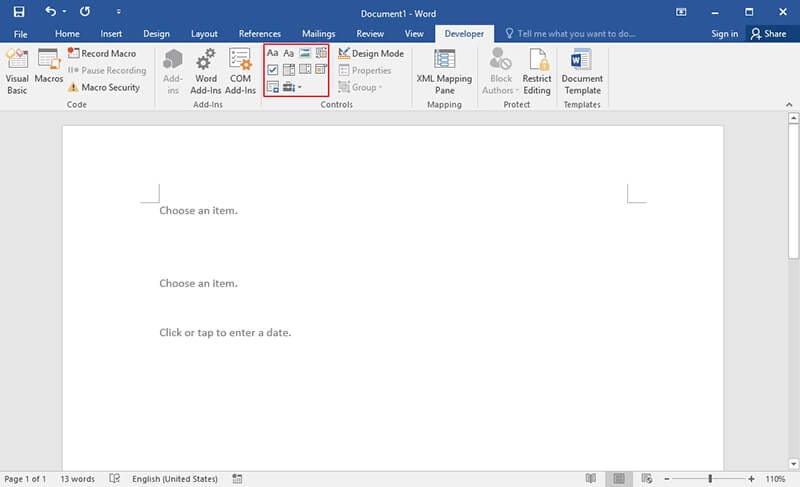
These controls are useful if you want people to complete the form in Word format. They do not always translate into a fillable PDF in the way users expect. In many workflows, Word controls become static or unreliable after PDF conversion. If the final file needs to be a PDF, it is usually safer to create or verify the interactive fields inside a PDF editor.
Microsoft’s page on showing the Developer tab can help if you want to build Word forms before converting them.
Manual Form Field Options You May Need
Automatic recognition is convenient, but a good fillable PDF often needs manual finishing. Different field types create different user experiences, and choosing the right one reduces mistakes.
Text Fields
Text fields are the most common form element. Use them for names, addresses, phone numbers, email addresses, ID numbers, notes, and short written responses.
For short answers, keep the field single-line. For comments, explanations, or descriptions, use a larger multi-line field. If you expect a specific format, such as a date or phone number, label the field clearly. Some PDF tools allow formatting or validation, but clear instructions are still the easiest way to prevent bad entries.
Check Boxes and Radio Buttons
Check boxes are best when users can select more than one option. For example, a maintenance request form might ask which services are needed: plumbing, electrical, HVAC, cleaning, or other. More than one could apply.
Radio buttons are best when users must choose only one option from a group. For example, “Preferred Contact Method” might offer email, phone, or text. If only one answer should be selected, radio buttons are cleaner than check boxes.
This distinction matters. A form with check boxes where only one answer is allowed can create inconsistent submissions. A form with radio buttons where multiple answers are valid can frustrate users.
Dropdown Lists and Combo Boxes
Dropdowns save space and reduce typing errors. They are useful for departments, states, office locations, request types, product categories, and approval statuses.
Use dropdowns when the set of answers is known and stable. Do not use them for answers that change constantly unless you are prepared to update the form. A stale dropdown can be worse than a blank text field because it forces users to pick an inaccurate option.
Combo boxes are similar but may allow users to type their own response depending on the settings. They work well when you want to suggest common options while still allowing exceptions.
Signature and Date Fields
If the form requires approval, add a clear signature area and date field. Some workflows need a simple typed name. Others require a digital signature. Be clear about what is acceptable before sending the form.
For legally sensitive forms, confirm your organization’s requirements. A PDF signature field can support a digital signing process, but the legal and compliance expectations vary by document type, location, and business policy.
Tips for Sharing, Testing, and Managing Fillable PDFs
A fillable PDF is only successful if recipients can complete and return it without confusion. The final review is less about design and more about real-world use.
Test the Form Like a Recipient
Open the blank PDF in a standard PDF reader, not only in the editor used to create it. Fill out every field. Save the file. Reopen it. Check whether the data is still there.
Then test the tab order. Press the Tab key and watch where the cursor moves. It should follow the visual order of the form, usually left to right and top to bottom. Poor tab order is irritating on long forms because users jump from one section to another unexpectedly.
Also test with realistic entries. A sample name like “John Smith” will fit almost anywhere. A longer name, a full address, or a detailed comment may reveal fields that are too small.
Protect the Layout While Keeping Fields Usable
If you do not want recipients to edit labels, instructions, or layout, use PDF protection carefully. The aim is to prevent content edits while still allowing form filling. Do not apply restrictions that block users from typing into fields or saving their completed copy.
Before distributing the form widely, send it to one or two colleagues and ask them to complete it without extra instructions. If they hesitate at the same field, the issue is probably the form design, not the user.
Manage Completed Forms With a PDF Workflow
This is where a PDF editor such as PDFelement can be useful beyond the initial conversion. After people return completed forms, you may need to rename files, combine related documents, extract form data, add comments, redact sensitive details, compress large attachments, or request signatures.
For example, an HR team might convert an Excel onboarding checklist into a fillable PDF, collect completed copies from new hires, then use PDFelement to organize the PDFs into employee folders or combine signed policy acknowledgments into one file. A finance team might use an Excel expense template as the form source, distribute it as a fillable PDF, and later export or review submitted data more consistently than with scanned paper forms.
The practical value is control. Excel or Word helps you design the source document. PDFelement helps you turn that design into a usable PDF form and manage the PDF files that come back.
A few final checks can prevent most form problems:
Keep a clean master copy of the blank fillable PDF.
Keep the original Excel or Word source file for future edits.
Test the form in at least one common PDF reader before sending it externally.
Avoid tiny fields, unclear labels, and overly complex layouts.
Use the right field type instead of making every answer a text box.
People Also Ask
-
Can I convert Excel to a fillable PDF without extra software?
You can save or export an Excel file as a PDF without extra software, but that usually creates a static PDF. The blank cells will not automatically become interactive fields. To make the PDF fillable, you need a PDF form editor or another tool that can add form fields. -
Why are my Excel cells not fillable after I save as PDF?
Excel’s PDF export preserves the visual layout of your worksheet. It does not convert empty cells into PDF text fields. To make those areas fillable, open the PDF in a form editor and add text fields, check boxes, dropdowns, or other interactive elements. -
What is the best way to create a fillable PDF form in Excel?
Use Excel to design a clean form with labels, borders, and properly sized answer areas. Then convert the Excel file to PDF and use a PDF editor such as PDFelement to recognize or manually add fillable fields. Test the finished PDF before sharing it. -
Can I create a fillable PDF from Word instead of Excel?
Yes. Word is often better for forms with paragraphs, instructions, agreements, or narrative sections. Create the layout in Word, convert it to PDF, and then use form recognition or manual form tools to add interactive fields. -
Do Word fillable fields stay fillable after converting to PDF?
Not always. Word’s Developer tab controls are designed for Word documents. They may flatten or behave inconsistently after PDF conversion. If the final file must be a fillable PDF, check and edit the fields inside a PDF form editor after conversion. -
Which is better for form design: Excel or Word?
Use Excel when the form is grid-based, such as an expense report, order sheet, checklist, or inspection table. Use Word when the form contains longer instructions, paragraphs, policy text, or agreement language. In both cases, use a PDF editor for the final fillable PDF fields. -
Can users fill out the PDF on mobile devices?
Usually, yes, if the PDF fields are properly created and the user opens the file in a PDF reader that supports forms. Mobile behavior can vary, so test important forms on a phone or tablet if many recipients will complete them that way. -
How do I stop people from editing the form layout?
Use PDF permissions or protection settings that restrict editing while still allowing form filling. Always test the protected file before sending it. If the restrictions are too strict, recipients may not be able to type into the fields or save their completed form.