

In this article
In today’s fast-paced digital world, paper documents can often feel like a roadblock. Sometimes you need to scan contracts that contain handwritten notes, extract data from printed invoices, or digitize pages from a physical book. If you simply take a photo or scan these pages, your computer treats them as static images. You can't search for a specific word, highlight a sentence, or edit a typo.
This is where Optical Character Recognition (OCR) comes to the rescue.
But exactly what is OCR, and how does this helpful technology analyze printed or handwritten text and turn it into an editable digital file? In this comprehensive guide, we will explore the meaning of OCR, break down how the technology works, highlight its real-world benefits, and help you find the best OCR software for your needs.


 G2 Rating: 4.5/5 |
 100% Secure
What Does OCR Stand For? (And What Is It?)
If you have ever asked, "OCR, what does it stand for?" the answer is quite simple. OCR stands for Optical Character Recognition.
So, what is an Optical Character Recognition system? At its core, OCR is a widespread technology that analyzes printed, typed, or handwritten text within a digital image and translates it into a machine-readable text format.
To understand what is meant by OCR, imagine you receive a paper invoice from a vendor. If you scan that invoice using a standard scanner, the resulting file is just an image—a collection of pixels. To a computer, it is no different than a photograph of a landscape. You cannot use a word processor to edit the vendor's name or copy the total amount due.
When you run that scanned image through OCR software, the program identifies the shapes of the letters and numbers in the image and converts them into actual text data. This process is often referred to as OCR text recognition or simply optical recognition. Once the text is digitized, you can search, copy, paste, and edit the content electronically, just as you would in Microsoft Word or Google Docs.
Hardware vs. Software: What is an Optical Character Reader?
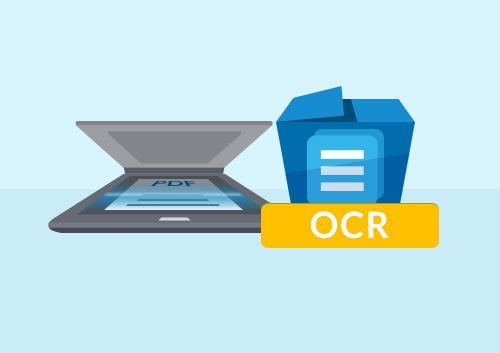
You may sometimes hear the term "optical character reader." While "recognition" refers to the software algorithm that interprets the text, an optical character reader refers to the physical hardware—like a specialized flatbed scanner, a barcode scanner, or a smartphone camera—used to capture the initial image of the physical document. Together, the reader and the recognition software form a complete OCR system.
How Does OCR Technology Work?
When a printed page is scanned, it is typically saved as a bit-mapped file (like a TIFF, JPG, or image-only PDF). To the human eye, the words are legible on the screen. However, to a computer, it is only a series of white and black dots.
So, what does OCR do to make sense of these dots? Modern OCR technology relies on a sophisticated, multi-step process to "read" the document:
Step 1Image Acquisition (Scanning)
The first step is capturing the document. A scanner or camera reads the physical paper and converts it into binary data. The OCR software analyzes this raw scanned image and categorizes the light areas as the background and the dark areas as the text that needs to be recognized.
Step 2Pre-Processing
Before the software attempts to read the text, it must clean up the image to ensure high accuracy. Poor image quality can drastically reduce the success rate of OCR. During pre-processing, the software performs several tasks:
- De-skewing: Straightening the image if the paper was scanned at a slight angle.
- Binarization: Converting color or grayscale images into stark black and white to make the text stand out clearly against the background.
- Despeckling (Noise Removal): Smoothing the edges of the text and removing dust, spots, or digital artifacts.
- Layout Analysis: Identifying columns, tables, paragraphs, and images to preserve the document's original structure.
Step 3Text Recognition
This is the core of what OCR scanning is all about. The algorithm targets the dark regions (the text) and attempts to identify letters and numbers using two primary methods:
- Pattern Matching: The software isolates a character image (called a glyph) and compares it pixel-by-pixel to a database of known fonts and text patterns. This works best for standard, printed text.
- Feature Extraction: The software breaks down the physical characteristics of a character—such as intersecting lines, closed loops, and line direction. For example, if it sees two angled lines meeting at a peak with a horizontal line across the middle, it recognizes the letter "A," regardless of the font.
Step 4Post-Processing
After the text is extracted, the system reviews the data to fix errors. Advanced OCR programs use built-in dictionaries and contextual analysis to ensure accuracy. For example, if the software is unsure whether a character is the number "0" or the letter "O," it will look at the surrounding characters. If it is surrounded by letters (e.g., "W-O-R-D"), it will correct it to an "O." Finally, the software outputs the data into an OCR format, such as a searchable PDF or an editable Word document.
G2 Rating: 4.5/5 |100% Secure
Exploring the Different Types of OCR
As technology has evolved, OCR has splintered into several specialized categories. Depending on the complexity of your documents, you may encounter different types of optical recognition:
- Simple Optical Character Recognition: This traditional method relies on template matching and pattern recognition. It is highly effective for clean, printed documents with standard fonts.
- Intelligent Character Recognition (ICR): What is intelligent character recognition? ICR is a more advanced subset of OCR designed specifically to read handwritten text and cursive. Because handwriting varies wildly from person to person, ICR uses machine learning algorithms to understand different writing styles.
- Intelligent Word Recognition (IWR): While ICR focuses on individual handwritten letters, IWR processes entire handwritten words or phrases at once. This is particularly useful for unstructured documents or messy cursive.
- Optical Mark Recognition (OMR): OMR does not read text; instead, it detects the presence of a mark on a page. It is widely used for grading multiple-choice tests, reading survey checkboxes, and processing lottery tickets.
- AI-Powered OCR: What is OCR in AI? Modern OCR solutions are increasingly powered by Artificial Intelligence and Neural Networks (Deep Learning). AI allows the software to contextually understand the data it is reading—for instance, identifying that a specific string of numbers on an invoice is a "Total Due" rather than just random digits.
What Is OCR Used For? Key Benefits and Applications
Why do thousands of businesses and individuals rely on this technology every day? The benefits of OCR go far beyond simply digitizing paper. Here is a look at what OCR is used for:
1. Creating Searchable PDF Documents
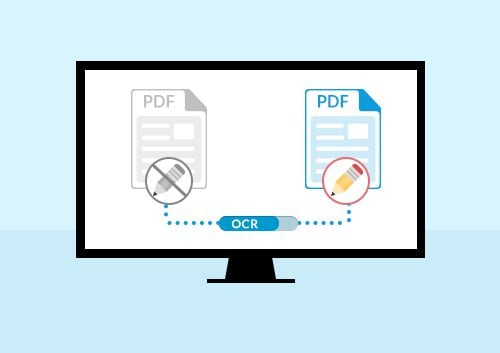
What is a searchable PDF? A standard scanned PDF is just a flat picture. A searchable PDF contains an invisible layer of text hidden directly behind the image of the document. The ability of OCR to create this text layer makes it possible to search for specific keywords, locate sections of a massive document in seconds, and copy text directly from the PDF.
2. Aiding the Blind and Visually Impaired
OCR technology was originally commercialized in the 1970s to help the visually impaired. Today, it remains a crucial accessibility tool. Screen readers can decode machine-readable text generated by OCR and read the words on the screen aloud using text-to-speech synthesizers, allowing visually impaired individuals to understand printed books, menus, and mail.
3. Faster Data Entry and Office Automation
In most offices, there is a high volume of paper processing. Manually typing data from paper forms into a computer system is slow, expensive, and prone to human error. What is an OCR application able to do here? It automates data extraction. By instantly converting paper records into digital data, OCR significantly improves productivity and reduces administrative costs.
4. Industry-Specific Applications
- What is OCR in banking? Banks use OCR to automatically read routing and account numbers on paper checks deposited via mobile apps. It is also used to process loan applications and verify identity documents.
- Healthcare: Hospitals use OCR to digitize patient intake forms, insurance claims, and historical paper medical records, integrating them seamlessly into Electronic Health Records (EHR) systems.
- Logistics and Supply Chain: OCR scanners in warehouses instantly read shipping labels, barcodes, and packing slips, ensuring packages are routed correctly without manual data entry.
What Is the Best OCR Software in 2026?
If you want your image-based or scanned documents to be searchable and editable, you need to find the right OCR software. The market is filled with desktop applications, mobile apps, and cloud-based services. Here are the top OCR programs available today:
1. Wondershare PDFelement (Top Pick)
When looking for an OCR tool that combines powerful capabilities with user-friendly simplicity, Wondershare PDFelement stands out. Its AI-powered OCR combines advanced AI recognition with OCR technology to deliver more accurate text and information extraction from scanned and image-based PDFs.
PDFelement transforms image-only PDFs into searchable or editable documents while preserving the original text, layout, and visual appearance with pixel-level accuracy. It also supports multiple languages and flexible OCR options. Beyond OCR, PDFelement offers PDF editing, conversion, annotation, e-signing, and AI-powered features such as summarization, translation, and analysis in one complete solution.
G2 Rating: 4.5/5 |100% Secure
How to Use Wondershare PDFelement for OCR
Step 1. Import the PDF
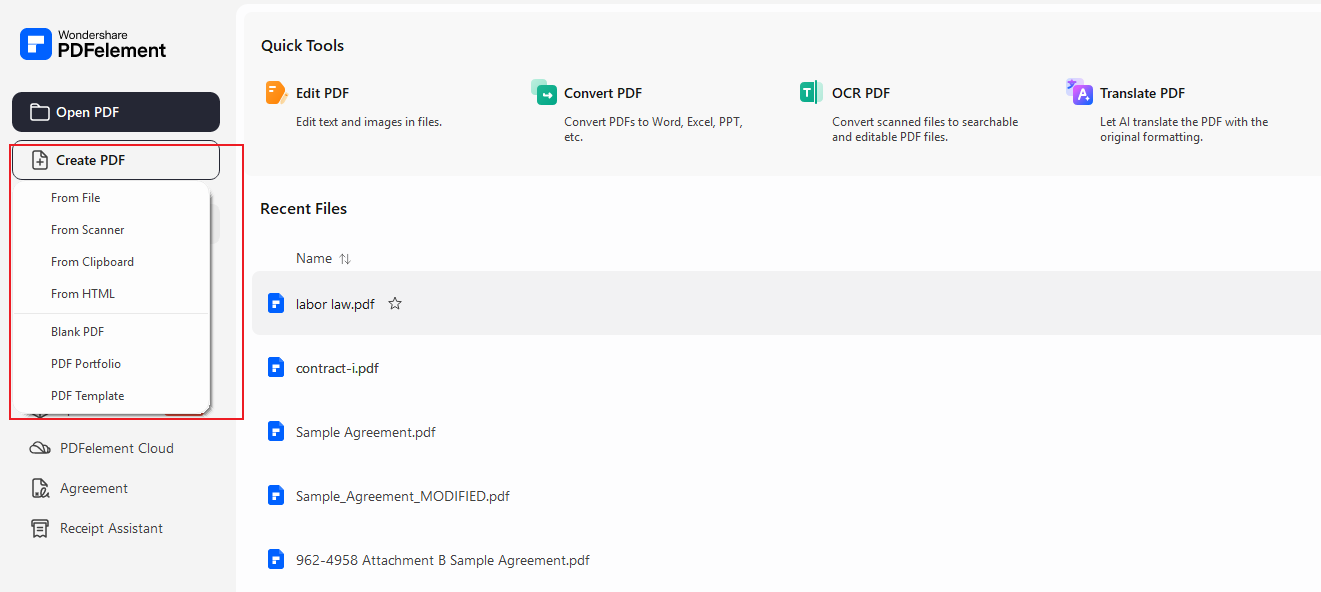
Launch PDFelement and click Create PDF > From File to import the PDF you want to recognize.
Step 2. Open the OCR Tool
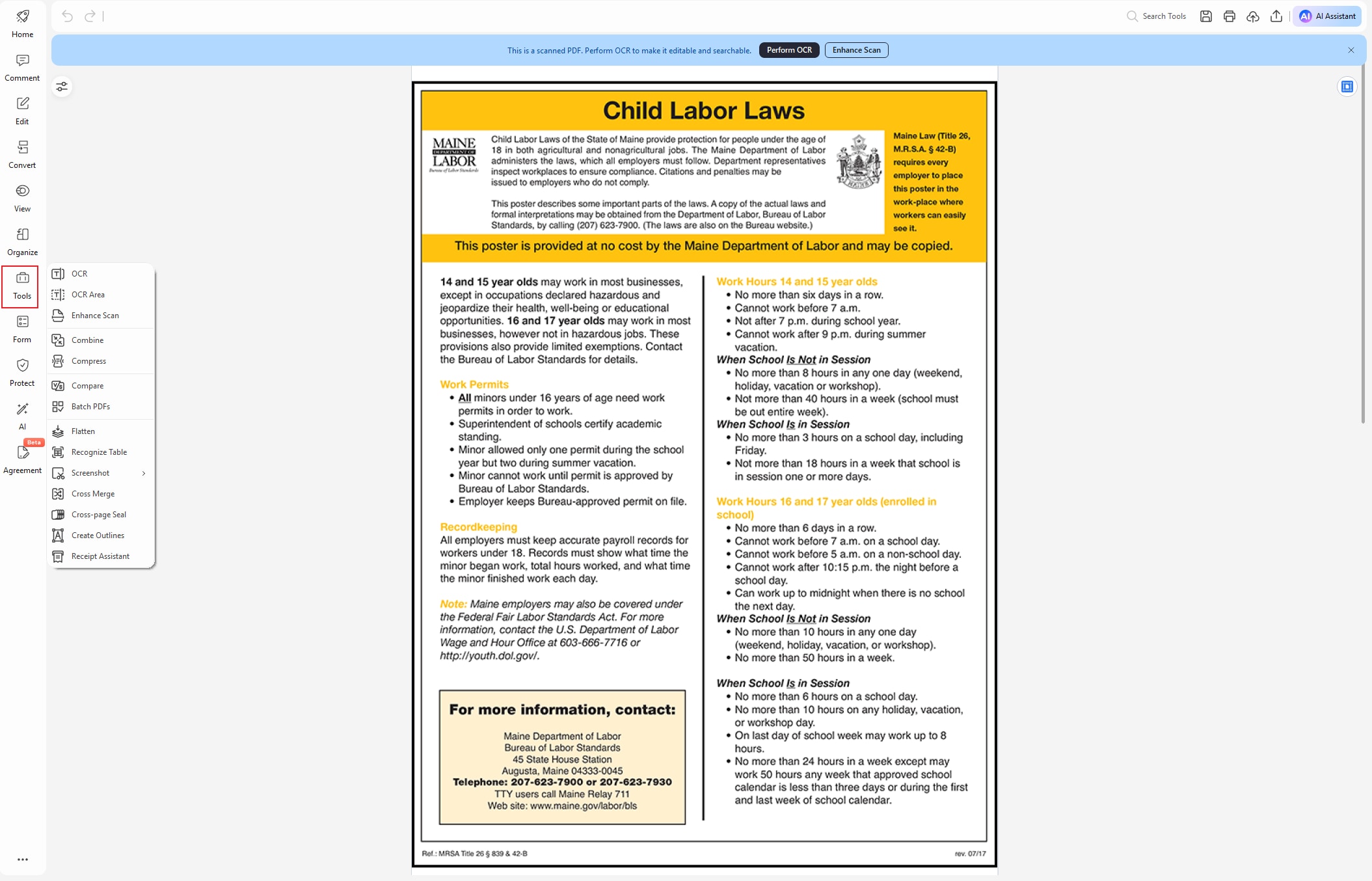
Once the PDF is open, go to Tools > OCR to start the OCR process.
Step 3. Select the OCR Output Type
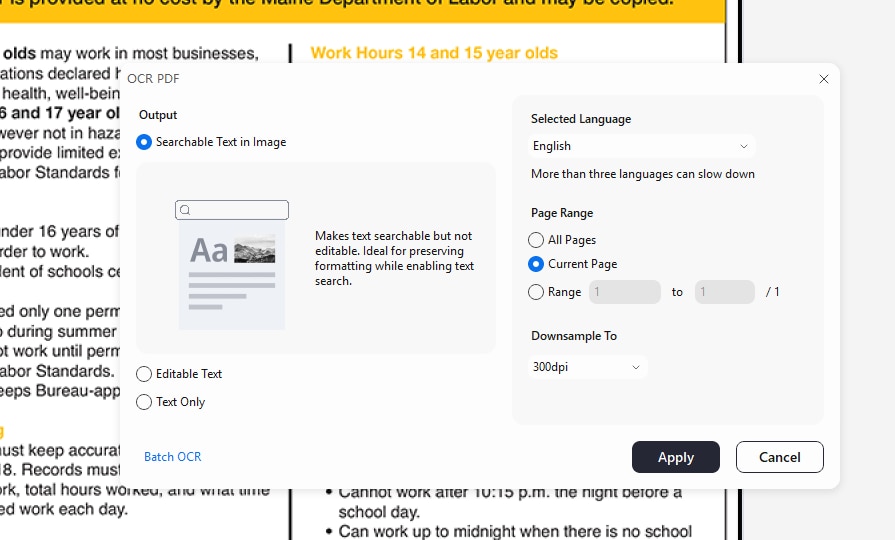
Select how you want the recognized content to be processed:
- Searchable Text: You can search for specific text using Ctrl+F while preserving the original PDF appearance.
- Editable Text: Recognize the text and make it editable.
- Text Only: Extract the recognized text only.
Step 4. Choose Language and Page Range
Choose the language used in your PDF and specify the page range you want to recognize.
Step 5. Apply OCR
After completing all the settings, click Apply to start OCR process.
2. Adobe Acrobat Pro
What is Adobe OCR? Adobe Acrobat Pro is one of the most famous PDF editors in the world, and it includes a powerful OCR engine. It excels at recognizing text accurately and integrating seamlessly with other Adobe Creative Cloud apps. While it is highly effective and widely used in corporate environments, its subscription pricing can be expensive for casual users.
3. ABBYY FineReader
What is ABBYY FineReader? ABBYY FineReader is an enterprise-grade OCR software renowned for its incredible accuracy and ability to support over 190 languages. It is heavily utilized by legal, academic, and corporate professionals who need to digitize massive archives of complex, multi-page documents with flawless layout retention.
4. OmniPage Ultimate
OmniPage Ultimate is another heavyweight in the OCR space, primarily focused on batch-processing large volumes of documents. It allows businesses to build custom workflows, automatically pulling scanned documents from network folders, applying OCR, and routing them to the correct digital destination.
5. Bluebeam Revu
What is Bluebeam OCR? Bluebeam Revu is a specialized PDF software used primarily in the architecture, engineering, and construction (AEC) industries. Its OCR tool is highly optimized for scanning large-format engineering drawings, blueprints, and CAD exports, allowing contractors to search for specific text or measurements within massive architectural plans.
Conclusion
Understanding what OCR is unlocks a new level of productivity for both personal and professional document management. Optical Character Recognition acts as the vital bridge between the physical and digital worlds. By transforming static images and paper clutter into dynamic, searchable, and editable text, OCR technology saves time, reduces errors, improves accessibility, and keeps your data organized.
Whether you are scanning a single receipt for your taxes or digitizing an entire library of corporate archives, investing in a reliable OCR software like PDFelement ensures your documents are always ready to work for you.
People Also Ask
-
What is OCR in PDF documents?
What is an OCR PDF? When you apply OCR to a PDF document, the software scans the flat, image-based pages of the PDF, recognizes the text within the images, and overlays a hidden, machine-readable text layer over the visual image. This transforms a "dead" PDF into a "searchable PDF," allowing you to highlight, copy, and search for specific words without altering the visual appearance of the document. -
What does "scan for OCR" mean?
If a printer or software prompts you to "scan for OCR," it means you are scanning a physical document with the specific intention of converting it into editable text. The scanner will often adjust its settings (such as increasing the DPI resolution and enhancing contrast) to capture the clearest possible image, ensuring the OCR software can read the characters accurately. -
What is an OCR file or OCR format?
There is no single "OCR file format." When people ask what is an OCR file, they are usually referring to the output document generated after the OCR process is complete. Common output formats include Searchable PDFs, Microsoft Word documents (.docx), plain text files (.txt), or Excel spreadsheets (.xlsx). -
Does OCR work on handwriting?
Yes, but standard OCR struggles with messy handwriting. To accurately read cursive or handwritten notes, you need a specialized form of OCR called Intelligent Character Recognition (ICR). ICR uses AI and machine learning to interpret different handwriting styles, though its accuracy still depends heavily on how legible the original writing is. -
What does OCR mean in computer terms?
OCR stand for in computer terminology is exactly the same: Optical Character Recognition. In computer science, it refers to the algorithmic process of using computer vision and pattern recognition to translate the pixel data of an image into standard text encodings (like ASCII or Unicode) that the computer's operating system can process natively.