

In this article
- Method 1: Convert InDesign to Word Using PDFelement (Best for Layout Preservation)
- Method 2: Export InDesign to Word via RTF (Best for Text Only)
- Method 3: Convert InDesign to Word Using Adobe Acrobat
- Method 4: How to Convert InDesign to Word Online
- Why Export InDesign to Microsoft Word? (Common Use Cases)
- Common Issues When Converting InDesign to Word (And How to Fix Them)
- Comparing the Conversion Methods (Summary Table)
- Frequently Asked Questions (FAQs)
If you have ever finalized a beautiful brochure, report, or flyer in Adobe InDesign, only to have a client or colleague ask, "Can you send this to me as a Word document?", you already know the frustration. You open your file, click "Save As," and realize that Microsoft Word (.docx) is nowhere to be found on the list of supported formats.
Adobe InDesign is the industry standard for page layout and desktop publishing, but it does not have a native feature to directly export InDesign to Word. Because the two programs handle text, images, and page geometry in fundamentally different ways, a simple one-click conversion doesn't exist.


 G2 Rating: 4.5/5 |
 100% Secure
In this comprehensive guide, we will walk you through every available method to get your InDesign content into Microsoft Word safely and accurately.
Method 1: Convert InDesign to Word Using PDFelement (Best for Layout Preservation)
If your goal is to maintain the visual integrity of your document—including columns, image placements, and styling—the most effective method is to use a PDF as a middleman. By exporting your InDesign layout as a PDF, you lock the design in place. From there, you can use a powerful document management tool like PDFelement to accurately translate that PDF into a fully editable Word document.
PDFelement is an excellent choice for this because of its advanced OCR (Optical Character Recognition) capabilities and its ability to reconstruct complex PDF layouts into Microsoft Word formats without scrambling the text.
G2 Rating: 4.5/5 |100% Secure
Step 1Export Your InDesign File as a PDF
Before you can convert the file, you need to get it out of InDesign.
- Open your document in Adobe InDesign.
- Navigate to the top menu and click File > Export (or press Ctrl+E on Windows / Cmd+E on Mac).
- In the "Save as type" (or "Format") dropdown menu, select Adobe PDF (Print).
- Name your file and click Save.
- The Export Adobe PDF dialog box will appear. For the best text conversion results, ensure your image compression isn't too low, and make sure that "Create Tagged PDF" is checked if you want to preserve structural reading order. Click Export.
Step 2Open the PDF in PDFelement
Now that you have a high-quality PDF version of your layout, it is time to convert it.
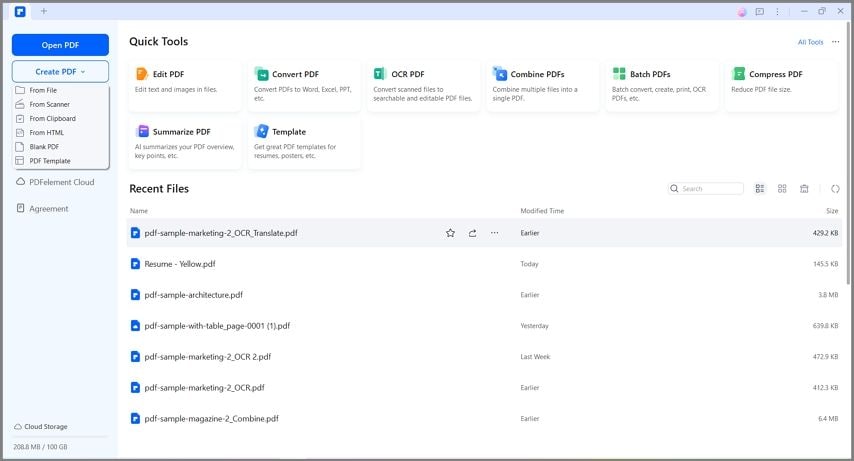
- Launch PDFelement on your computer.
- Click on "Open PDF" in the program's main window, or simply drag and drop your newly created PDF into the workspace to open it.
Step 3Convert the PDF to Microsoft Word
Once the file is open and you have verified that everything looks correct, you can initiate the conversion process.
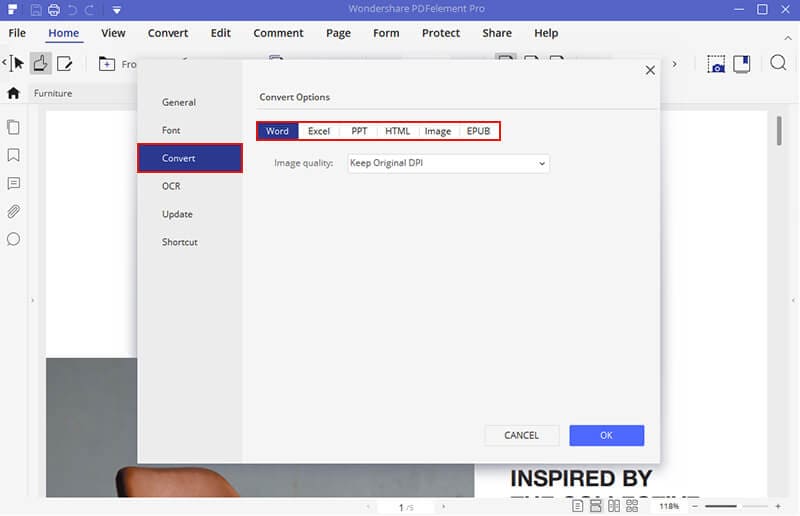
- In the main menu ribbon at the top, click on the Convert tab.
- Select the To Word button.
- A dialog box will appear, allowing you to choose the output folder where your new Word document will be saved.
- If your InDesign document contains flattened images with text, PDFelement may prompt you to perform OCR. Accept this prompt to ensure all text is editable.
- Click Convert.

G2 Rating: 4.5/5 |100% Secure
Method 2: Export InDesign to Word via RTF (Best for Text Only)
Sometimes, preserving the visual layout isn't necessary. If you are working with an editor, a copywriter, or a proofreader who only needs to revise the text—and you plan to re-import their edits back into InDesign later—the RTF (Rich Text Format) method is your best option.
RTF is a universal text format that retains basic formatting (like bolding, italics, and paragraph styles) but strips away complex page geometry, master pages, and high-resolution images. Because Microsoft Word opens RTF files natively, this is the most direct way to get text from InDesign to Microsoft Word.
Step-by-Step Guide for RTF Export
- Open your document in Adobe InDesign.
- Select the Type Tool (T) from your toolbar.
- Click inside the text frame that you want to export. If you have multiple connected (threaded) text frames, clicking inside one will allow you to export the entire story.
- Go to File > Export.
- In the format dropdown menu, select Rich Text Format (RTF).
- Choose a destination folder, name your file, and click Save.
- Locate the saved .rtf file on your computer, right-click it, and choose Open with > Microsoft Word.
- Once open in Word, you can click File > Save As and save it as a standard .docx file.
Method 3: Convert InDesign to Word Using Adobe Acrobat
If you already subscribe to the Adobe Creative Cloud suite, you likely have access to Adobe Acrobat Pro. Similar to the PDFelement method, Adobe Acrobat allows you to convert a PDF into a Word document. This keeps your workflow entirely within the Adobe ecosystem.
How to Use Acrobat for the Conversion
- Export to PDF: Open InDesign, go to File > Export, and save your document as an Adobe PDF (Print).
- Open in Acrobat: Launch Adobe Acrobat Pro and open the PDF you just exported.
- Export to Word: In the right-hand pane, click on the Export PDF tool.
- Choose Format: Select Microsoft Word as your export format, and then select Word Document.
- Adjust Settings (Optional): Click the gear icon to choose between retaining page layout or prioritizing flowing text.
- Save: Click Export, name your file, and save it.
Method 4: How to Convert InDesign to Word Online
If you are working on a borrowed computer or simply in a rush, you may want to convert InDesign to Word online. It is important to note that there are almost no online tools that accept native .indd files directly.

Steps to Use an Online Converter
- Export your InDesign file as a PDF (File > Export > Adobe PDF).
- Navigate to a reputable online PDF to Word converter (such as Adobe's free online tool, HiPDF, or Smallpdf).
- Upload your PDF to the platform.
- Select Word (.docx) as your desired output format.
- Click Convert and download the final file to your hard drive.
Why Export InDesign to Microsoft Word? (Common Use Cases)
Understanding why you are moving from InDesign to Word can help you choose the best conversion method.
Client Reviews and Approvals
Many clients do not own Adobe Creative Cloud licenses. Providing a Word document empowers the client to use tools they are familiar with to add comments or track changes.
Copywriting and Editing Workflows
By exporting a layout to Word, a copywriter can see the exact spatial constraints they need to write for and insert their copy directly into the approximated layout.
Accessibility and Universal File Sharing
Word documents are versatile. They can be imported into accessibility screen readers or parsed by various content management systems (CMS), making information accessible to a wider audience.
Common Issues When Converting InDesign to Word (And How to Fix Them)
Translating a layout from professional design software to a standard word processor is rarely flawless.
Lost Formatting and Shifting Layouts
The Problem: Images are on the wrong pages or text boxes overlap.
The Fix: Try simplifying your layout before exporting. Lock your layers and remove unnecessary transparent background elements. Choose "Retain Page Layout" in your conversion settings.
Missing Fonts
The Problem: Typography defaults to Times New Roman or Calibri in Word.
The Fix: Ensure the recipient has the fonts installed, or change the fonts in InDesign to standard system fonts (like Arial) prior to exporting.
Image Resolution Drops
The Problem: Photos look blurry in the Word document.
The Fix: Select High Quality Print when exporting your PDF from InDesign to ensure images are not downsampled below 300 PPI.
Comparing the Conversion Methods (Summary Table)
| Feature | PDFelement Method | RTF Method (Text Only) | Adobe Acrobat | Online Converters |
|---|---|---|---|---|
| Maintains Layout | Yes, excellent accuracy | No | Yes, good accuracy | Varies (often struggles) |
| Maintains Images | Yes | No | Yes | Yes (quality may drop) |
| Requires Software? | Yes (PDFelement) | No (Built-in) | Yes (Acrobat Pro) | No (Web browser only) |
| Data Security | High (Local) | High (Local) | High (Local) | Low (Cloud upload) |
G2 Rating: 4.5/5 |100% Secure
Frequently Asked Questions (FAQs)
-
How do I copy and paste from InDesign to Word?
Highlight the text in InDesign using the Type Tool, press Ctrl+C, and paste into Word with Ctrl+V. Note that this only copies text and basic character formatting, not images or layouts. -
Can I convert an INDD file to Word without InDesign?
No, you cannot convert an INDD file directly without the software. You must ask the sender to provide a PDF, which you can then convert using PDFelement or an online tool. -
What is the best format to export from InDesign for text editing?
The Rich Text Format (RTF) is the best option if the layout doesn't matter. It is natively supported by Word and retains text styles while being lightweight. -
Does exporting to Word keep my master pages and styles?
No. Elements on master pages are typically converted into static headers or fixed background images, and complex InDesign style linkages will be broken.
![All the Methods to Convert a PDF to Black and White [2026]](https://images.wondershare.com/pdfelement/images2026/pdf-like-article-3.png)