
How to Convert PDF to PDF/A: 4 Easy Methods
Learn how to convert PDF to PDF/A for long-term archiving. Explore PDF/A standards, conversion steps with PDFelement, and validating PDF/A files.
 100% Secure |
 Powered by AI
 Home
>
PDF Converter
> How to Convert PDF to PDF/A: 4 Easy Methods
Home
>
PDF Converter
> How to Convert PDF to PDF/A: 4 Easy Methods
When handling PDF files at work or home, you may notice that some files cannot be opened by some of the latest document programs. In that case, you should ensure that your PDF files are compatible with different browsers and the emerging applications by optimizing them to a standard format known as PDF/A. In case the term PDF/A is new to you, there is no need to worry. This article defines PDF/A to you. It also describes Wondershare PDFelement - PDF Editor Wondershare PDFelement Wondershare PDFelement you can use to convert PDF to PDFA and the steps that you need to follow.


 G2 Rating: 4.5/5 |
 100% Secure
Part 1. What is PDF/A Format?
PDF/A is an ISO-standardized subset of PDF designed. Its core purpose is indeed long-term preservation; both ISO 19005 and the PDF Association explicitly define PDF/A as a standard for the long-term preservation of electronic documents.It places additional requirements on files so that their visual appearance and required document information can be preserved over time, regardless of changes in software or systems.
PDF/A is different from PDF:
| Format | Main Purpose | Key Difference |
| General document sharing and viewing | Supports a wide range of PDF features | |
| PDF/A | Long-term preservation and archiving | Restricts features that may affect long-term reproducibility |
PDF/A standards can be understood from two perspectives: the PDF/A version and, for earlier versions, the conformance level. Each PDF/A version is based on a specific version of the PDF specification and defines different requirements for long-term document preservation.
1. PDF/A Versions
There are four main PDF/A versions: PDF/A-1, PDF/A-2, PDF/A-3, and PDF/A-4. Each was developed to support different PDF capabilities while maintaining requirements for long-term preservation.
- PDF/A-1 — Based on PDF 1.4 and published in 2005, PDF/A-1 is the original PDF/A standard. It has relatively strict requirements and does not support features such as transparency, audio, and video.
- PDF/A-2 — Based on PDF 1.7 and published in 2011, PDF/A-2 supports more modern PDF features, including transparency, JPEG 2000 compression, layers, and embedded OpenType fonts. It can also contain other PDF/A documents as embedded files.
- PDF/A-3 — Also based on PDF 1.7 and published in 2012, PDF/A-3 retains the features of PDF/A-2 while allowing files in arbitrary formats to be embedded in the PDF/A document. This makes it useful for workflows involving associated files, such as electronic invoices and other business records.
- PDF/A-4 — Based on PDF 2.0 and published in 2020, PDF/A-4 introduces a revised conformance model and simplifies the classification system used by earlier PDF/A versions. It is designed for newer PDF 2.0-based workflows.
2. PDF/A Conformance Levels
For PDF/A-1, PDF/A-2, and PDF/A-3, conformance is further divided into different levels. These levels specify how much information about the document must be preserved in addition to its visual appearance.
PDF/A Level B — Basic Visual Preservation
Level B focuses on the reliable visual reproduction of a document. A conforming PDF/A-B file is intended to preserve the document's visual appearance over time.
Common designations include:
- PDF/A-1b
- PDF/A-2b
- PDF/A-3b
PDF/A Level A — Enhanced Accessibility and Structure
Level A includes the requirements of Level B while adding requirements for document structure and semantic information. For example, the document must contain appropriate logical structure information and reliable text representations.
Common designations include:
- PDF/A-1a
- PDF/A-2a
- PDF/A-3a
Level A can provide additional benefits for document accessibility, text processing, and content reflow. However, PDF/A Level A should not be confused with PDF/UA, which is a separate standard specifically focused on PDF accessibility.
PDF/A Level U — Unicode Text Mapping
Level U was introduced with PDF/A-2 and PDF/A-3. It includes the visual preservation requirements of Level B and adds requirements for reliable Unicode mapping of text.
This helps ensure that text can be reliably searched, copied, and processed while not requiring the full structural requirements of Level A.
Common designations include:
- PDF/A-2u
- PDF/A-3u
3. PDF/A-4 and Its Conformance Categories
PDF/A-4 uses a different classification system from PDF/A-1, PDF/A-2, and PDF/A-3. The traditional A, B, and U conformance levels are not used for PDF/A-4.
Instead, PDF/A-4 is divided into the following categories:
- PDF/A-4 — The general-purpose PDF/A-4 conformance category for long-term preservation of PDF 2.0 documents.
- PDF/A-4e — The engineering-oriented category, designed for documents containing engineering information and 3D content. It is intended for workflows that need to preserve engineering documents and interactive 3D models.
- PDF/A-4f — The file-attachment category. It allows files in other formats to be embedded within the PDF/A document, extending the concept introduced by PDF/A-3.
Part 2. How to Convert PDF to PDF/A Offline
If you need to convert a PDF for long-term archiving, an offline PDF/A converter can be a practical option, especially when you are working with confidential or sensitive documents. Instead of uploading files to an online service, you can process them directly on your computer.
There are several ways to create a PDF/A file from an existing PDF. For example, you can convert the PDF directly to PDF/A, or edit the document first and then save it in a PDF/A-compliant format. Wondershare PDFelement supports both workflows, making it possible to prepare and convert your PDF in the same application.
Follow the steps below to learn how to convert a PDF to PDF/A with PDFelement.
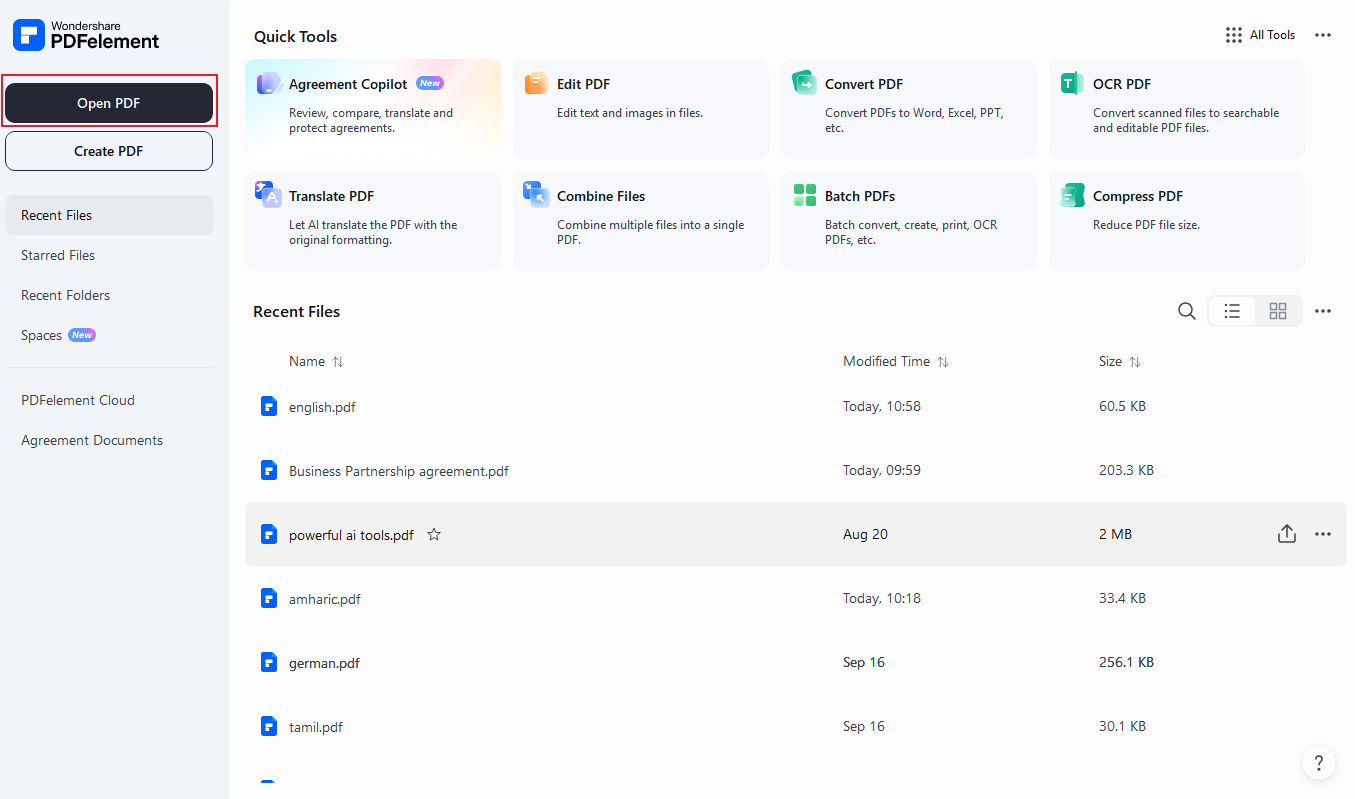
Step 1. Open PDF File
Open PDFelement on your computer. On the home window, you'll see some useful tabs displayed on it. Click on the "OpenPDF" button and choose the PDF document as you want to convert and select "Open"
Step 2. Convert to PDF/A Format
Next, go to the menu bar and select "Convert" and then click the "To PDF/A" button.
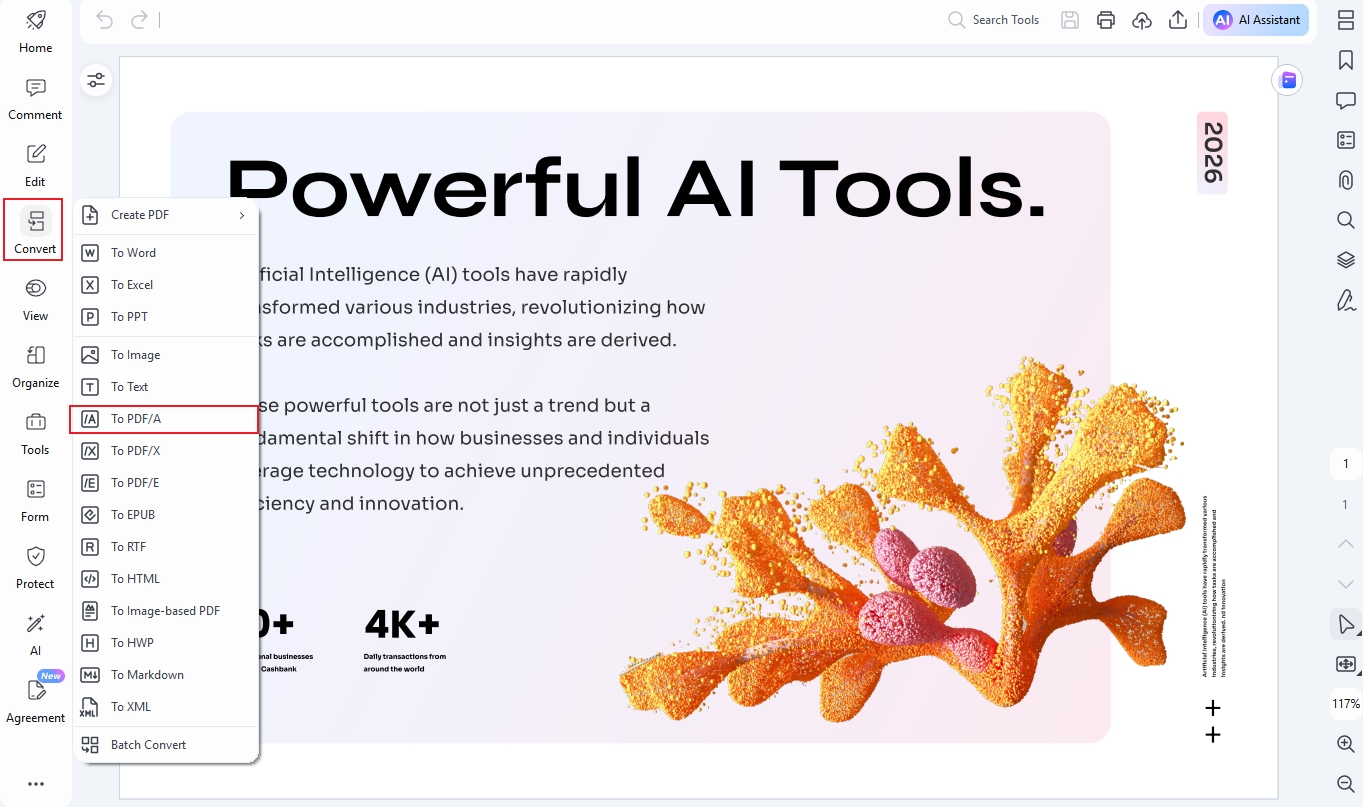
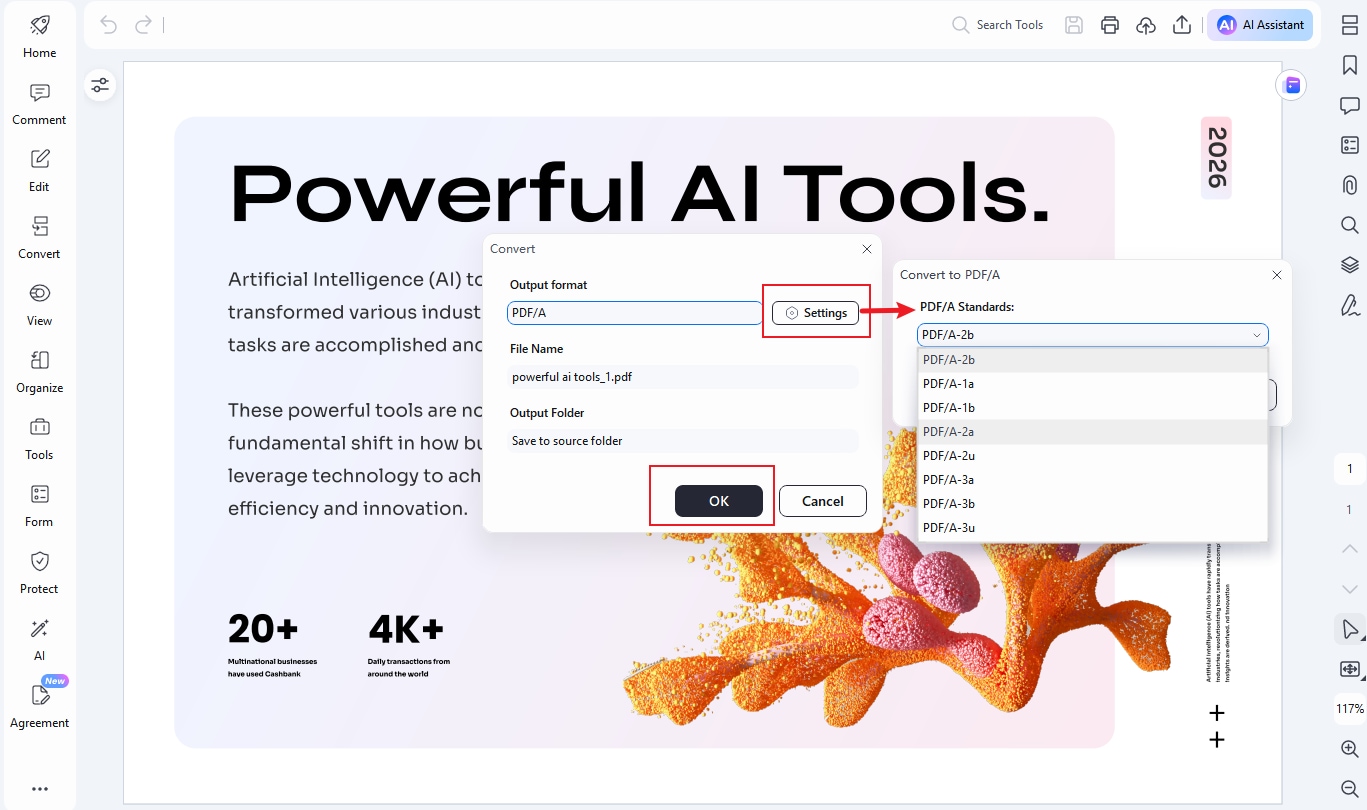
Step 3. Convert to PDF/A Format
Then,click "Settings" to select the required PDF/A standard, specify the file name and save location, and then click "OK".
PDFelement is the perfect solution for saving PDF as PDF/A format. The tool has a variety of editing options that allow you to edit your PDF before you save it as PDF/A. For instance, you can add some text, cut, or delete some text from your PDF before the conversion. Besides, this tool allows you to scan and convert image-based files using OCR technology. The OCR feature supports more than 40 languages which can totally meet your need.
It is also a PDF creator that converts images, Office documents, text, and HTML to PDF. It can also split large PDFs or merge multiple PDFs into a single PDF. You can also use it to add electronic and digital signatures to your PDF. More so, it can encrypt your PDF with passwords for permission restrictions. Lastly, it is a PDF viewer that supports the viewing of PDFs with preferred layout settings.
G2 Rating: 4.5/5 |100% Secure
Part 3. How to Convert PDF to PDF/A Online
If you prefer not to install desktop software, an online PDF/A converter can provide a simpler way to convert your files directly in a web browser. This can be useful when you only need to convert a few PDFs or want to complete the conversion from different devices.
Xodo's online PDF to PDF/A Converter, powered by Apryse, allows you to upload a PDF, choose a PDF/A standard, and download the converted file without installing additional software.
Step 1. Open the Xodo PDF to PDF/A Converter
Open Xodo's online PDF to PDF/A Converter in your web browser.
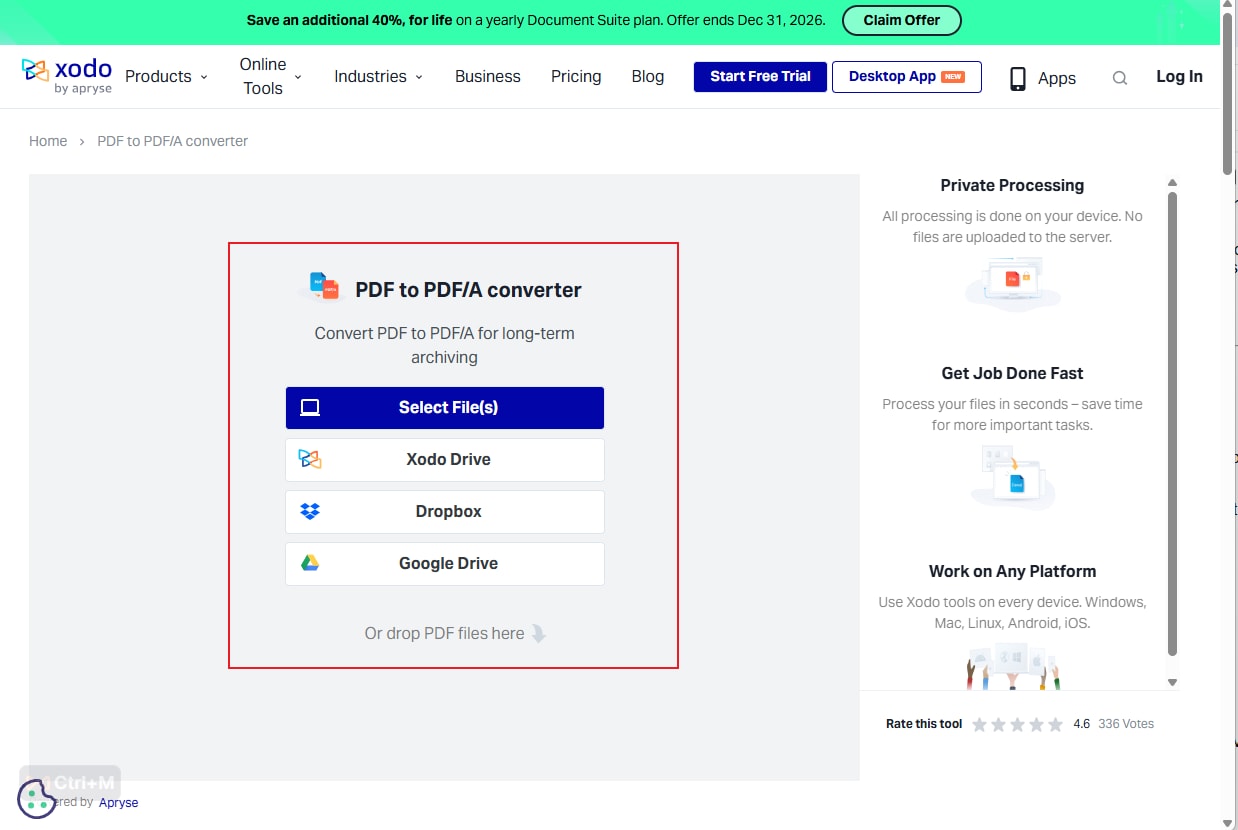
Step 2. Upload Your PDF
Upload the PDF file you want to convert. You can select a file from your device or drag and drop it into the converter.
Step 3. Choose a PDF/A Standard
Choose the PDF/A standard you need. Xodo currently supports PDF/A-1, PDF/A-2, PDF/A-3, and PDF/A-4 conversion. If your workflow requires a specific conformance level, check the available options before starting the conversion.
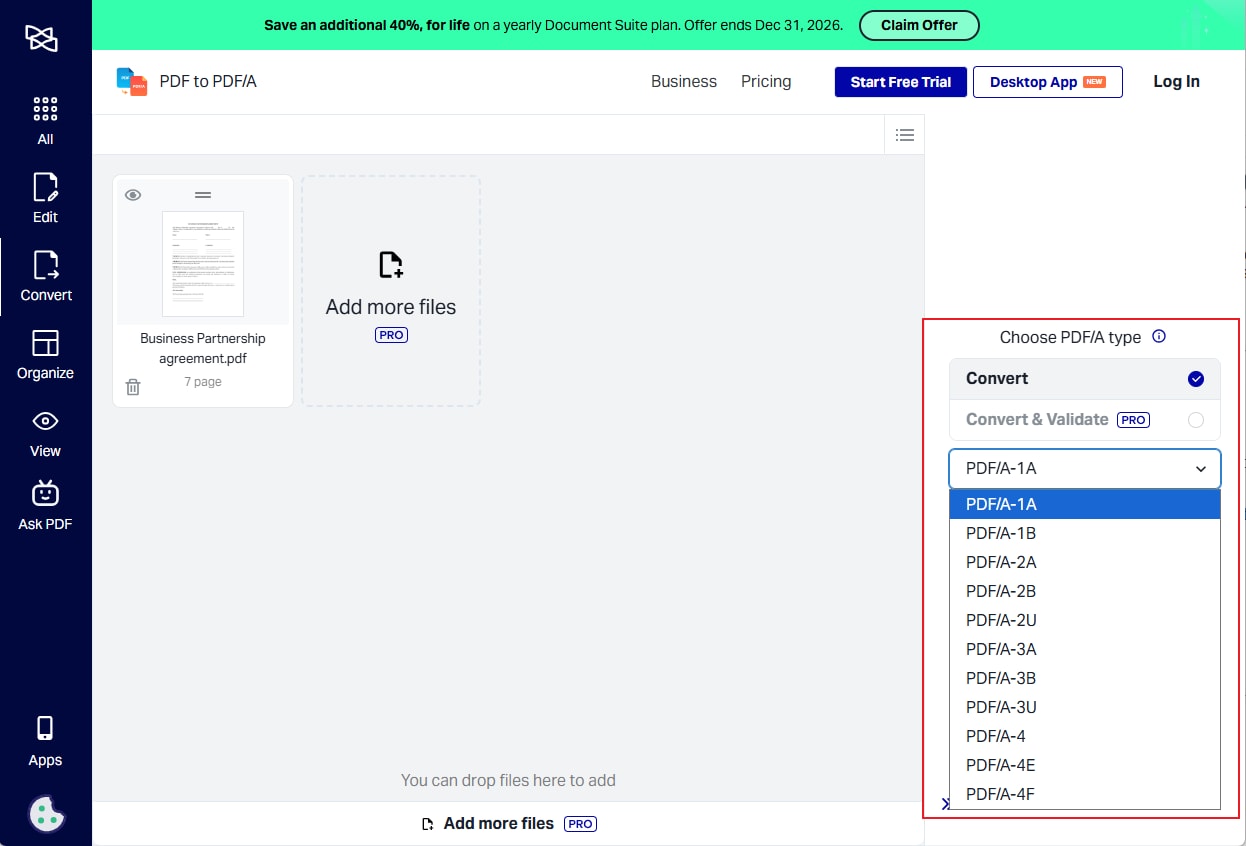
Step 4. Convert the PDF
Click Convert to start the conversion. Xodo will create a PDF/A version of your document based on the selected standard.
Step 5. Download the PDF/A File
Once the conversion is complete, download the PDF/A file to your device.

Part 4. Convert to PDF/A with Microsoft Word
In case you are using a Windows system and do not want to download any additional software, you can use Microsoft Word to convert the files. In this section, we are going to tell you how you can save your document in PDF/A document using Microsoft Word. So, let's proceed.
Step 1. Open the Document
Open the document you want to save as PDF/A in Microsoft Word. Go to File > Save As or File > Save a Copy, then select PDF from the file type dropdown.
Step 2. Open PDF Options
Select More Options > Options to open the PDF export settings. Under PDF options, select ISO 19005-1 compliant (PDF/A).
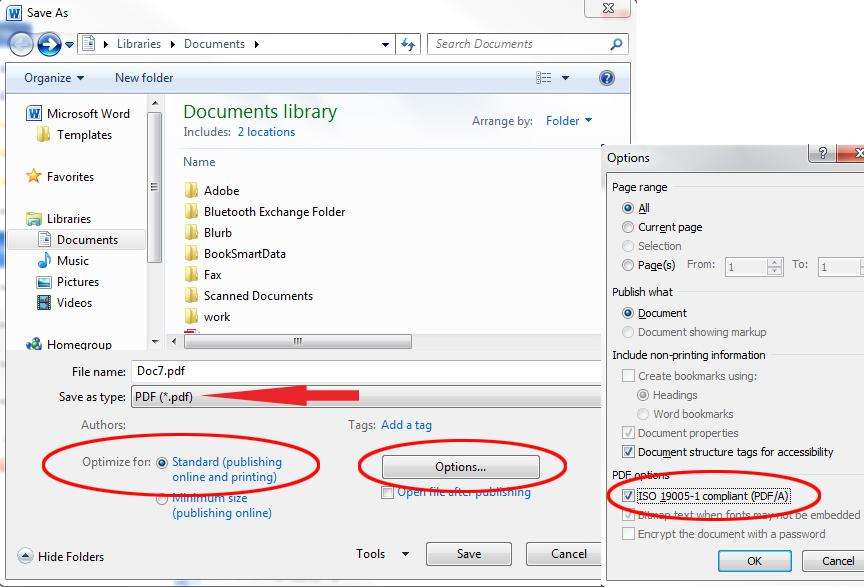
Step 3. Save the PDF/A File
Click OK, return to the Save As dialog, and select Save to create the PDF/A file.
Part 5. How to Validate a PDF/A File
Converting a PDF to PDF/A and validating a PDF/A file are two different steps. A PDF/A converter creates a file in the PDF/A format, while a validator checks whether the resulting file actually conforms to the requirements of the selected PDF/A standard and conformance level.
This distinction is important because a .pdf file extension or a PDF/A export option alone does not confirm PDF/A compliance. If your workflow requires formal conformance, especially when a document is being submitted to an archive or organization with specific PDF/A requirements, it is recommended to validate the converted file before submission or long-term preservation.
To validate a PDF/A file, use a PDF/A validation tool and check the validation result against the PDF/A version and conformance level required for your workflow. For example, you can use veraPDF to check whether your converted file conforms to the relevant PDF/A requirements.
In general, the validation process is straightforward: select the converted PDF/A file, run the validation check, and review the results. If the file fails validation, review the reported issues, make the necessary changes to the source document or conversion settings, and validate the file again.
Free Download or Buy PDFelement right now!
Free Download or Buy PDFelement right now!
Try for Free right now!
Try for Free right now!
Audrey Goodwin
chief Editor