
Table of Contents
A white page is not always the best PDF background. You may want a pale cream background for easier reading, a branded color for a proposal, or a clean white background to replace a dark or textured page before printing. The tricky part is that PDFs are not edited like Word documents. A “background” may be a real editable page background, a colored shape behind the text, part of a scanned image, or just a display setting in your PDF viewer.
That is why the right method depends on the PDF you have. If the file is editable, a PDF editor can usually add, update, or remove the background cleanly. If it is scanned, you may need OCR or image cleanup first. If you only want the PDF to look different on your own screen, a viewer accessibility setting may be enough, but it will not change the actual file.
This guide walks through the practical ways to change background color of PDF files on Windows, Mac, and online, plus the issues that usually cause poor results.


 G2 Rating: 4.5/5 |
 100% Secure
Why PDF Background Color Changes Are Not Always the Same
Before choosing a tool, it helps to know what you are actually changing. Two PDFs can look similar on screen but be built very differently.
In an editable PDF, the page may contain text, images, shapes, headers, footers, and a separate background layer. Changing the background color is usually straightforward because the editor can place a new color behind the page content or update an existing background layer.
In a scanned PDF, each page is often one large image. The “background” is not a separate PDF element; it is baked into the page image. If the scan has yellow paper, gray shadows, or a dark page, a normal PDF background tool may not fix it because there is no separate background to select. In that case, you may need OCR, image enhancement, or conversion before editing.
There is also a third case: viewer-only color changes. Some PDF readers let you replace document colors for easier reading. This can make a PDF appear with a different background color on your screen, but it does not change the file for other people. If you email or print the PDF, the original background may still appear.
A real PDF background color change is best when you need the saved file itself to have a new page color. That is the workflow covered in most of the steps below.
How To Change Background Color of PDF on Windows
For Windows users, a dedicated PDF editor is usually the most reliable way to change the page background without disturbing the text layout. Wondershare PDFelement is a practical option because it includes background editing along with the related tasks people often need afterward: editing text, converting files, running OCR, adding comments, compressing a finished PDF, and organizing pages.
The steps below focus on changing the actual PDF background color, not just changing how it displays in a viewer.
Step 1. Open the PDF in PDFelement
Launch PDFelement and open the PDF you want to edit. You can use the Open files option from the home screen, or drag the PDF into the workspace if that is easier.
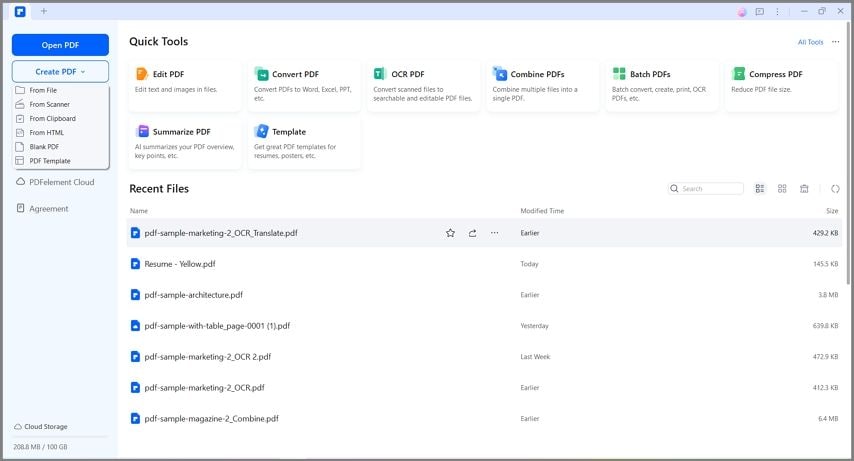
Before editing, quickly scroll through the document. Check whether every page has the same background and whether the file contains scanned pages. If the text is selectable, the PDF is more likely to respond well to background editing. If the whole page selects as a single image, you may be dealing with a scan.
Step 2. Choose the Background Tool
After the PDF opens, go to the Edit tab and find the Background option. Depending on the version and the file, you may see options such as adding a new background, updating an existing background, or removing one.
If the PDF already has a colored background and you want to replace it, choose Update Background. If the PDF has no background layer and you want to add one, choose the add background option.
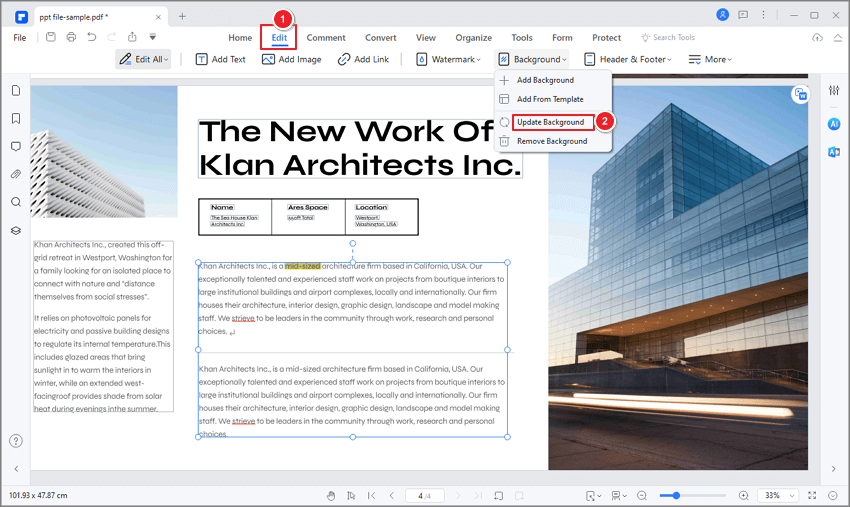
This distinction matters. Adding a new background on top of a file that already has a colored shape or image behind the text may not remove the old color. If the original color is part of the page content, you may need to select and delete that object or use another editing approach.
G2 Rating: 4.5/5 |100% Secure
Step 3. Select the New Background Color
In the background settings window, choose a color from the color picker. For readability, subtle colors usually work better than saturated ones. Pale gray, warm beige, soft blue, or white are safer choices for long documents than bright yellow, dark red, or strong green.
You can usually preview the result before applying it. Use the preview carefully. Look at headings, footnotes, hyperlinks, tables, and any light-colored text. A background that looks fine behind black body text may reduce contrast in charts or callout boxes.
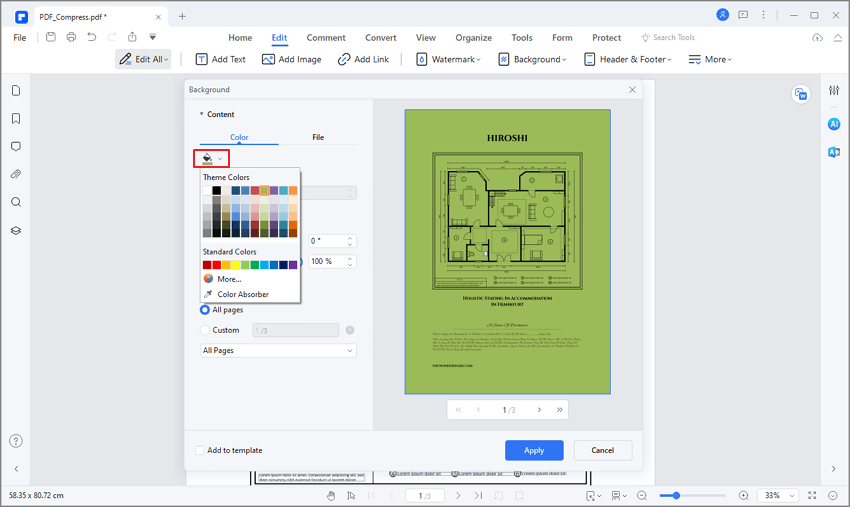
If your editor includes opacity controls, keep the background subtle unless you intentionally want a strong design effect. Low opacity can help when you are adding a tint behind existing content. Full opacity is better when you need a solid page color, such as changing the PDF background to white.
Step 4. Apply the Color to the Right Pages
Many PDFs do not need the same background on every page. A cover page may have its own design, while the body pages need a plain white or light background. In the background settings, check the page range before applying the change.
For example, you might apply the new background only to pages 2–20 and leave page 1 unchanged. This is useful for reports, brochures, manuals, and proposals where the cover layout is more visual than the interior pages.
After applying the background, scroll through the PDF again. Do not check only the first page. Look at pages with images, tables, signatures, stamps, and form fields. Those elements are where background changes most often create visibility problems.
Step 5. Save the Edited PDF
When the result looks right, save the file. If this PDF is important, use Save As instead of overwriting the original. A separate copy gives you a fallback if you later notice that a page range, watermark, or scanned page did not update as expected.
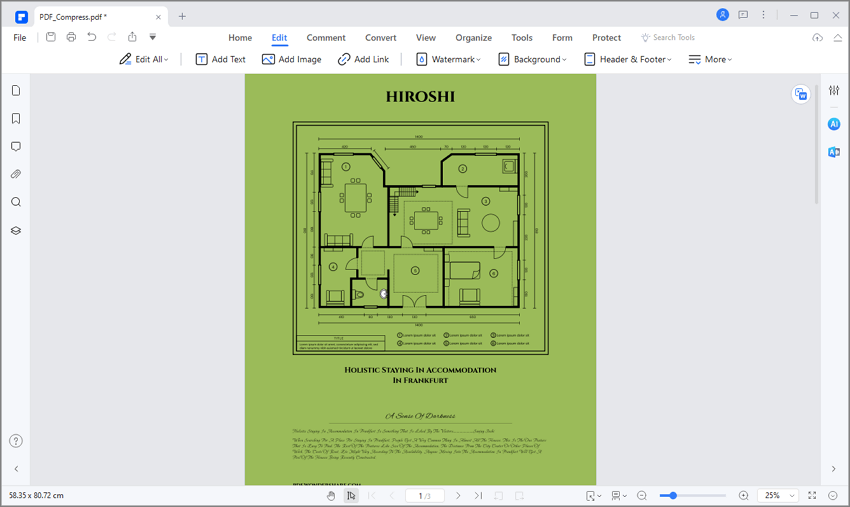
This is also a good moment to handle follow-up PDF tasks. For example, if you changed the background before sending a contract, you may want to compress the file, add a signature field, or protect it with a password. If you changed the background for a handout, you may want to run a quick print preview and check margins before sharing.
How To Change PDF Background Color on Mac
The Mac workflow is similar, but the menu names are slightly different. PDFelement for Mac lets you add or edit a PDF background from the tools area, then apply the change to the document.
G2 Rating: 4.5/5 |100% Secure
Step 1. Open the PDF File
Open PDFelement for Mac and import the PDF you want to edit. You can select the file from the open dialog or drag it into the app.
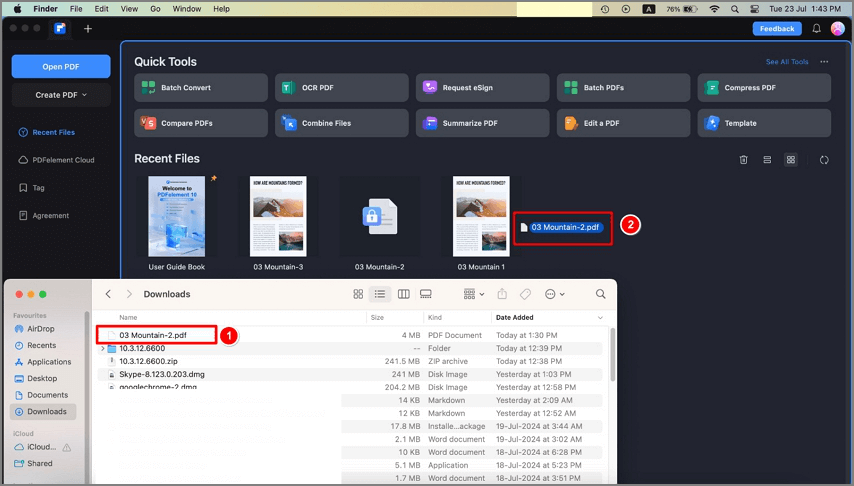
As with Windows, take a moment to identify the type of file. If it is a designed PDF with selectable text, background editing is usually simple. If it is a scan of paper, the background color may be embedded in the image.
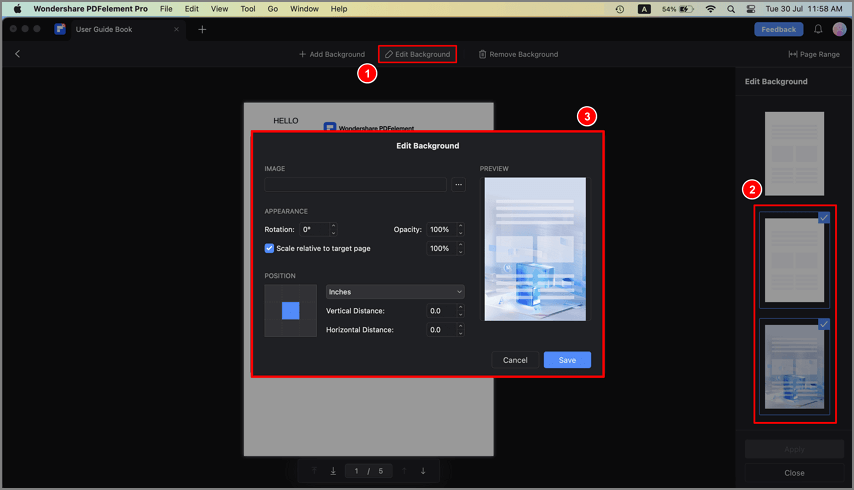
Step 2. Open Add or Edit Background
Go to the Tool tab and choose Add or Edit Background. This opens the background editing panel, where you can create a new background style or edit an existing one.
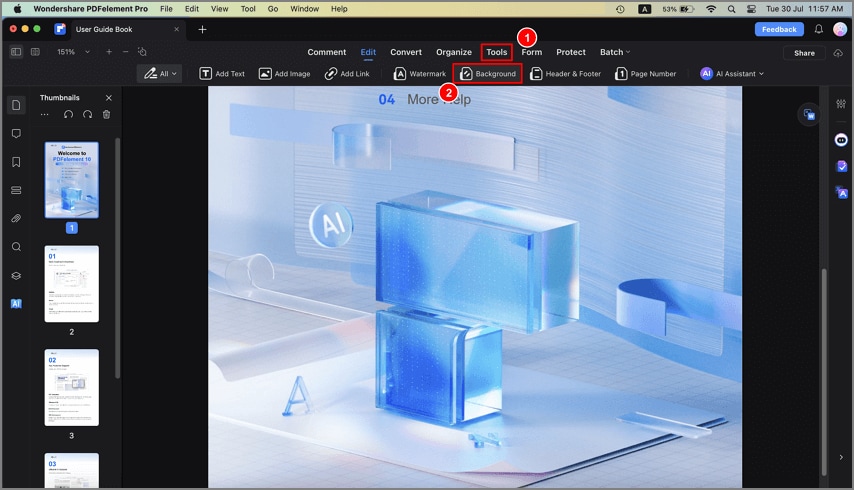
If there is an existing background template, use the edit option rather than stacking a new background over it. Stacking backgrounds can make the page look darker or cause uneven color if transparency is involved.
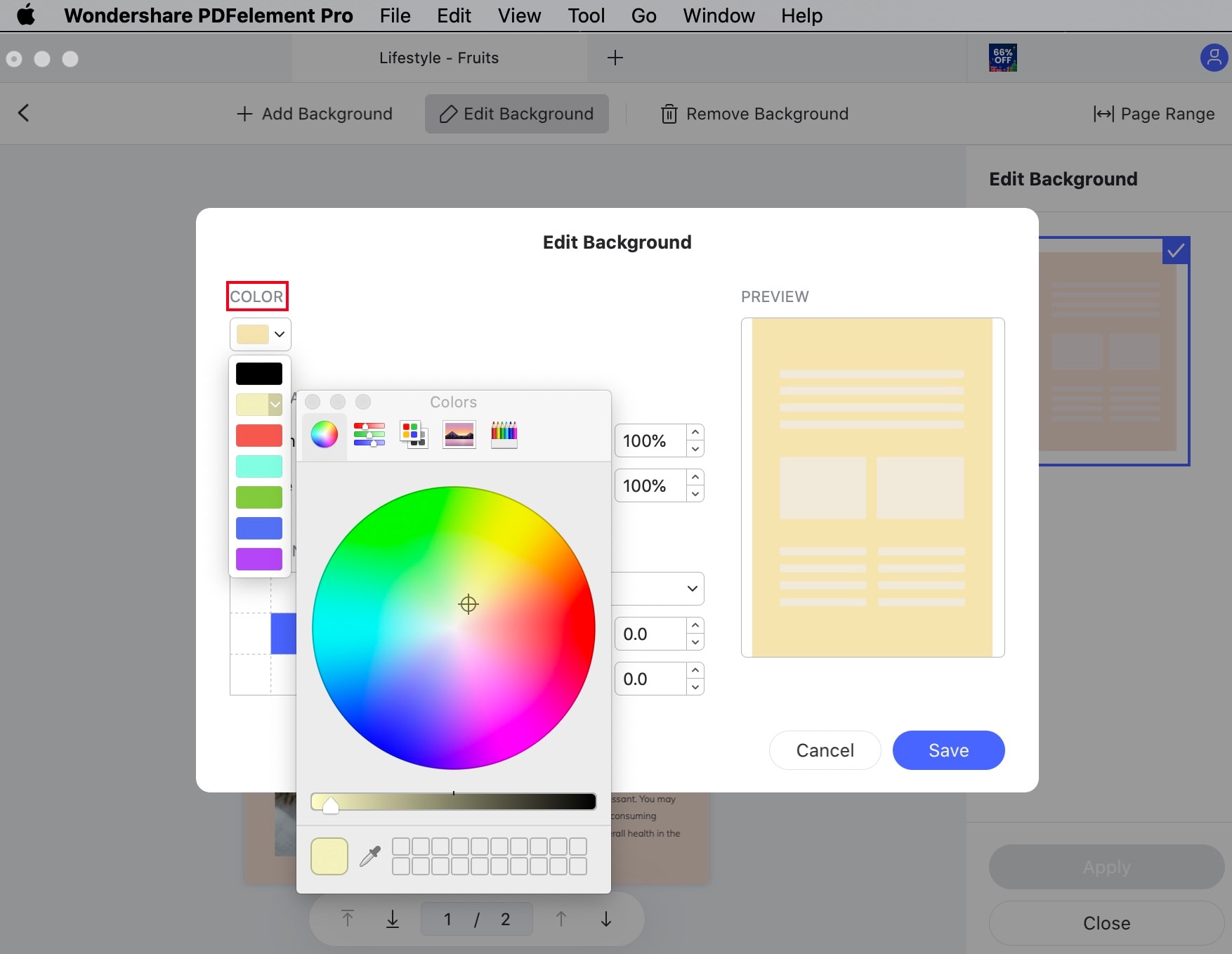
Step 3. Edit the Background Color
Select the background template and click the edit icon. In the color section, choose the new color you want to apply.
For professional documents, avoid choosing a background based only on appearance at full zoom. Zoom out to page view and zoom in to 150% or 200%. This helps you catch low-contrast text, small table labels, and light gray lines that may disappear against the new background.
Step 4. Apply and Save
After choosing the color, save the background setting and apply it to the PDF. Then save the document itself.
If the PDF will be printed, test one page before printing the full document. Background colors can look noticeably different on paper, especially if the chosen color is pale on screen but prints with a gray or yellow cast.
How To Change PDF Background Color Online
A PDF background color change online can be convenient when you only need a quick edit and do not want to install software. Browser-based methods work best for simple files, short documents, and non-sensitive content.
There are two common online approaches: using Google Docs as a workaround or using an online PDF editor.
Option 1. Use Google Docs for Simple PDFs
Google Docs can change page color, but it is not a true PDF editor. It works by opening or converting the PDF into an editable document-like format. That means the layout may change, especially in files with columns, complex tables, forms, headers, footers, or many images.
Use this method only when the PDF is simple and you do not mind checking the formatting afterward.
Open Google Drive, upload the PDF, and open it with Google Docs. Once the document is open, go to File > Page setup. In the page setup window, choose a new page color and confirm the change.
You can read Google’s own documentation on page setup and document formatting in the Google Docs Editors Help Center.
After changing the color, export the file again as a PDF. Then open the exported PDF and compare it with the original. Pay attention to page breaks, fonts, spacing, and image positions. If the file is a resume, contract, academic paper, or designed report, this extra check is not optional.
Option 2. Use an Online PDF Editor
Some online PDF editors let you upload a file and add a colored background directly. This is closer to a real PDF editing workflow than converting through Google Docs. It may be enough for a small PDF where privacy is not a concern.
The usual process is simple: upload the PDF, choose a background or page color tool, select a color, apply it to the page range, and download the edited PDF. The quality depends on the tool and on how the original PDF is built.
Online tools are less ideal for confidential documents. If the PDF contains client records, contracts, IDs, financial data, internal reports, or student information, use a desktop editor instead. Adobe’s security overview on protecting PDFs is a useful reminder that document handling matters, especially when files contain sensitive information.
When Online Background Changes Are a Bad Fit
Online methods are not wrong; they are just limited. They can struggle with large PDFs, layered designs, scanned pages, password-protected files, and documents that need exact formatting.
A browser tool is fine for a one-page flyer or a simple reading copy. For legal documents, brand materials, files with signatures, or anything you need to preserve exactly, a desktop PDF editor is safer.
Fixes for Common PDF Background Color Problems
Changing the background seems simple until the edited file looks worse than the original. Most problems come from layering, contrast, page range settings, or scanned content.
The New Background Covers the Text
If the background appears on top of the text, the new color may have been added as a foreground object rather than a background layer. Undo the change and use the dedicated background function instead of drawing a colored rectangle over the page.
If you must use a shape, send it behind the text or reduce its opacity. For a final document, a true background layer is cleaner and less likely to interfere with selection, copying, or printing.
Only Some Pages Changed
This is usually a page range issue. Reopen the background settings and check whether the change was applied to the full document, selected pages, odd pages, even pages, or a custom range.
Some PDFs also contain mixed page sizes or sections with different templates. In that case, you may need to apply the background in batches. For example, apply one setting to portrait pages and another to landscape pages.
The PDF Background Will Not Change
If nothing changes, the “background” may not be a PDF background at all. It may be a large image, a scanned page, or a colored object placed behind the text.
Try selecting the page content in edit mode. If the page acts like one big image, use OCR or image editing tools first. PDFelement can help in this kind of workflow because OCR can turn scanned text into editable or searchable content, while PDF editing tools can handle the document after cleanup. The background of the scan itself may still need enhancement, but OCR makes the file much easier to work with afterward.
The Background Looks Different When Printed
Screens and printers do not reproduce color the same way. A soft gray background on screen may print darker than expected. A cream background may look yellow. A pale blue background may reduce readability under office lighting.
If printing is the goal, test one page first. For long documents, consider changing the background to white instead of adding color. White saves ink, improves text contrast, and avoids color shifts across different printers.
The PDF Has a Dark Background and Light Text
Changing only the background may make light text unreadable. For example, if a PDF uses white text on a black page, changing the background to white will cause the text to disappear unless you also change the text color.
In that case, you need a broader edit: change the background, then adjust text and line colors. This is where a full editor is better than a quick background changer. Review headings, captions, icons, and chart labels carefully.
Best Practices Before You Save or Share the PDF
A good background change should make the PDF easier to read, print, or present. It should not create new problems for the person receiving the file.
Use high contrast. Dark text on a light background is still the safest choice for most documents. If you are choosing a colored background for reading comfort, keep it pale. A warm off-white can be easier on the eyes than pure white without harming readability.
Think about accessibility, too. Color choices affect people with low vision or color sensitivity. The Web Content Accessibility Guidelines are written mainly for web content, but the basic contrast principles are useful for PDFs as well. If the document is important, do not rely on color alone to separate sections or highlight warnings.
Keep a clean original copy. Background changes are usually easy to make, but PDFs can contain hidden complexity: layers, form fields, embedded images, annotations, and permissions. Saving a new version protects you from accidental changes.
Before sending the final PDF, check these details:
Text remains readable on every page, including footnotes, links, charts, and captions.
The background applies only where intended, not to the cover or pages with full-page images.
The file still prints correctly and does not waste unnecessary ink.
Form fields, comments, stamps, and signatures remain visible.
The file size is still reasonable after editing.
If the PDF is part of a larger workflow, PDFelement can be useful beyond the background edit. For instance, after changing the background color of a PDF, you can compress the final file for email, convert it to Word for deeper revisions, add annotations for review, organize pages, or apply OCR to scanned sections. That matters because background color is often just one step in preparing a document for real use.
People Also Ask
-
Can I change a PDF background color for free?
Yes, but the best free method depends on the file. For a simple PDF, an online editor or Google Docs workaround may be enough. The trade-off is that formatting can shift, file size may be limited, and uploaded documents may not be suitable if they contain sensitive information.
For more control, a desktop PDF editor is usually better. Some editors offer free trials or limited free features, which can be useful if you need to change the background color and check the output before saving.
-
How do I change a PDF background color to white?
Open the PDF in a PDF editor, go to the background editing tool, and update the background color to white. If the editor has opacity settings, use a solid white background when you want to cover an existing page tint.
If the colored background is part of a scanned image, changing the PDF background layer may not fix it. You may need to enhance the scan, convert it with OCR, or edit the page image before saving the PDF.
-
Can Adobe Reader change the background color of a PDF?
Adobe Acrobat Reader can change some display colors for viewing accessibility, but it does not truly edit the PDF background in the saved file. Those settings affect how the document appears on your screen.
To change the actual file, you need a PDF editor such as Adobe Acrobat Pro, PDFelement, or another tool with background editing features.
-
What is the difference between page color and background color in a PDF?
“Page color” often refers to the visible color behind the content. In some tools, especially document editors like Google Docs, page color is a document formatting setting.
In a PDF editor, “background” usually means a layer or object placed behind page content. This can be applied to one page, selected pages, or the whole file. The difference matters because changing page color through conversion may alter layout, while editing the PDF background directly is more likely to preserve the original design.
-
Can I change the background color of a scanned PDF?
Sometimes, but not in the same way as an editable PDF. A scanned PDF is usually made of page images, so the background color is part of the image itself. A normal background tool may add a new color behind the scan, but the scan’s original paper color will still show on top.
For scanned PDFs, try OCR and image cleanup first. If the scan has shadows or yellowed paper, enhancement tools may improve the page before you apply further PDF edits.
-
Is online PDF background color change safe?
It can be safe for low-risk documents, but you should be cautious with private files. Any online method requires uploading your PDF to a third-party service. Avoid browser-based tools for contracts, IDs, medical records, financial documents, internal company files, or anything protected by confidentiality rules.
For sensitive PDFs, use a desktop editor so the file stays on your device.