
How to Translate Scanned PDF to Any Language
How do I translate scanned document? This article gives you the best solution to translate a scanned PDF to English and other language for free.
 100% Secure |
 Powered by AI
 Home
>
Translate PDF
> How to Translate Scanned PDF to Any Language
Home
>
Translate PDF
> How to Translate Scanned PDF to Any Language
A scanned PDF cannot be translated reliably until the text inside the page images is recognized. The practical workflow is OCR first, translation second: OCR turns the scan into machine-readable text, then an AI translator converts that text into your target language while keeping as much of the document structure as possible.
This guide shows how to translate a scanned PDF with PDFelement V13, how to translate scanned documents online, what to do with long or low-quality scans, and how to avoid common OCR and formatting errors when translating contracts, certificates, reports, forms, and other image-based PDFs.
Quick Answer:
To translate a scanned PDF, run OCR first so the image-based text becomes readable, then translate the recognized text or the whole document. PDFelement V13 combines AI OCR and AI Translate in one PDF workflow, so you can review OCR results, choose a target language and page range, use Fast or Professional Translation, and continue editing the translated PDF. For browser-based translation, choose a service with OCR support; Google Translate can accept PDF documents on desktop, but Google notes that text inside scanned PDF pages and images is not translated.
 AI Powered |
  Fast & Professional Translation |
  50+ Languages
- Why Do Scanned PDFs Need OCR Before Translation?
- Method 1: Translate a Scanned PDF with AI OCR and AI Translation
- Method 2: Translate a Scanned PDF Online
- How to Improve OCR and Translation Accuracy
- Which Scanned PDF Translation Method Should You Use?
- How to Translate a Scanned PDF Without Losing Formatting
- What About Sensitive or Confidential Scanned Documents?
- FAQs About Translating Scanned PDFs
Why Do Scanned PDFs Need OCR Before Translation?
A scanned PDF is usually a collection of page images, not a document with selectable text. A normal translator can only translate characters it can read, so the text first needs to be recovered with OCR, or Optical Character Recognition.
The full workflow is simple:
- Recognize: OCR detects letters, numbers, punctuation, tables, and reading order in the scanned pages.
- Review: Check the recognized text for errors, especially names, dates, numbers, accented characters, and technical terms.
- Translate: Send the corrected text to the translation engine and choose the target language.
- Rebuild and verify: Review the translated PDF against the source layout before sharing or using it for important work.
This distinction matters because translation quality can only be as good as the OCR result. A mistranslated sentence may actually begin as a recognition error - for example, a wrong digit, broken table cell, or misread proper name - rather than a language problem.
Method 1: How to Translate a Scanned PDF with PDFelement V13
PDFelement V13 is best suited to scanned PDF translation when you want OCR, translation, review, and PDF editing in the same workflow. Instead of extracting text in one app and rebuilding the translated document in another, you can recognize the scan first and continue directly into AI Translation.
This workflow is particularly useful for scanned contracts, invoices, research papers, certificates, manuals, forms, and long reports where text accuracy and document structure both matter.
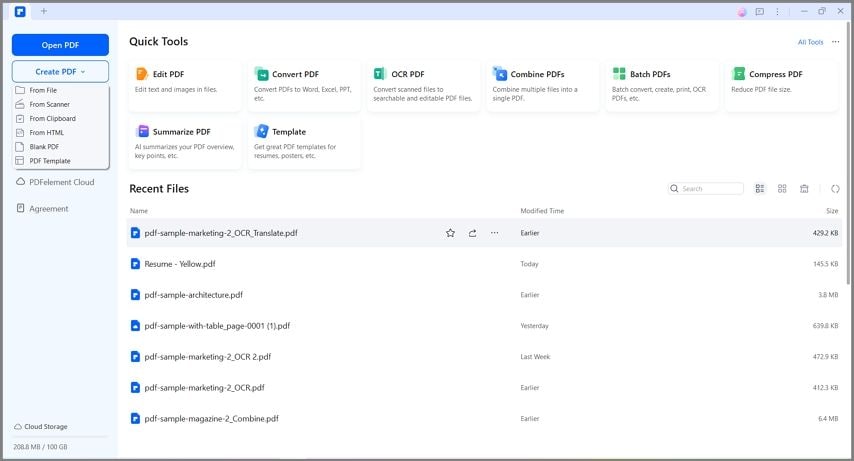
Step 1. Open the Scanned PDF
Open PDFelement and click Open PDF, then select the scanned or image-based PDF you want to translate.
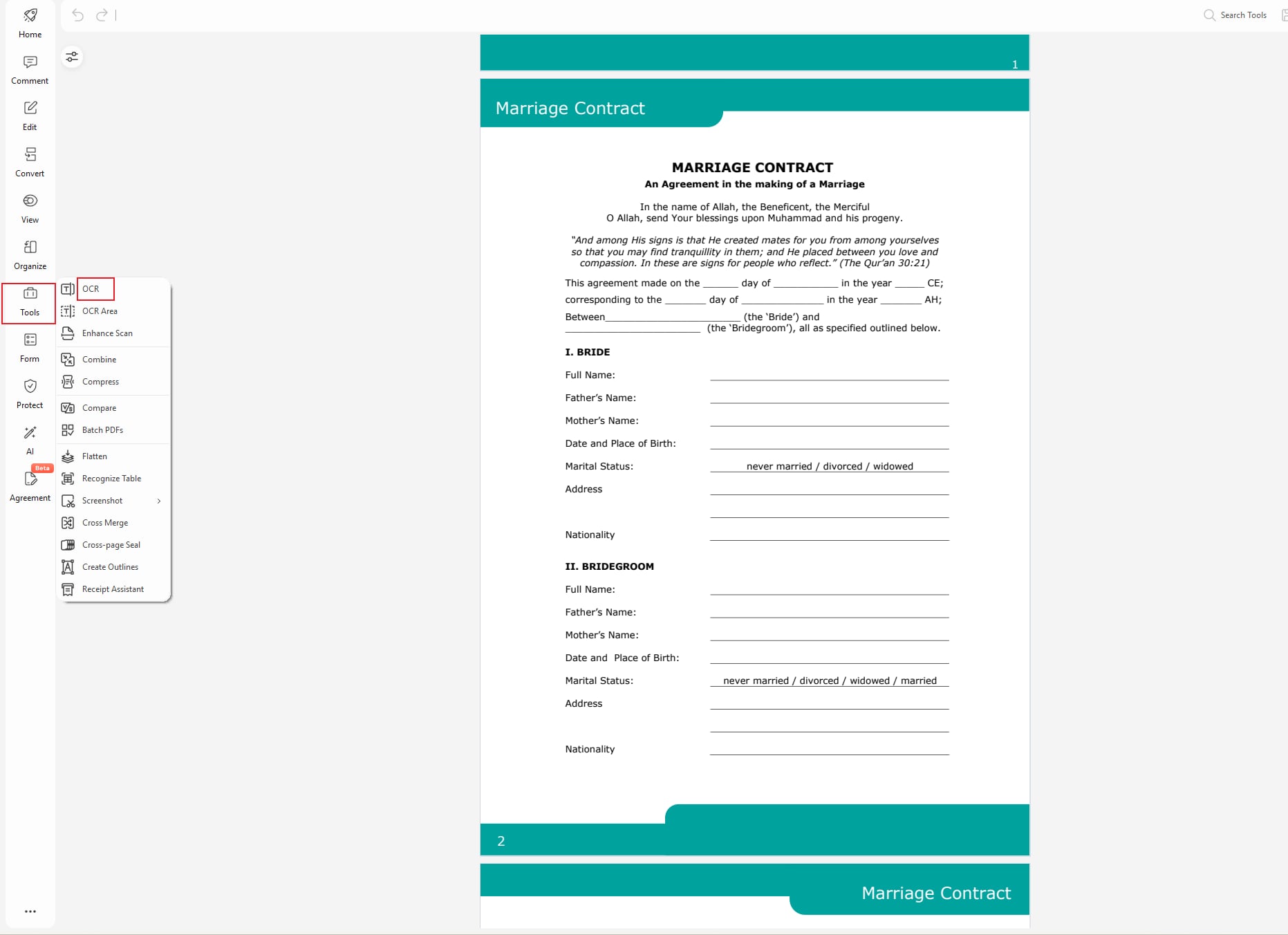
Step 2. Run AI OCR Before Translation
Run OCR so the text in the scanned pages becomes searchable and editable. In PDFelement, open the OCR tool and select the appropriate recognition language and page range for the source document.
Do not skip the review step. After OCR finishes, check a few representative pages - including headings, tables, names, numbers, and any low-quality scans - before translating the whole file. Fixing OCR errors first prevents them from becoming translation errors later.
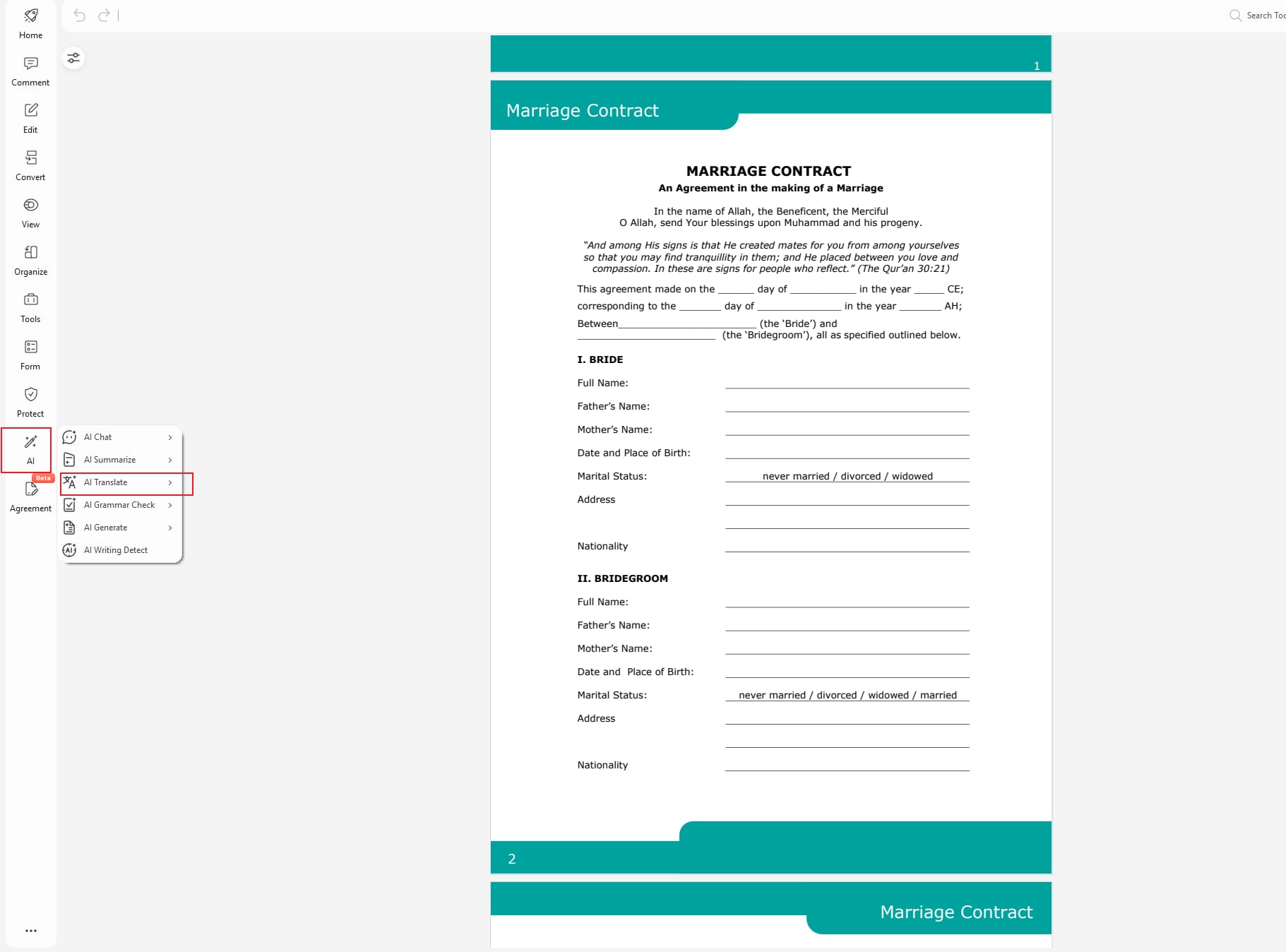
Step 3. Open AI Translate
After the scan is recognized, open AI > AI Translate > PDF Translator. PDFelement can translate the full PDF or a selected page range, so you do not have to process pages you do not need.
If you only need a sentence or paragraph, use the text translation option instead of translating the entire document.


 G2 Rating: 4.5/5 |
 100% Secure
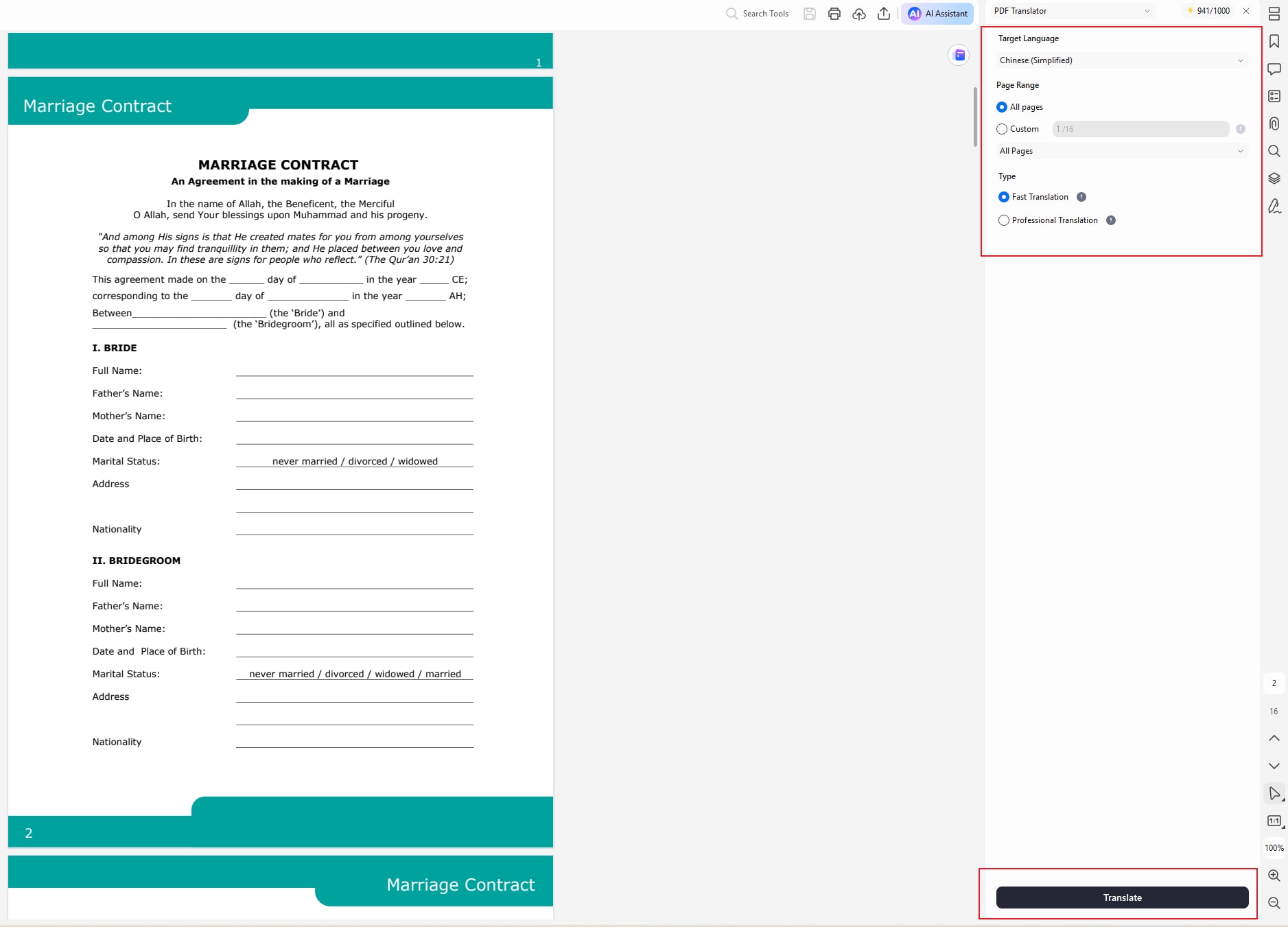
Step 4. Choose the Language, Page Range, and Translation Mode
Select the target language and page range. Then choose the translation mode that fits the document:
- Fast Translation: better for quick reading, everyday documents, and drafts where speed matters most.
- Professional Translation: better for specialized content where terminology and context need more careful handling, such as legal, financial, academic, medical, or technical documents.
PDFelement's current AI PDF translation workflow supports 50+ languages and also provides Batch Translate for multiple files.
Step 5. Review the Translated PDF Against the Source
Open the translated file and compare important sections with the original scan. Pay particular attention to tables, dates, names, measurements, legal clauses, and text that was faint or skewed in the source.
For bilingual review, PDFelement also supports original-and-translated viewing modes, which can make it easier to check whether information has been omitted or moved. After verification, you can continue editing, annotating, converting, or sharing the PDF without rebuilding the document from scratch.
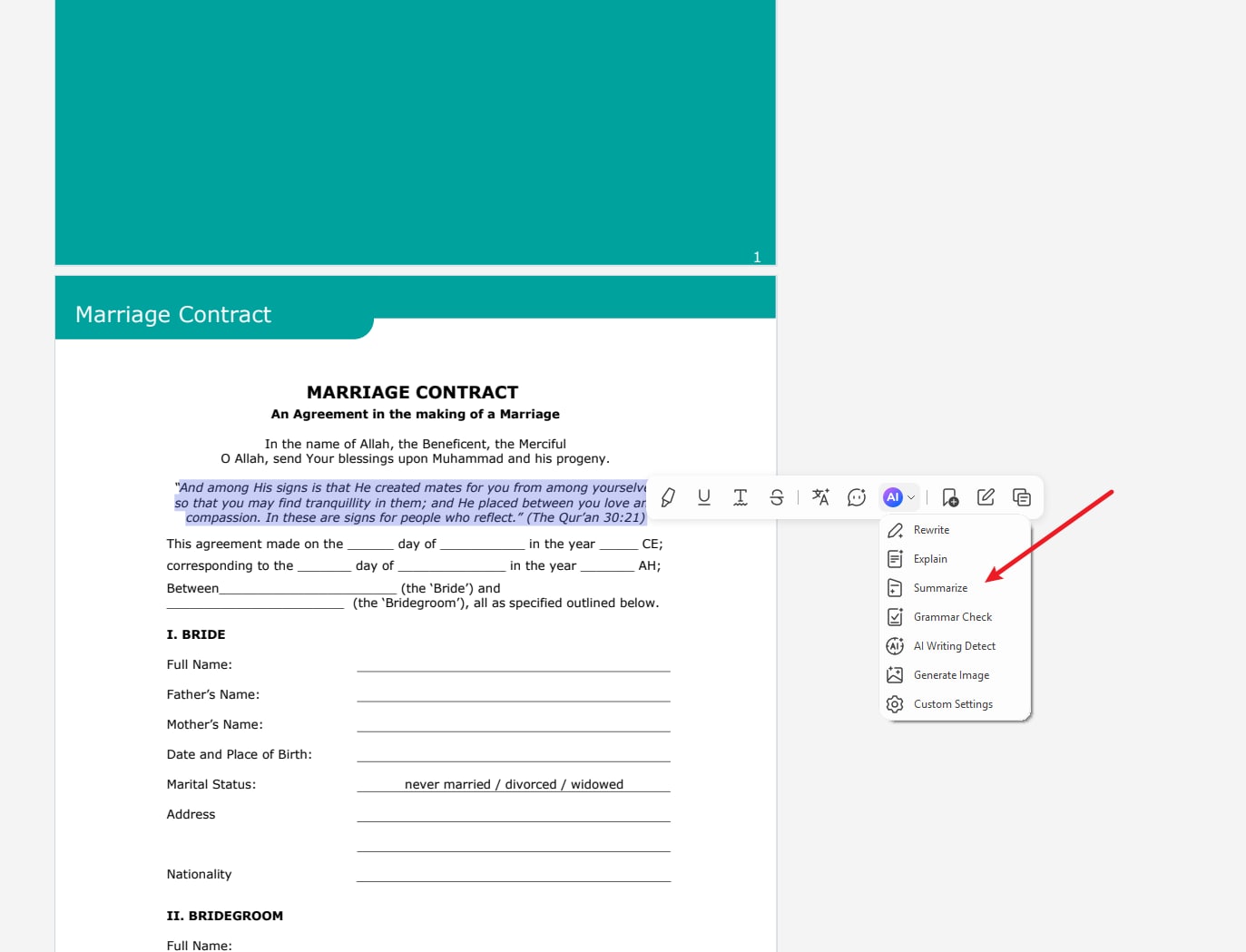
For long scanned PDFs: OCR and review the document in logical page ranges if the scan quality varies. If your main challenge is file length rather than scanning, see our guide to translating large PDF files.
Method 2: How to Translate a Scanned PDF Online
An online scanned PDF translator is convenient when you do not want to install desktop software, but the tool must support OCR. A standard document translator may accept a PDF file while still failing to translate text that exists only inside scanned page images.
Option 1. Wondershare AI PDF Translator
Wondershare AI PDF Translator provides a browser-based workflow for PDF translation. For scanned PDFs, OCR support is important because the page image must be recognized before the text can be translated.
- Useful when you need a quick browser-based workflow.
- Supports scanned and native PDFs with OCR-aware translation.
- Designed to preserve the PDF layout rather than returning only plain translated text.
- Useful for comparing source and translated content before reuse.
Option 2. Google Translate - Know the Scanned PDF Limitation
Google Translate can translate PDF documents on desktop, but it is not a complete scanned-PDF OCR translation workflow. According to Google Translate Help, document translation accepts PDFs up to 10 MB and 300 pages, while text inside images and scanned PDF pages can appear in the output but is not translated.
If your file is an image-only scan, run OCR first, then upload an OCRed PDF or another supported document format. For one or two photographed pages, image translation may also be more practical than uploading a full PDF.
How to Improve OCR and Scanned PDF Translation Accuracy
The best way to improve a scanned PDF translation is to fix recognition problems before translation begins. AI translation cannot reliably recover information that OCR has already misread.
- Check scan quality: blurry, skewed, shadowed, cropped, or very low-resolution pages produce more OCR errors.
- Select the correct OCR language: this is especially important for accented text, right-to-left scripts, and documents containing multiple languages.
- Review names and numbers: proper nouns, account numbers, dates, measurements, and reference codes are easy to misrecognize and can materially change meaning.
- Inspect tables and columns: complex reading order can cause text to be translated in the wrong sequence even when individual words are recognized correctly.
- Use Professional Translation for specialized material: terminology consistency matters more in contracts, research, finance, healthcare, engineering, and other domain-heavy documents.
- Verify high-stakes content manually: machine translation should not replace qualified review when a legal, medical, financial, immigration, or compliance decision depends on exact wording.
Which Method Should You Use to Translate a Scanned PDF?
Choose the workflow based on whether you need speed, OCR control, layout preservation, or continued PDF editing.
| If You Need To | Recommended Method | Why |
|---|---|---|
| Translate one or two lines from a scan | OCR or image translation | Fastest for a small amount of text |
| Translate a short scanned PDF online | Online PDF translator with OCR | No desktop installation required |
| Translate a long scanned PDF | PDFelement V13 AI OCR + AI Translate | Lets you review OCR, choose page ranges, and continue working in the PDF |
| Translate technical, legal, or academic scans | OCR + Professional Translation + human verification | Better control over terminology and critical details |
| Translate several scanned PDFs | Batch OCR / Batch Translate workflow | Reduces repetitive file-by-file processing |
| Keep editing after translation | Desktop PDF editor with OCR and translation | Keeps recognition, translation, editing, annotation, and export in one workflow |
How Do You Translate a Scanned PDF Without Losing Formatting?
Use a workflow that preserves document structure after OCR instead of copying recognized text into a separate translator. Copy-paste translation often strips headings, tables, columns, spacing, and page relationships because only the extracted words move to the translation tool.
With a PDF-aware workflow, OCR first identifies the text layer and page structure, then translation is applied within the document context. PDFelement's PDF Translator can generate a translated PDF and provides options for reviewing the source and translated content. Complex layouts should still be checked manually, especially when translated text becomes longer or shorter than the source.
What About Sensitive or Confidential Scanned Documents?
Do not upload confidential scans to an unfamiliar online translator without checking its data handling terms. Scanned PDFs often contain contracts, IDs, invoices, medical records, financial information, signatures, or personal details.
For business or regulated documents, check your organization's policy, the provider's privacy terms, retention settings, and whether the workflow meets your compliance requirements. A desktop PDF application can give you a more controlled document workflow than moving files through several unrelated online services, but you should still verify how any cloud or AI feature processes the document before using it for sensitive material.
FAQs About Translating a Scanned PDF
Is There a Way to Translate a Scanned PDF?
Yes. A scanned PDF needs OCR before normal text translation because the page content is stored as images. Use an OCR-enabled PDF translator to recognize the text, review the OCR result, and then translate the full document or selected pages.
How Do I Translate a Scanned PDF to English?
Run OCR on the scanned PDF, select English as the target language, and translate the recognized text or the full document. If the PDF contains tables, names, dates, or technical terms, review the OCR output before translation and compare the translated PDF with the source afterward.
Can Google Translate Translate a Scanned PDF?
Not completely. Google Translate can accept PDF documents on desktop, but Google states that text inside images and scanned PDF pages is not translated in document translation. OCR the scan first or use an OCR-enabled scanned PDF translator.
Can ChatGPT Translate a Scanned PDF?
ChatGPT can translate document content, but scanned and image-heavy PDFs require the content to be readable as text or supported visual input. For a predictable document workflow, OCR the scan first and verify the recognized text before translation. See our guide to translating PDFs with ChatGPT for the full workflow.
How Can I Translate a Scanned PDF Without Losing Formatting?
Use an OCR-enabled PDF translator that creates a translated PDF instead of copying extracted text into a separate translation box. This gives the translator access to the document structure, although complex tables, forms, and multi-column layouts should still be reviewed after translation.
Do I Need OCR for Every PDF Translation?
No. OCR is mainly required when the PDF is scanned or image-based and the text cannot be selected or searched. A native PDF with a usable text layer can usually be translated directly without running OCR first.
Final Takeaway
The reliable way to translate a scanned PDF is OCR first, translation second, verification last. That sequence solves the real problem behind scanned documents: the translator cannot work accurately until the page images have been converted into readable text.
For a quick browser task, an online translator with OCR can be enough. For long, complex, or editable documents, PDFelement V13 connects AI OCR with AI PDF Translation, page-range control, Fast and Professional Translation, bilingual review, and continued PDF editing in one workflow. Whichever method you choose, review names, numbers, tables, and high-stakes passages against the original scan before relying on the translated document.
G2 Rating: 4.5/5 |100% Secure
Free Download or Buy PDFelement right now!
Free Download or Buy PDFelement right now!
Try for Free right now!
Try for Free right now!


Elise Williams
chief Editor